US envoy urges NKorea to follow China, Russia
|
|
|
SEOUL, South Korea - North Korea should follow in the footsteps of Russia and China and open up its economic and political systems to improve conditions for its people, President Barack Obama's point man for human rights in the country said Thursday. Robert King, in a live conversation with South Korean Internet users held on a U.S. Embassy-run Web site, said he wants North Korea to achieve significant political and economic changes like Russia and China have gone through over the past 20 years. Pyongyang has long been regarded as having one of the world's worst human rights records, with more than 150,000 political prisoner believed detained in large prison camps. The North has bristled at outside criticism of its rights situation, calling it part of a U.S.-led plot to topple its regime. South Koreans submitted questions to King in Korean and his answers were translated back into that language. The embassy did not immediately release a transcript of his original English-language comments. King reiterated his view that the North should improve human rights conditions if it wants to forge normalized, productive ties with the United States. He said respect for human rights must be part of relations among countries, arguing the U.S. is not using the issue as a "stick" - the only English word released - to criticize the country. North Korea and the U.S. have never had diplomatic relations. The North was founded in 1948 three years after the end of World War II, and the 1950-53 Korean War ended with an armistice, not a peace treaty. Earlier this week, the North proposed peace talks to formally end the war, but the U.S. brushed aside the offer, saying Pyongyang should first return to six-nation talks on its nuclear weapons program. King, a former staff director on the House of Representatives' Foreign Affairs Committee, was on his first visit overseas as special envoy for North Korean human rights, only weeks after assuming the position. He will travel on to Japan later Thursday. He also said the U.S. has urged North Korea to release an American citizen it has detained since late last month for entering the country illegally. Activists say the detainee is a 28-year-old Korean-American missionary named Robert Park who slipped into the country on Christmas Day to raise international awareness of the North's dire human rights situation. The North hasn't identified by name who it is holding. King said he knows the North's human rights situation would not improve quickly but stressed the need to continue to apply pressure on the country. On Monday, he called the human rights situation there appalling. Separately, King met Thursday with Vitit Muntarbhorn, the United Nations' special investigator on human rights in North Korea, who is also visiting South Korea to meet government officials, civic activists and North Korean defectors. The U.S. Embassy in Seoul declined to disclose the contents of the meeting. Source: News Tribune. ------------------------ According to the Associated Press Writer Kwang-tae Kim,dated January 13th, 2010, North Korea's military warned Wednesday that it would retaliate against South Korea if Seoul doesn't stop activists from launching propaganda leaflets across their divided border. The two Koreas agreed in 2004 to end decades of propaganda warfare across the Demilitarized Zone dividing the neighbors. However, the South Korean government says it cannot prevent activists from sending the leaflets, citing freedom of speech, though it has urged them to stop so that they don't damage relations on the peninsula. The North's military said it "will never tolerate even the slightest acts" of undermining "our leadership's absolute authority." The comments came in separate statements issued in Korean and English that were carried by the official Korean Central News Agency. The North demanded South Korea immediately punish activists engaged in sending leaflets and disband their organizations, saying hundreds of thousands of propaganda leaflets were flown to the North on Jan. 1. Relations between the Koreas turned sour after a pro-U.S., conservative government was inaugurated in Seoul in early 2008 with a tough policy on the North. Pyongyang responded by suspending reconciliation talks and joint projects. The North, however, has tried to reach out to Seoul and Washington since last summer in an about-face that some analysts say shows the regime is feeling the pain of U.N. sanctions imposed following its second nuclear test in May last year. 14 Dec 09: Police in Thailand have seized a cargo plane carrying 35 tonnes of battlefield weapons, including missile launchers, made in North Korea. The seizure is one of the biggest ever busts which shows Al Jazeera Report via Youtube. Meanwhile, Ambassador Rober King met Thursday with Vitit Muntarbhorn, the United Nations' special investigator on human rights in North Korea, who is also visiting South Korea to meet government officials, civic activists and North Korean defectors but, The U.S. Embassy in Seoul declined to disclose the contents of the meeting. He believes that North Korea is "It's one of the worst places in terms of lack of human rights. See more details: Sources: The
News tribune Yahoo News YouTube
|
Meanwhile, Many rally's were given and one of the rally is from KCC. As
part of Korean Church Coalition for North Korea Freedom's letmypeoplego2008.com
pledge to speak out on behalf of the 300,000 North Korean Refugees residing
within China's borders who have no voice of its own, KCC, on behalf
of its 3000 plus pastors and millions of congregational members its
member pastors were march to the US Capital during the North Korea Freedom
Week (April 26 - May 3, 2008) see below photos:
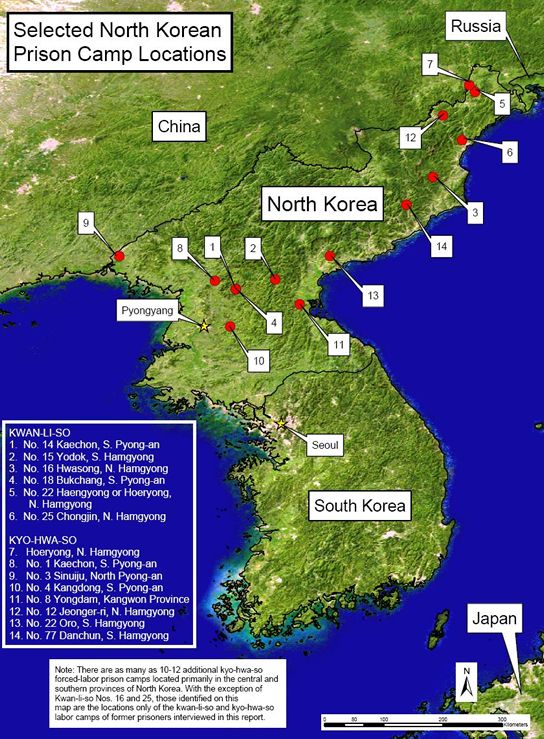
See
below Satellite imagery via /US Committee for Human Rights in North
Korea
|
-------------------------------------------------------------------------------------
Sources:
Yahoo.com
|
|
North
Korea warns of nuclear war amid rising tensions
Nuclear Test will DAMAGE THE SOUTH KOREA, JAPAN AND BEYOND THE GREEN WORLD"
|
![]() |
|
According to SEOUL, South Korea - North Korea's communist regime has warned of a nuclear war on the Korean peninsula while vowing to step up its atomic bomb-making program in defiance of new U.N. sanctions. The North's defiance presents a growing diplomatic headache for President Barack Obama as he prepares for talks Tuesday with his South Korean counterpart on the North's missile and nuclear programs. A commentary Sunday in the North's the main state-run Rodong Sinmun newspaper, carried by the official Korean Central News Agency, claimed the U.S. has 1,000 nuclear weapons in South Korea. Another commentary published Saturday in the state-run Tongil Sinbo weekly claimed the U.S. has been deploying a vast amount of nuclear weapons in South Korea and Japan. North Korea "is completely within the range of U.S. nuclear attack and the Korean peninsula is becoming an area where the chances of a nuclear war are the highest in the world," the Tongil Sinbo commentary said. Kim Yong-kyu, a spokesman at the U.S. military command in Seoul, called the latest accusation "baseless," saying Washington has no nuclear bombs in South Korea. U.S. tactical nuclear weapons were removed from South Korea in 1991 as part of arms reductions following the Cold War. On Saturday, North Korea's Foreign Ministry threatened war on any country that dared to stop its ships on the high seas under the new sanctions approved by the U.N. Security Council on Friday as punishment for the North's latest nuclear test. It is not clear if the statements are simply rhetorical. Still, they are a huge setback for international attempts to rein in North Korea's nuclear ambitions following its second nuclear test on May 25. It first tested a nuclear device in 2006. In its Saturday's statement, North Korea said it has been enriching uranium to provide fuel for its light-water reactor. It was the first public acknowledgment the North is running a uranium enrichment program in addition to its known plutonium-based program. The two radioactive materials are key ingredients in making atomic bombs. On Sunday, Yonhap news agency reported South Korea and the U.S. have mobilized spy satellites, reconnaissance aircraft and human intelligence networks to obtain evidence that the North has been running a uranium enrichment program. South Korea's Defense Ministry said it cannot confirm the report. The National Intelligence Service - South Korea's main spy agency - was not available for comment. North Korea said more than one-third of 8,000 spent fuel rods in its possession has been reprocessed and all the plutonium extracted would be used to make atomic bombs. The country could harvest 13-18 pounds (6-8 kilograms) of plutonium - enough to make at least one nuclear bomb - if all the rods are reprocessed. In addition, North Korea is believed to have enough plutonium for at least half a dozen atomic bombs. North Korea says its nuclear program is a deterrent against the U.S., which it routinely accuses of plotting to topple its regime. Washington, which has 28,500 troops in South Korea, has repeatedly said it has no such intention. The new U.N. sanctions are aimed at depriving the North of the financing used to build its rogue nuclear program. The resolution also authorized searches of North Korean ships suspected of transporting illicit ballistic missile and nuclear materials. U.S. Secretary of State Hillary Rodham Clinton said the new U.N. penalties provide the necessary tools to help check North Korea's continued pursuit of nuclear weapons. The sanctions show that "North Korea's pursuit of nuclear weapons and the capacity to deliver those weapons through missiles is not going to be accepted by the neighbors as well as the greater international community," Clinton said Saturday at a news conference in Canada. The United Nations Security Council sent a clear and united message on June 12, 2009, when they voted unanimously to tighten sanctions on North Korea following the nation’s recent nuclear test and missile firings. The detonation on May 25 of the suspected nuclear device violated the 1953 armistice. U.N. Resolution 1874 includes a number of measures aimed at stopping North Korea’s nuclear proliferation, including tougher inspections of cargo, an expanded arms embargo, and new financial restrictions on North Korea, curbing loans and money transfers that serve as funding for their nuclear program. The vote on Resolution 1874, United States Ambassador Rosemary DiCarlo said that North Korea chose a path of provocation, and now they must face the consequences. "United States welcomes the strong and united response to North Korea’s nuclear test, and is committed to implementing the provisions outlined by the Security Council" said United States Ambassador Rosemary DiCarlo. Sources: Yahoo.com The White House Reported by catch4all.com, Sandra Englund |
|
North
Korea celebrates the Nuclear Tests
|
North
Korea Nuclear Tests Reaction
|
|
|
|
THE
WHITE HOUSE Office of the Press Secretary ________________________________________________________________
STATEMENT
BY THE PRESIDENT Today, North Korea said that it has conducted a nuclear test in violation of international law. It appears to also have attempted a short range missile launch. These actions, while not a surprise given its statements and actions to date, are a matter of grave concern to all nations. North Korea's attempts to develop nuclear weapons, as well as its ballistic missile program, constitute a threat to international peace and security. By
acting in blatant defiance of the United Nations Security Council, North
Korea is directly and recklessly challenging the international community.
North Korea's behavior increases tensions and undermines stability in
Northeast Asia. Such provocation will only serve to deepen North Korea's
isolation. It will not find international acceptance unless it abandons
its pursuit of weapons of mass destruction and their means of delivery. Source: The White House. |
|
|
|