
|
WHAT THEY ARE SAYING:
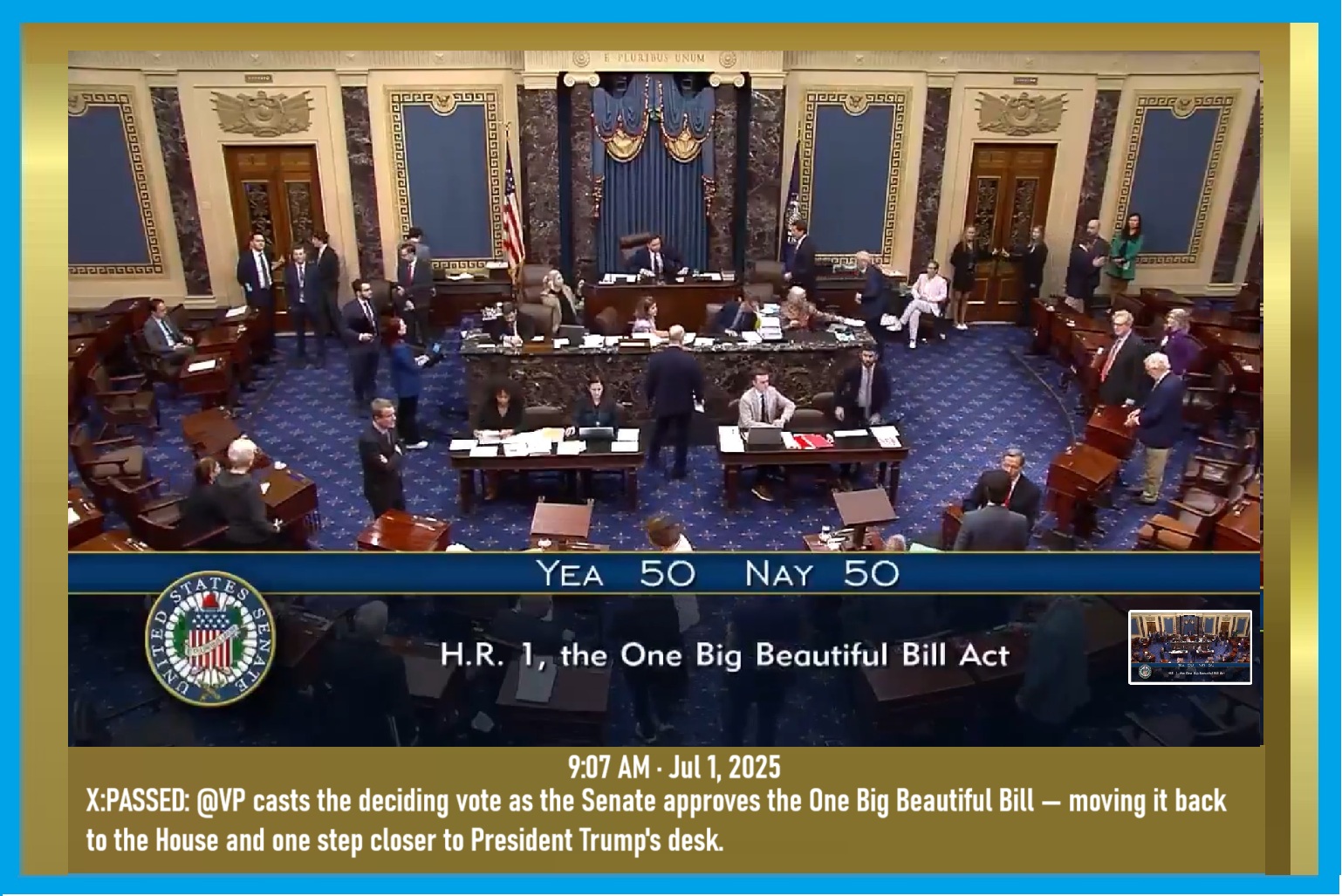
SENATE APPROVES LANDMARK
ONE BIG BEAUTIFUL BILL
July 1, 2025
The Senate
delivered a resounding victory for American workers, farmers, and small
businesses by passing President
Donald J. Trump’s One Big Beautiful Bill — a transformative legislative package
that locks in historic tax relief, delivers border security, reforms welfare,
funds critical infrastructure, and more.
Industry
leaders and stakeholders nationwide hailed the Senate’s vote and called on the
House to swiftly send the bill to President Trump’s desk:
Airlines
for America: “We are grateful that the Senate understands the urgent need
to overhaul our nation’s air traffic control (ATC) system and included $12.5
billion in their reconciliation package for that cause. This is an important
first step as Secretary Duffy works to implement President Trump’s vision of a
brand new, state-of-the-art system. We especially appreciate Commerce Committee
Chairman Ted Cruz for his long-time dedication to the safety and efficiency of
our nation’s airspace. We urge the House of Representatives to quickly pass
this legislation so President Trump can sign the One Big Beautiful Bill into
law, begin the work of upgrading our ATC system and revitalize our airspace.”
America’s
Credit Unions President and CEO Jim Nussle: “We thank the U.S. Senate for
securing the credit union not-for-profit tax status and not adding a new tax on
142 million credit union members as part of H.R. 1. Hard working Americans and
their communities rely on the competitive rates and personally tailored
services offered by credit unions to achieve their American Dream. By
preserving the credit union tax status, it provides consumers across the
country with more opportunities to achieve financial freedom.”
American
Airlines: “American
Airlines strongly supports the much-needed funding to bolster and modernize our
air traffic control system in the Senate reconciliation bill. In addition to
staffing challenges, the U.S. air traffic control system’s technology and
infrastructure have fallen behind much of the world. As President Trump and
Secretary Duffy urgently work to build a state-of-the-art air traffic control
system, this down payment is an essential first step in making aviation even
safer and more efficient. The reconciliation bill also extends other key
pro-growth tax policies that provide businesses with the necessary certainty to
continue driving the economy. We urge the House to move swiftly and pass the
bill.”
American
Farm Bureau Federation President Zippy Duvall: “Farm Bureau applauds the
U.S. Senate for passing the reconciliation package. Farmers and ranchers are
the foundation of America’s food supply chain, and they need the certainty that
this legislation will provide. Improvements to farm safety net programs that
reflect today’s agricultural economy and maintaining important tax provisions
will directly benefit farm and ranch families … Important tax provisions will
also help farmers save money that can be used to pay bills, invest in new
technologies, and pass the family farm to the next generation. We now urge the
House to pass the bill and get it to the president’s desk for his signature to
ensure America’s farmers and ranchers can continue putting food on the table
for America’s families.”
American
Federation for Children CEO Tommy Schultz: “The mission is clear: deliver
school choice to every state in America. Today’s vote marks a monumental step
toward that goal for the first time in history … We are eager to see President
Trump sign school choice into law!”
American
Hotel & Lodging Association President and CEO Rosanna Maietta: “AHLA
applauds the Senate’s swift action today to prevent major tax increases on both
hotel employees and businesses. The tax provisions included in the Senate bill
provide small business hotel owners with the level of certainty they need to
effectively operate amidst tremendous uncertainty resulting from years of
inflation, trade impacts, and a softening of demand within the broader travel
sector. We commend Majority Leader Thune, Senator Crapo, and other Senate
champions for securing passage. We urge Congress to swiftly get this package to
the President’s desk for his signature to help put businesses back on a
pro-growth footing.”
American Iron
and Steel Institute President and CEO Kevin Dempsey: “Capital investment is
crucial for economic growth and job creation in the American steel industry and
the manufacturing sector as a whole. Many of the key capital cost recovery
provisions of the 2017 tax law have expired or are being phased out. Restoring
these provisions is essential to ensuring that many companies will be able to
make new investments in steel-intensive facilities and machinery. We applaud
Senate passage of this legislation which will permanently restore key
provisions that have a proven record of fueling innovation and economic growth,
including 100 percent bonus depreciation for business investment, immediate
expensing for domestic research and development expenses and the EBITDA-based
limitation on business net interest deductions. We urge the House to pass this
bill and send it to President Trump this week so that he can sign it into law
as soon as possible.”
American
Petroleum Institute President and CEO Mike Sommers: “We applaud the Senate
for passing the One Big Beautiful Bill to bolster America’s energy advantage
and support economic growth. This historic legislation will help usher in a new
era of energy dominance by unlocking opportunities for investment, opening
lease sales and expanding access to oil and natural gas development. We will
continue to work with policymakers to get this final package to President
Trump’s desk.”
American
Soybean Association President Caleb Ragland: “ASA applauds the Senate for
its support of agriculture and the farm economy in this legislation. Soybean
growers have long championed comprehensive revisions to the 45Z Clean Fuel
Production Credit, an improved safety net for agriculture, and increased
support for research and market expansion. The modified biofuel tax credits,
enhancements to crop insurance and support for MAP and FMD, among other
agriculture provisions included in this legislation will support U.S. farmers
and expand market opportunities domestically. ASA urges the House to maintain
these key agricultural provisions that support our rural economies as they
consider this legislation.”
American
Trucking Association SVP of Legislative Affairs Henry Hanscom: “The
American Trucking Associations is grateful to Senate Republicans for their hard
work to craft a package that will guarantee tax certainty for our nation’s
trucking companies. Trucking is the backbone of our economy, employing over 8.5
million Americans in companies that range in size from one-truck operators and
small family businesses to enterprise carriers. Enacting pro-business,
pro-growth tax policies will ensure that all of those companies are able to
better plan for the future, invest in their workforce and equipment, and move
freight safely and efficiently. As the industry that moves 72% of
America’s freight by tonnage, and that is the sole source of freight services
for more than 80% of American communities, ATA looks forward to President Trump
signing this measure into law as soon as possible.”
Americans
for Prosperity Chief Government Affairs Officer Brent Gardner: “We are so
close to delivering a generational win to Americans by making pro-growth tax
policy permanent. When we pass this bill, job creators and families will have
the certainty they need to invest in their businesses and futures, reigniting
the American Dream. We are encouraged by the thoughtful and productive
discussions that have brought this legislation back to the House and urge
members to pass it expeditiously to ensure that Americans start reaping the
benefits of this transformative legislation as soon as possible … It’s time to
get this bill to the Oval Office for President Trump’s signature. We’re at the
goal line, it’s time to punch it in. Let’s fulfill all those campaign promises
and secure this victory for hardworking American taxpayers.”
Associated
Builders and Contractors VP of Government Affairs Kristen Swearingen: “Tax
certainty and pro-growth policies are not abstract policy goals for
construction businesses—they are the foundation that allows ABC members to
invest, grow and keep America building. We thank the Senate for passing this
important legislation and urge the U.S. House of Representative to take swift
action to send it to the president’s desk.”
Associated
Equipment Distributors President and CEO Brian P. McGuire: “By permanently
extending and restoring pro-growth, capital investment incentivizing tax
policies, the Senate is ensuring long-term tax code certainty that will benefit
the equipment sector and the broader economy. AED applauds Senate Majority
Leader John Thune and his team for heeding our call for tax permanence, and we
urge the House to pass this legislation and send it to the president’s desk
expeditiously.”
Association of
Equipment Manufacturers SVP of Government and Industry Relations Kip Eideberg:
“The Association of Equipment Manufacturers applauds the U.S. Senate’s passage
of the One Big Beautiful Bill (OBBB) Act — a historic bill that will strengthen
U.S. manufacturing, providing the certainty in the tax code necessary for
equipment manufacturers to innovate, invest, and create more family-sustaining
jobs right here in America. By extending and expanding the tax reforms from
2017, the OBBB will help equipment manufacturers build more in America, while
also bolstering our global competitiveness. We commend Leader Thune for his
leadership and commitment to ensuring the permanence of President Trump’s
pro-growth tax reforms, and applaud the lawmakers involved in driving this
effort forward. We urge the U.S. House of Representatives to act swiftly and
send the bill to President Trump’s desk.”
Business
Roundtable CEO Joshua Bolten: “Today’s vote puts us on the cusp of
extending and strengthening tax reform. Business Roundtable applauds the Senate
for passing the One Big Beautiful Bill … The House now has the opportunity to
send a swift, decisive signal that America will remain a premier destination
for business to invest, hire, and grow. We urge the House to act without delay
and send the bill to President Trump’s desk by the Fourth of July.”
Center
for Transportation Policy Executive Director Jackson Shedelbower: “… it’s
clear that lawmakers are united in an effort to modernize the country’s aging
air traffic control systems. The $12.5 billion that is appropriated in both
versions of the package will be a strong down payment towards ensuring that the
U.S. maintains its reputation as a global leader in air travel. Lawmakers need
to work out the remainder of their differences so the legislation can be
swiftly pushed over the finish line.”
CTIA—The
Wireless Association President and CEO Ajit Pai: “CTIA applauds the Senate
for passing the One Big Beautiful Bill, which includes a solid spectrum
pipeline and smart tax provisions to support wireless investment. Along with
restoring FCC auction authority, establishing a robust 800-megahertz pipeline
of mid-band spectrum with a specific timeframe for action is critical to
meeting growing consumer demand, securing U.S. leadership in 5G, and
strengthening national and economic security. The bill’s targeted tax
incentives will accelerate private investment in next-generation networks and
support infrastructure deployment, job creation, and economic growth across the
country. We thank Senate leadership, including Senate Majority Leader John
Thune, Senate Commerce Committee Chairman Ted Cruz, and Senator Marsha
Blackburn for their commitment to securing America’s wireless future, and we
urge swift action to pass this legislation so President Trump can sign it into
law.”
Concerned
Veterans for America Executive Director John Vick: “This legislation
represents a win for American families, small businesses, and veterans across
the country―groups that form the backbone of a thriving and resilient nation.
This is a monumental moment for Americans who believe in hard work, opportunity,
and service. The One Big Beautiful Bill Act sets the stage for lasting
prosperity and a stronger future for those who have sacrificed the most.”
Global
Business Alliance President and CEO Jonathan Samford: “I applaud Chairman
Mike Crapo, Leader John Thune and their Senate colleagues for advancing
international tax policies that keep the U.S. the top destination for global
investment. These provisions will help sustain American jobs, drive innovation,
and reinforce a stable tax environment that attracts cross-border capital and
world-class know-how. I urge swift House action and final passage of this One
Big Beautiful Bill Act in order to secure America’s competitive edge.”
Iowa
Biodiesel Board Executive Director Grant Kimberley: “These improvements to
the biomass-based diesel tax incentive come at a pivotal moment for the
industry, which has seen months of uncertainty, stalled production and
investment hesitation. Together with EPA’s proposed increase in Renewable Fuel
Standard volumes—projecting more than 2 billion additional gallons of
biomass-based diesel in 2026—the tax developments point to a significant
resurgence in clean fuel demand. This gives us much-needed certainty for the
near future.”
Information
Technology Industry Council President and CEO Jason Oxman: “The One Big
Beautiful Bill will advance President Trump’s vision of ensuring America
outpaces global competitors and remains the world’s leader in technology. We’re
pleased to see the Senate pass the reconciliation text with strong
innovation-focused language that will empower companies to invest in America by
restoring critical research and development expensing and stimulate economic
growth and high-skilled job creation. We urge the House of Representatives to
send this critical package to President Trump as quickly as possible.”
Job
Creators Network CEO Alfredo Ortiz: “By passing this tax cut bill,
Republican Senators show once again that they are the party of Main Street. By
expanding and making permanent the Tax Cuts and Jobs Act, including restoring
full, immediate expensing, the Senate has delivered historic, pro-growth reform
that can last for generations. These tax cuts empower small business owners to
invest, hire, raise wages, and reinvest in their communities, ushering in
America’s next Golden Age. On behalf of Main Street, JCN calls on the House to
quickly pass this legislation and get it to President Trump’s desk by July 4,
giving America the best birthday present it could ask for.”
National Association
of Home Builders Chairman Buddy Hughes: “NAHB commends the Senate for
passing the One Big Beautiful Bill Act. This legislation will help spur
economic growth and allow our members to invest more resources in multifamily
rental construction, land development to build more single-family homes, and
new equipment to expand their businesses. In turn, this will create a better
business climate that allows builders to increase the nation’s housing supply,
which is crucial to help ease America’s housing affordability crisis. We urge
the House to move quickly to pass this bill.”
National
Association of Manufacturers President and CEO Jay Timmons: “The Senate
just pushed the ball deep into the red zone. Now it’s the House’s turn to
finish the drive and deliver a big win for manufacturers in America. The Senate
advanced a tax package that will strengthen small businesses, family-owned
operations and manufacturing workers across the country. It drives
manufacturers closer to the goal line—growing businesses, creating jobs and
powering stronger communities. After months of driving, months of endurance and
effort, months of playing audacious offense and tenacious defense, months of
partnership between manufacturers of every industry and our leaders in Congress
and the administration, the House now can finish the job. We call on our
partners in the House to send this bill to the president’s desk—the strongest
tax bill for manufacturers we have seen in a generation. Because when Congress
champions the 13 million people who make things in America, manufacturing
wins—and when manufacturing wins, America wins.”
National
Business Aviation Association President and CEO Ed Bolen: “We thank the
Senate for recognizing with this initial funding that a safe and efficient
national airspace requires a robust, resilient ATC system that bolsters our
nation’s global aviation leadership. As leading economists have found,
immediate expensing helps companies and entrepreneurs relying on business
aviation have access to a critical competitive asset, while strengthening
America’s manufacturing base. These provisions represent an important
investment in an essential American industry, and the citizens, companies and
communities that depend on it. NBAA looks forward to their continued progress.”
National
Cattlemen’s Beef Association SVP of Government Affairs Ethan Lane: “The
Senate version of the One Big Beautiful Bill protects family farmers and
ranchers across the country from a massive tax hike at the end of the year,
increases the Death Tax exemption, makes the Section 199A tax deduction
permanent, increases the Section 179 tax deduction, funds foreign animal
disease prevention programs, and delivers so many more wins for cattle
producers … It’s time for the House to pass this bill and send it to President
Trump’s desk so he can sign it into law.”
National
Corn Growers Association President Kenneth Hartman, Jr.: “NCGA has worked
closely with members of Congress as they drafted and voted on this legislation.
We are particularly pleased to see the permanent extension of certain tax
provisions, which will provide more certainty to corn farmers around the
country as they plan for the future of their businesses.”
National
Cotton Council Chairman Patrick Johnson: “The NCC appreciates the momentous
effort that has gone into crafting and passing the One Big Beautiful Bill. We
are grateful for the Senate’s commitment to delivering meaningful enhancements
to the cotton safety net, which is absolutely critical for the stability and
future of our industry.”
National
Council of Farmer Cooperatives President and CEO Chuck Conner: “We commend
the Senate for advancing permanent tax relief through the extension of Section
199A, a key priority for farmer co-ops that ensures they are not penalized for
doing business together. Equally important are the provisions extending Section
179 expensing and the clean fuel production credit under Section 45Z, which
provide producers and co-ops with the incentives and tools they need to
innovate, invest, and lead the transition to a more sustainable agricultural
future. We also appreciate the Senate’s attention to the needs of production
agriculture by updating reference prices and commodity title support to reflect
today’s economic realities. Combined with a significant increase in funding for
market development programs, these provisions will help producers reach new
markets and stay competitive amid global uncertainty. Now, it’s time for the
House of Representatives to act. We urge lawmakers to take up the Senate
package without delay and send it to the president’s desk before the July 4th
recess. America’s farmers can’t afford to wait.”
National
Council of Textile Organizations President and CEO Kim Glas: “On behalf of
the U.S. textile industry, I would like to commend Senate leaders for including
an important provision in the broader budget reconciliation bill that would
permanently end de minimis for commercial shipments from all countries,
effective July 2027. The Senate language mirrors a provision included in the
House reconciliation package passed earlier in May … We are also grateful that
the Trump administration has already used executive authorities to end de
minimis access for Chinese goods—which represent approximately two-thirds of
all de minimis shipments—while also laying the groundwork to close de minimis
to commercial shipments from all countries.”
National
Foreign Trade Council VP for International Tax Policy Anne Gordon: “We
welcome Senate passage of the One Big Beautiful Bill … We welcome the Senate’s
decision to retain core international and business provisions of the Tax Cuts
and Jobs Act in its version of the bill, as well as including permanent
immediate expensing of research and development and reinstating depreciation
and amortization in the interest deduction limitation. We are also pleased to
see the Senate make permanent the look-through for controlled foreign
corporations and provide other long-needed international tax fixes for U.S.
corporations. As the House considers the revised bill, we encourage swift
consideration and passage of tax legislation that incentivizes investment,
innovation, and global opportunity for America’s job creators.”
National
Milk Producers Federation President Gregg Doud: “Dairy farmers are grateful
for legislation that will create several key opportunities for dairy. Following
last month’s successful vote in the House, we are excited that the Senate’s
legislation also positions these investments to benefit dairy farmers and the
cooperatives they own. We hope they are enacted into law as swiftly as
possible.”
National
Mining Association President and CEO Rich Nolan: “We urge the House to
quickly pass this bill, which increases the competitiveness of the American
mining industry and provides vital incentives, including funding to counter
China’s mineral dominance. The bill also makes improperly withdrawn lands available
for energy production, which is key to supplying a reliable electric grid
capable of powering our nation’s future. Through these measures, the bill will
directly support U.S. economic growth and security. Mining feeds and fuels
virtually every American supply chain; a strong mining industry creates an
equally strong foundation for every industry that depends on the products and
energy we provide. More can be done, and the NMA will continue to advocate with
Congress and the administration on ways to support additional domestic mining,
and mineral production and processing.”
National
Pork Producers Council President Duane Stateler: “We appreciate the efforts
of Agriculture Chair John Boozman and other Senate leadership to ensure key
animal health provisions were included in the bill, along with tax and other
measures important to agriculture. Foreign animal diseases (FADs) threaten not
only the livelihoods of pork producers but also our food supply chain at large.
We thank our congressional leaders for these important steps to help keep our
pork supplies safe, secure, and affordable for American families.”
National
Restaurant Association EVP for Public Affairs Sean Kennedy: “This bill
includes the most important pro-growth tax policies restaurant operators need
to continue to power the national economy. The inclusion of permanent policies
for 199A qualified business income deduction, full expensing of capital
investments, and the return of depreciation and amortization in the calculation
of business interest expense will give restaurant operators working capital to
invest in their businesses and employees. We are also pleased to see the
inclusion of policies like No Tax on Tips and Overtime that will benefit our
workforce. We appreciate the work that has gone into getting this bill through
the Senate and encourage the House to quickly pass it, sending it to the
President for signature.”
National
Roofing Contractors Association CEO McKay Daniels: “This legislation is
critical to providing certainty for all businesses to continue to invest in
their employees and grow their companies. In particular, the bill is a huge win
for ‘main street,’ family-owned and pass-through entities that represent 95% of
all U.S. businesses and employ the majority of private-sector workers. Without
passage of this legislation, our industry will face rising tax burdens and
diminished global competitiveness. Congress must act now to secure a stable
future for America’s job creators.”
National
Small Business Association President and CEO Todd McCracken: “NSBA applauds
the Senate for passing H.R. 1, the One Big Beautiful Bill Act which includes
NSBA’s #1 priority, permanency for the small-business tax rate cut in the form
of the 199A Qualified Business Income deduction. Enacting this provision and
several others—including reversing a very problematic change to the R&D tax
deduction—is a major win for small business. As our nation celebrates
Independence Day, I urge the House to pass the language approved in the Senate
and give America’s small businesses the freedom and independence they need and
deserve to keep their businesses thriving.”
National
Sorghum Producers Chair Amy France: “These are critical improvements that
will help sorghum producers manage risk, plan for the future, and stay
competitive. We’re grateful to Chairman Boozman and other leaders in the Senate
Ag Committee who ensured these priorities were part of the final bill.”
Nuclear
Energy Institute President and CEO Maria Korsnick: “We applaud the U.S.
Senate for advancing policies that recognize the important role of nuclear
energy to achieve a reliable, affordable and increasingly clean energy system.
The Senate version of the budget reconciliation bill restores the nuclear power
production tax credit through 2032, and the tax credits for new nuclear
generation through 2033, with transferability retained for both. The Senate
version also preserves the viability of the Loan Program Office by extending
the program’s authority and funding from 2026 to 2028, although the
appropriation of $1B is less than available under current law. Maintaining the
tax provisions in the Senate bill will continue to address economic hurdles and
provide confidence to invest in today’s nuclear plants, while securing
long-term, well-paying jobs. Further the bill allows us to continue down the
path to achieve the Administration’s ambitious goals for deploying new,
cutting-edge nuclear technologies that will meet the growing demand for more
reliable energy.”
Philanthropy
Roundtable COO Elizabeth McGuigan: “Now more than ever, we need a strong,
vibrant civil society. Government spending is shrinking – which is a good thing
– and generous Americans are ready and willing to support causes and
communities around the country. We’re especially grateful for the leadership of
President Donald J. Trump, whose pro-growth, pro-America agenda continues to
inspire strong economic stewardship. We encourage the House to pass the Senate
bill quickly and without changes.”
RATE
Coalition Executive Director Dan Combs: “Today’s vote is a major win for
workers, businesses, and the American economy as a whole. By preserving the 21
percent corporate tax rate, the Senate has reaffirmed its commitment to a
competitive tax code that drives investment, fuels job growth, and ensures the
U.S. remains the best country in the world to start and grow a business.
We applaud this strong, pro-growth action and urge lawmakers to expeditiously
finalize the legislation and send it to President Trump’s desk without delay.”
Small
Business & Entrepreneurship Council President and CEO Karen Kerrigan:
“We commend Republican Senate leaders for their tireless work in getting the
‘One Big Beautiful Bill Act’ to this critical stage for America’s small
business owners and entrepreneurs. Their commitment to advancing this powerful
package shows incredible dedication to the success of Main Street businesses
across the country and to the future of U.S. entrepreneurship. Now, House
members must focus on the widespread gains in the legislation for the U.S.
economy, workers, families, and small business owners. We urge the House to
promptly pass the bill so it can be signed by President Trump.”
Steel Manufacturers
Association: “Congratulations to the @SenateGOP for passing H.R. 1! The
bill will make historic investments in Americans, our workers, our communities
and our economy will all benefit.”
The
LIBRE Initiative President Daniel Garza: “We commend the Senate for passing
H.R. 1 to make the Trump tax cuts permanent—measures that have proven to
deliver real benefits to hardworking families, job creators, and entrepreneurs
across the country. For Latinos—who are starting businesses at a notable rate
and powering local economies—this bill is not just good policy, it’s
essential. By making the low tax rates and small business provisions
permanent, this legislation helps ensure that Latino workers, small business
owners, and families can thrive with greater certainty, flexibility, and
opportunity. Tax relief allows families to keep more of what they earn, invest
in their future, and weather economic uncertainty with confidence. We applaud
the Senate for sending a clear message that the American Dream remains alive
and within reach for all—especially those working hard to build a better life.”
U.S.
Chamber of Commerce EVP and Chief Policy Officer Neil Bradley: “With
today’s vote, the Senate has taken decisive action to deliver the kind of
permanent tax relief the American business community has been calling for. The
tax provisions included in this bill will not only drive economic growth and
sharpen America’s competitive edge but also put more money in workers’ pockets,
increasing prosperity in communities across the country. The Chamber thanks
Leader Thune, Chairman Crapo, and all who are working to make the pro-growth
reforms of the 2017 Tax Cuts and Jobs Act permanent, including the deduction
for domestic R&D expenditures, 100% bonus depreciation for certain business
investments, and an expanded business interest limitation. The Chamber applauds
the Senate for voting to make these provisions permanent features of the tax
code. We urge lawmakers to swiftly pass the OBBBA and deliver it to President
Trump to be signed into law.”
USA Rice Farmers
Chair LG Raun: “USA Rice applauds the Senate for passing the OBBB Act
including a historic and critical investment in the farm safety net. We urge
the House of Representatives to take up and pass this bill with the key ag
investments before the 4th of July.”
Wine & Spirits
Wholesalers of America President and CEO Francis Creighton: “On behalf of
the Wine & Spirits Wholesalers of America, I want to thank the United
States Senate for passing President Trump’s One Big Beautiful Bill Act under
Section 198A. This critical legislation empowers America’s family-owned
wholesalers to reinvest, compete, and thrive. We urge the U.S. House to act
swiftly and send this bill to the President’s desk without delay.”
|
| |
|
TRUMP EFFECT: A Running List of New U.S. Investment
in President Trump’s Second Term
May 16, 2025
Since
President Donald J. Trump took office, his unwavering commitment to
revitalizing American industry has spurred trillions of dollars of investments
in U.S. manufacturing, production, and innovation — and the list only continues
to grow.
Here is a
non-comprehensive running list of new U.S.-based investments in President
Trump’s second term:
- Project Stargate, led by Japan-based Softbank
and U.S.-based OpenAI and Oracle, announced a $500 billion private
investment in U.S.-based artificial intelligence infrastructure.
- Apple announced a $500 billion investment
in U.S. manufacturing and training.
- NVIDIA, a global chipmaking
giant, announced it will invest $500
billion in U.S.-based AI infrastructure over the next four years amid its
pledge to manufacture AI supercomputers entirely in the U.S. for the first
time.
- IBM announced a $150 billion investment over
the next five years in its U.S.-based growth and manufacturing operations.
- Taiwan Semiconductor
Manufacturing Company (TSMC) announced a $100 billion investment in U.S.-based chips
manufacturing.
- Johnson & Johnson announced a $55 billion investment
over the next four years in manufacturing, research and development, and
technology.
- Roche, a Swiss drug and diagnostics
company, announced a $50 billion investment
in U.S.-based manufacturing and research and development, which is
expected to create more than 1,000 full-time jobs and more than 12,000
jobs including construction.
- Bristol Myers Squibb announced a $40 billion investment
over the next five years in its research, development, technology, and
U.S.-based manufacturing operations.
- Eli Lilly and Company announced a $27 billion investment
to more than double its domestic manufacturing capacity.
- United Arab Emirates-based ADQ and
U.S.-based Energy Capital Partners announced a $25 billion investment
in U.S. data centers and energy infrastructure.
- Novartis, a Swiss drugmaker, announced a $23 billion
investment to build or expand ten manufacturing facilities across the
U.S., which will create 4,000 new jobs.
- Hyundai announced a $21 billion U.S.-based
investment — including $5.8 billion for a new steel plant in Louisiana, which will
create nearly 1,500 jobs.
- Hyundai also secured an equity investment and
agreement from Posco Holdings, South Korea’s top steel maker.
- United Arab Emirates-based DAMAC
Properties announced a $20 billion investment
in new U.S.-based data centers.
- France-based CMA CGM,
a global shipping giant, announced a $20 billion investment
in U.S. shipping and logistics, creating 10,000 new jobs.
- Sanofi announced it will invest at least
$20 billion over the next five years in manufacturing and research and
development.
- Venture Global LNG announced an $18 billion investment
at its liquefied natural gas facility in Louisiana.
- Gilead Sciences announced an $11 billion boost to
its planned U.S.-based manufacturing investment.
- AbbVie announced a $10 billion investment
over the next ten years to support volume growth and add four new
manufacturing plants to its network.
- Pratt Industries announced a $5 billion investment to
create 5,000 new manufacturing jobs in Ohio, Michigan, Pennsylvania, and
Arizona.
- GlobalWafers, a Taiwanese silicon wafer
manufacturer, announced a $4 billion investment in
its U.S.-based production.
- Thermo Fisher Scientific announced it will invest an
additional $2 billion over the next four years to enhance and expand its
U.S. manufacturing operations and strengthen its innovation efforts.
- Merck & Co. announced it will invest a total of
$9 billion in the U.S. over the next several years after opening a new $1
billion North Carolina manufacturing facility — including in a new state-of-the-art
biologics manufacturing plant in Delaware, which will create at least 500
new jobs.
- Clarios announced a $6 billion plan to
expand its domestic manufacturing operations.
- Stellantis announced a $5 billion investment in
its U.S. manufacturing network, including re-opening its Belvidere, Illinois,
manufacturing plant.
- In addition to its overall
investments, Amazon announced it is investing $4 billion
in small towns across America, creating more than 100,000 new jobs and
driving opportunities across the country.
- Regeneron Pharmaceuticals, a leader in
biotechnology, announced a $3 billion agreement
with Fujifilm Diosynth Biotechnologies to produce drugs at its North
Carolina manufacturing facility.
- Kraft Heinz announced a $3 billion investment to
upgrade its U.S. factories — its largest investment in its plants in
decades.
- NorthMark Strategies, a multi-strategy investment
firm, announced a $2.8 billion investment
to build a supercomputing facility in South Carolina.
- Kimberly-Clark announced a $2 billion investment to
expand its U.S. manufacturing operations, including a new advanced
manufacturing facility in Warren, Ohio, an expansion of its Beech Island,
South Carolina, facility, and other upgrades to its supply chain network.
- Chobani, a Greek yogurt giant,
announced $1.7 billion to expand its U.S. operations.
- $1.2 billion to build its third U.S.
dairy processing plant in New York, which is expected to create more than
1,000 new full-time jobs.
- $500 million to expand its Idaho
manufacturing plant.
- Corning announced it is expanding its
Michigan manufacturing facility investment to $1.5 billion, adding 400 new
high-paying advanced manufacturing jobs for a total of 1,500 new jobs.
- Carrier announced an additional $1 billion
investment in its U.S. manufacturing, innovation, and workforce expansion,
which is expected to create 4,000 new jobs.
- GE Aerospace announced a $1 billion investment in
manufacturing across 16 states — creating 5,000 new jobs.
- Anduril Industries announced a $1 billion investment
for a new autonomous weapon system facility in Ohio.
- Amgen announced a $900 million investment
in its Ohio-based manufacturing operation.
- Merck Animal Health announced an $895 million investment
to expand their manufacturing operations in Kansas.
- Schneider Electric announced it will invest $700
million over the next four years in U.S. energy infrastructure.
- GE Vernova announced it will invest nearly $600
million in U.S. manufacturing over the next two years, which will create
more than 1,500 new jobs.
- Abbott Laboratories announced a $500 million investment
in its Illinois and Texas facilities.
- AIP Management, a European infrastructure
investor, announced a $500 million investment
to solar developer Silicon Ranch.
- London-based Diageo announced a $415 million investment
in a new Alabama manufacturing facility.
- Lego announced a $366 million investment
to build a new distribution center in Prince George County, Virginia.
- The Bel Group announced a $350 million investment
to expand its U.S.-based production, including at its South Dakota, Idaho
and Wisconsin facilities — which will create 250 new jobs.
- Dublin-based Eaton
Corporation announced a $340 million investment
in a new South Carolina-based manufacturing facility for its three-phase
transformers.
- Anheuser-Busch announced a $300 million investment
in its manufacturing facilities across the country.
- Germany-based Siemens announced a $285 million investment
in U.S. manufacturing and AI data centers, which will create more than 900
new skilled manufacturing jobs.
- Clasen Quality Chocolate announced a $230 million investment
to build a new production facility in Virginia, which will create 250 new
jobs.
- Fiserv, Inc., a financial technology
provider, announced a $175 million investment to open a new strategic
fintech hub in Kansas, which is expected to create 2,000 new high-paying
jobs.
- Paris Baguette announced a $160 million investment
to construct a manufacturing plant in Texas.
- Siemens Healthineers announced a $150 million investment
to expand production, including relocating manufacturing operations for
its Varian company from Mexico to California.
- TS Conductor announced a $134 million investment
to build an advanced conductor manufacturing facility in South Carolina,
which will create nearly 500 new jobs.
- Switzerland-based ABB announced a $120 million investment
to expand production of its low-voltage electrification products in
Tennessee and Mississippi.
- Saica Group, a Spain-based corrugated
packaging maker, announced plans to build a $110 million
new manufacturing facility in Anderson, Indiana.
- Hotpack, a Dubai-based maker of food
packaging materials and related products, announced a $100 million investment
to establish its first U.S. manufacturing facility in Edison, New Jersey.
- Charms, LLC, a subsidiary of candymaker
Tootsie Roll Industries, announced a $97.7 million investment
to expand its production plant and distribution center in Tennessee.
- Toyota Motor Corporation announced an $88 million investment
to boost hybrid vehicle production at its West Virginia factory, securing
employment for the 2,000 workers at the factory.
- AeroVironment, a defense contractor, announced a $42.3 million investment
to build a new manufacturing facility in Utah.
- Paris-based Saint-Gobain announced a new $40 million NorPro
manufacturing facility in Wheatfield, New York.
- India-based Sygene
International announced a $36.5 million
acquisition of a Baltimore biologics manufacturing facility.
- Asahi Group Holdings, one of the largest Japanese
beverage makers, announced a $35 million investment
to boost production at its Wisconsin plant.
- Cyclic Materials, a Canadian advanced recycling
company for rare earth elements, announced a $20 million investment
in its first U.S.-based commercial facility, located in Mesa, Arizona.
- Guardian Bikes announced a $19 million investment
to build the first U.S.-based large-scale bicycle frame manufacturing
operation in Indiana.
- Amsterdam-based AMG
Critical Minerals announced a $15 million investment
to build a chrome manufacturing facility in Pennsylvania.
- NOVONIX Limited, an Australia-based battery
technology company, announced a $4.6 million investment
to build a synthetic graphite manufacturing facility in Tennessee.
- LGM Pharma announced a $6 million investment to
expand its manufacturing facility in Rosenberg, Texas.
- ViDARR, a defense optical equipment
manufacturer, announced a $2.69 million investment
to open a new facility in Virginia.
That
doesn’t even include the U.S. investments pledged by foreign countries:
- United Arab Emirates committed to investing $1.4 trillion
in the U.S. over the next decade.
- Qatar committed to generating $1.2
trillion in an economic exchange between the two countries.
- Japan announced a $1 trillion investment
in the U.S.
- Saudi Arabia committed investing $600 billion in
the U.S. over the next four years.
- Taiwan announced a pledge to boost its
U.S.-based investment.
Last
updated on May 16, 2025
]
|
|
President Trump’s
Bold Trade Action Draws Praise
The White House
April 2, 2025
Today, President Donald J. Trump made clear to the world
that the days of economic surrender are over. After being sold out by career
politicians for generations, President Trump is enacting fair trade policies that will restore our workforce,
rebuild our economy, and finally put America First.
The move drew immediate praise:
Coalition
for a Prosperous America Chairman Zach Mottl: “A permanent,
universal baseline tariff resets the global trade environment and finally
addresses the destructive legacy of decades of misguided free-trade policies.
President Trump’s decision to implement a baseline tariff is a game-changing
shift that prioritizes American manufacturing, protects working-class jobs, and
safeguards our economic security from adversaries like China. This is exactly
the type of bold action America needs to restore its industrial leadership.
Today’s action will deliver lasting benefits to the U.S. economy and
working-class Americans, cementing President Trump’s legacy as one that ushered
in a new Golden Age of American industrialization and prosperity.”
National
Cattlemen’s Beef Association SVP of Government Affairs Ethan Lane: “For
too long, America’s family farmers and ranchers have been mistreated by certain
trading partners around the world. President Trump is taking action to address
numerous trade barriers that prevent consumers overseas from enjoying
high-quality, wholesome American beef. NCBA will continue engaging with the
White House to ensure fair treatment for America’s cattle producers around the
world and optimize opportunities for exports abroad.”
Steel Manufacturers
Association President Philip K. Bell: “President Trump is a
champion of the domestic steel industry, and his America First Trade Policy is
designed to fight the unfair trade that has harmed American workers and
weakened manufacturing in the United States. The recently reinvigorated 232
steel tariffs have already started creating American jobs and bolstering the
domestic steel industry. President Trump is working to turn America into a
manufacturing powerhouse and the steel tariffs are driving that movement.
President Trump’s initial 232 steel tariffs and the historic tax cuts led to
investments of nearly $20 billion by steel manufacturers in the United States.
Since the revised tariffs took effect, Hyundai Steel announced a $5.8 billion
steel mill in Louisiana, demonstrating that the tariffs are working to bring
more steel investments and production to the United States. The domestic steel
market is stronger when other nations are forced to compete on a level playing
field. On a level playing field, American workers can outcompete anyone. We look
forward to continuing working with President Trump and his administration to
ensure a level playing field for Americans and a robust domestic steel industry
that strengthens our national, economic and energy security.”
Alliance for American
Manufacturing President Scott Paul: “Today’s trade action
prioritizes domestic manufacturers and America’s workers. These hardworking men
and women have seen unfair trade cut the ground from beneath their feet for
decades. They deserve a fighting chance. Our workers can out-compete
anyone in the world, but they need a level playing field to do it. This trade
reset is a necessary step in the right direction.”
National
Electrical Contractors Association CEO David Long: “President
Trump has consistently prioritized policies that put the electrical industry as
a priority, and we recognize his commitment to strengthening our nation’s
economy. As these new tariffs take effect, we look forward to working with the
Administration to ensure that electrical contractors and the entire electrical
industry can continue powering America efficiently while navigating potential
cost and supply chain challenges.”
Bienvenido
Empresarios: “As an organization committed to empowering
Hispanic Americans and strengthening our nation’s future, Bienvenido supports
policies that build a more resilient American economy, safeguard our
communities, and reassert U.S. leadership on the global stage. President
Trump’s emphasis on using economic leverage — including tariffs — reflects a
broader strategy to counter China, confront the deadly fentanyl crisis, and
bring critical industries back home. Now is a time for tough, decisive action
when national security and American livelihoods are at stake. Our hope is that
these measures lead to stronger enforcement, fairer trade, and long-term
prosperity for all Americans.”
America First
Policy Institute: “Tariffs worked then—and they’ll work
again. Under President Trump, tariffs brought back jobs, lowered inflation, and
strengthened national security. It’s not just economic policy—it’s America
First in action.”
Speaker
Mike Johnson: “President Trump is sending a clear message
with Liberation Day: America will not be exploited by unfair trade practices
anymore. These tariffs restore fair and reciprocal trade and level the playing
field for American workers and innovators. The President understands that FREE
trade ONLY works when it’s FAIR!”
Gov. Jeff
Landry: “Pro Jobs. Pro Business. Pro America.”
Senate
Majority Whip John Barrasso: “President Trump is acting
boldly to put America first. America needs fair and free trade. We can’t allow
other countries to keep abusing our workers and job creators. It’s time we had
a level playing field. I applaud President Trump’s 100% commitment to Made in
America.”
Sen. Jim
Banks: “The decision by President Trump today to impose
reciprocal tariffs will be so good for Indiana. … Those are the manufacturing
jobs that President Trump is bringing back from overseas.”
Sen. Bill
Cassidy: “The president’s trade agenda can pave the way for
stronger trade deals, fairer rules, and real results. I am excited to work with
President Trump to make it happen. Louisiana’s workers and families deserve
nothing less.”
Sen.
Roger Marshall: “President Donald Trump is fighting for
long-term solutions to put America’s farmers and ranchers first.”
Sen.
Ashley Moody: “It’s liberation day in America! Today,
@POTUS sent a message to the world that the era of America being taken
advantage of is over.”
Sen. Markwayne
Mullin: “President Trump is going to charge foreign
countries roughly half of what they *already* charge us to do business.
Literally who can argue with this?”
Sen. Pete
Ricketts: “President Trump is delivering on his campaign
promises to level the playing field and stand up for the American people.
Reciprocal tariffs will ensure equal treatment for American businesses. @POTUS
is working to reshore jobs lost overseas and secure our supply chains. He is
working to open new markets for our nation’s agriculture products. He is
demonstrating to foreign adversaries like China that we will no longer be taken
advantage of.”
Sen. Rick
Scott: “The days of the U.S. being taken advantage of by
other countries are OVER! Pres. Trump is making it clear that he will ALWAYS
put American jobs, manufacturing and our economy first. As Americans, let’s
stand with him and support one another by buying products MADE IN AMERICA.”
Sen. Eric
Schmitt: “President Trump is bringing America back. We
won’t be ripped off by other countries anymore. We’re bringing back
manufacturing, unleashing energy production, and paving the way for
prosperity.”
Sen. Tommy
Tuberville: “For too long, other countries have ripped us
off with bad trade deals – resulting in American jobs and manufacturing moving
overseas. But change is coming. The Golden Age of America’s economy is here.
Happy Liberation Day.”
House
Majority Leader Steve Scalise: “The United States and
American workers will no longer be ripped off by other countries with unfair
trade practices. Thank you President Trump for putting America’s workers and
innovators first with reciprocal tariffs that level the playing field and make
trade FAIR.”
House
Majority Whip Tom Emmer: “For too long, foreign countries have taken
advantage of us at the expense of American workers. President @realDonaldTrump
says NO MORE.”
House
Republican Conference Chairwoman Lisa McClain: “Tariffs
work! @POTUS has proven tariffs are an effective tool in achieving economic and
strategic objectives. The President’s long-term strategy will pay off.”
Rep. Elise
Stefanik: “I strongly support President Trump’s America
First economic policies to strengthen American manufacturing and create
millions of American jobs. For too long, Americans have suffered under unfair
trade practices putting America Last. We will not allow other countries to take
advantage of us and we must put America and the American worker first.”
Rep.
Jason Smith: “America shouldn’t reward countries that
discriminate against American workers and manufacturers. On Liberation Day,
President Trump is correcting this and demanding fair treatment for American
producers.”
Rep. Mark
Alford: “The days of the United States being taken
advantage of are OVER. Republicans are putting American workers FIRST.”
Rep. Jodey
Arrington: “For too long, our leaders have allowed other
nations to rip us off through numerous unfair trade practices resulting in
suppressed wages, lost opportunities, and unrealized economic growth. Just as
he did in his first term, President Trump is fighting to ensure an even playing
field for our manufacturers, farmers, and workers so we can unleash American
prosperity and Make America Great Again.”
Rep. Brian
Babin: “Trump’s tariffs aren’t starting a trade war—they’re
ending one. For decades, other countries ripped off American workers with
unfair tariffs and barriers. Now, we’re finally fighting back.”
Rep. Andy
Biggs: “Past administrations have allowed the United States
to be ripped off by allies and adversaries alike. President Trump said “NO
MORE!” The Art of the Deal.”
Rep. Vern
Buchanan: “For too long, unfair trade practices devastated
America’s manufacturing base and stole millions of blue-collar jobs. It’s time
to level the playing field and bring those jobs back. @POTUS is fighting for
American workers.”
Rep. Michael
Cloud: “America-First means putting the American people
first. We will no longer be taken advantage of as a nation and people.”
Rep. Andrew
Clyde: “For far too long, the U.S. has been ripped off by
countries across the globe with unfair trade practices. Now, we’re finally
leveling the playing field. THANK YOU, President Trump, for putting American
workers and manufacturing FIRST.”
Rep. Mike
Collins: “This is fair. Whether it’s our military or
economy, other countries have taken advantage of the U.S. for far too long.
That time is over.”
Rep.
Chuck Edwards: “Many countries are taking advantage of the
United States by imposing tariffs against us while we don’t have reciprocal
tariffs against them. @POTUS has used tariffs to produce successful trade deals
for us in his first term, and I support his plan to use them again to create a
more level playing field and secure fairer trade deals for America. The quicker
other countries agree to fairer trade deals, the quicker the tariffs can end.”
Rep. Scott
Franklin:“For years the US handcuffed itself and played nice
while other countries imposed massive tariffs and took advantage of us. We’re
done putting America last. @POTUS is leveling the playing field, ending trade
imbalances and prioritizing American workers and manufacturing again!”
Rep. Russell
Fry: “HAPPY LIBERATION DAY. Thanks to @POTUS, America is
DONE being taken advantage of. A new era has begun.”
Rep. Lance
Gooden: “For decades, Washington allowed Texans to be
ripped off by foreign countries. Those days are now over. @POTUS is committed
to making America wealthy again!”
Rep. Marjorie
Taylor Greene: “If you want to do business in America, you
need to play by our rules. For too long, American businesses, big and small,
have been ripped off by bad trade deals and unfair competition. President Trump
is putting a stop to it. He’s standing up for our workers, our companies, and
our consumers.”
Rep. Abe
Hamadeh: “The America First Republican party is the party
of the working class, the forgotten men and women. On this Liberation Day, we
further our commitment to them, that we will reshore our manufacturing, restore
fair trade, and rebuild the greatest economy in the world.”
Rep. Pat
Harrigan:“If you want access to the most powerful economy in the
world, treat us fairly. If not, don’t expect a free ride. That’s real
leadership and @POTUS is delivering it!”
Rep. Andy
Harris: “President Trump’s reciprocal tariffs will put the
American worker first and bring fairness back to international trade. America
is being respected again.”
Rep. Diana
Harshbarger: “President Trump is bringing back the American
Dream. Our taxpayers have been ripped off by foreign countries for far too
long, but those days are over. President Trump is right to impose these
reciprocal tariffs.”
Rep. Clay
Higgins: “@POTUS’ trade agenda puts American industry and
America first. I support the President’s action to protect our domestic
producers.”
Rep. Wesley Hunt: “Today,
President Trump empowered the American middle class. His policies on
tariffs will bring automotive manufacturing back to America.”
Rep. Nicole
Malliotakis: “Since President Trump has been elected, we’ve
attracted $5 trillion in private investment, foreign & domestic companies
have announced Made in USA manufacturing, countries have reduced tariffs or
changed foreign policies. President Trump is sticking up for American workers
& farmers, repatriating our supply chain and protecting our national
security.”
Rep. Addison
McDowell: “My district was hit hard over the years by
unfair trade deals. Finally, we have a President who wants to put the American
worker FIRST.”
Rep. Mary
Miller: “America will no longer be taken advantage of! This
is how you put America First.”
Rep. Riley
Moore: “For decades, foreign countries have enjoyed free
access to the greatest consumer marketplace on the face of the planet, all
while still charging our domestic producers hefty duties or imposing
significant barriers to access their markets. Today that ends. President Trump
is the only president in my lifetime to acknowledge how unfair trade has gutted
the heartland and shipped countless jobs overseas. By finally reciprocating
in-kind, we’ll force foreign competitors to the negotiating table, lower trade
barriers, and ultimately create real free and fair trade across the
board. I’m confident this move will boost our domestic manufacturing
industry and fuel demand for American products across the globe.”
Rep. Tim
Moore: “President Trump is leveling the playing field for
American workers and bringing back MADE IN AMERICA!”
Rep. Troy
Nehls: “President Trump’s reciprocal tariffs make it clear
that our country will not be ripped off anymore. We are bringing back American
manufacturing and putting America First.”
Rep. Ralph
Norman: “Happy LIBERATION Day … ✅Protect the American worker ✅Strengthen manufacturing ✅Reduce unfair trade practices …
Our economy will be competitive again!!”
Rep. Andy Ogles: “He’s
resetting the negotiating table. He’s resetting the deck here to say, ‘You know
what? For too long, you’ve taken advantage of our free market and you’ve
literally leached jobs away from the American people … Let’s have a serious
conversation and let’s do something that’s fair and mutually beneficial for
both sides.’”
Rep. Guy
Reschenthaler: “I fully support President Trump’s critical
efforts to right this generational wrong, bring manufacturing jobs home, and
rejuvenate American working families. Made in America is back.”
Rep. John
Rutherford: “Tariffs help bring American jobs back home,
incentivize buying American, AND put pressure on Canada and Mexico to stop the
flow of fentanyl and illegal immigrants from their countries into ours. Even
the Biden Admin kept or increased tariffs that President Trump imposed during
his first presidency. Under Trump, inflation stayed around 2% and our GDP grew
to 3%. Smart tariffs are a long-term investment in the American economy that
are worth the short-term cost.”
Rep. Greg
Steube: “What many fail to realize: Trump’s reciprocal
tariffs are a long-overdue response to years of unfair trade policies against
America. For decades, America has been ripped off by other countries who have
repeatedly slapped tariffs on our goods, blocked our products, and flooded our
markets with theirs. The numbers don’t lie–the rest of the world has profited
at the expense of American workers and businesses. President Trump is finally
putting America First by taking bold, necessary actions that past leaders
wouldn’t take.”
Rep. Marlin
Stutzman: “If Australia doesn’t want our beef – WE DON’T
WANT THEIRS! Thank you @POTUS for opening the door of fair treatment for
America’s Cattlemen”
Rep. Tom
Tiffany: “Gone are the days of America being taken
advantage of by foreign countries. The American worker comes FIRST.”
Rep. William
Timmons: “President Trump’s tariffs are a necessary move to
protect American workers and rebuild our economy. We are finally breaking free
from decades of unfair trade deals that gutted our industries. These tariffs
will bring jobs back to our districts, strengthen manufacturing, and ensure our
children inherit a country that is not just a consumer, but a producer. Thank
you, @POTUS.”
Rep. Beth
Van Duyne: “For far too long, the United States has been
taken advantage of by our foreign trade partners. The American people
re-elected President Trump to bring back truly fair trade with other countries.
Reciprocal tariffs are a first step to have a level playing field for American
products and to start bringing back manufacturing to our country!”
Rep. Daniel
Webster: “President @realDonaldTrump is delivering on his
mandate to restore America’s economic strength. For too long, unfair trade
deals have hollowed out our factories and shipped American jobs overseas. By
standing up to bad actors like China and Venezuela and enforcing fair trade,
President Trump is defending American industries and putting American workers
first.”
Rep. Tony
Wied: “President Trump has made it clear with these
reciprocal tariffs that we will no longer allow other countries to take
advantage of us. His goal is simple: to bring jobs and manufacturing back to
our country and open up foreign markets to American products. If companies want
to avoid these tariffs, they will do business in the United States. I applaud
the President for taking a stand against years of unfair trade practices and
making sure we put American workers and consumers first. It’s time our foreign
trading partners finally live up to their end of the bargain.”
Rep. Roger
Williams: “For too long, America Last policies have put the
U.S. auto industry at a disadvantage. As a car dealer and small business owner,
I support @POTUS’ Executive Order to increase competition, boost revenue, and
bring back American jobs.”
U.S.
Trade Representative Ambassador Jamieson Greer: “Today,
President Trump is taking urgent action to protect the national security and
economy of the United States. The current lack of trade reciprocity,
demonstrated by our chronic trade deficit, has weakened our economic and
national security. After only 72 days in office, President Trump has
prioritized swift action to bring reciprocity to our trade relations and reduce
the trade deficit by leveling the playing field for American workers and
manufacturers, reshoring American jobs, expanding our domestic manufacturing
base, and ensuring our defense-industrial base is not dependent on foreign
adversaries—all leading to stronger economic and national security.”
Secretary
of Commerce Howard Lutnick: “Today, the world starts taking
us seriously. Our workforce will finally be treated fairly.”
Secretary
of the Treasury Scott Bessent: “President Trump signed the
Declaration of Economic Independence for the American people. For decades, the
trade status quo has allowed countries to leverage tariffs and unfair trade
practices to get ahead at the expense of hardworking Americans. The President’s
historic actions will level the playing field for American workers and usher in
a new age of economic strength.”
Secretary of
Agriculture Brooke Rollins: “FARMERS COME FIRST — @POTUS is
leveling the playing field, ensuring American farmers and ranchers can compete
globally again!”
Secretary of
State Marco Rubio: “Thank you, @POTUS! ‘Made in America’ is
not just a tagline — it’s an economic and national security priority.”
Secretary of
Homeland Security Kristi Noem: “For too long, America has
been targeted by unfair trade practices that made our supply chain dependent on
foreign adversaries, eroded our industrial base, and hurt American workers.
This has gravely impacted our national security. President Trump’s strong
action will help make America safe again. @DHS, primarily through @CBP, is
ready to collect these new tariffs and put an end to unfair trade practices.
Thank you President @realDonaldTrump for putting America FIRST.”
Secretary of
Labor Lori Chavez-DeRemer: “Promises made, promises kept”
Secretary
of Energy Chris Wright: “President Trump is a businessman; he’s a
negotiator. The result of that has been and will continue to be improvements
for the American people. We are in the midst of a negotiation, and he is
fighting every day to make the cost-of-living conditions better for Americans.”
Secretary of
Education Linda McMahon: “At the White House this
afternoon, we celebrated Liberation Day — setting our economy on the path of
future prosperity for our children. Business owners, workers, and taxpayers
have been waiting for strong economic leadership. @POTUS’ actions today prove
we are done being taken advantage of in international trade.”
Secretary of
the Interior Doug Burgum: “President Trump’s Liberation Day
reciprocity plan is commonsense. If you tariff us, we’ll tariff you. This will
strengthen our economy and make America wealthy again!”
Secretary of
Transportation Sean Duffy: “Today is the day we will
liberate ourselves from unfair trade practices and outdated ways of thinking.
Tariffs are an important tool in the President’s toolbox to stop foreign
countries from ripping us off, protect America’s workers, and restore U.S. manufacturing.
I stand with @POTUS as he finally levels the playing field. Happy Liberation
Day!”
Secretary
of Housing and Urban Development Scott Turner: “For four
years, Americans couldn’t afford groceries, let alone a house. This Liberation
Day, @POTUS is bringing manufacturing and jobs back. President Trump is making
the American Dream achievable again!”
Environmental
Protection Agency Administrator Lee Zeldin: “Massive
announcement by @POTUS today restoring U.S. dominance, cementing his America
First vision, and Powering the Great American Comeback.”
Small Business
Administration Administrator Kelly Loeffler: “Small
businesses will no longer be crushed by foreign governments and unfair trade
deals. Instead, we will put American industry, workers, and strength FIRST.
Thank you @POTUS for bringing back Made in America!”
National
Security Advisor Mike Waltz: “Economic security is national
security. Thank you President Trump for putting America first.”
--------------------------
On April 2, a day Trump nicknamed "Liberation Day", Trump announced a 10% universal import duty on all goods brought into the U.S. and even higher rates for 60 nations. The 10% baseline tariff takes effect on April 5 while the additional rates begin April 9. On April 3, a 25% tariff on all imported automobiles went into effect, with auto parts expected to follow. Canada, China, and the European Union have announced counter-tariffs, while other countries began proactive negotiations to prevent additional trade disputes.
Regulating Imports with a Reciprocal
Tariff to
Rectify Trade Practices that Contribute to
Large and Persistent
Annual United States
Goods Trade Deficits
April
2, 2025
By the authority vested in me as President by the
Constitution and the laws of the United States of America, including the
International Emergency Economic Powers Act (50 U.S.C. 1701 et seq.)(IEEPA),
the National Emergencies Act (50 U.S.C. 1601 et seq.)(NEA), section 604 of the
Trade Act of 1974, as amended (19 U.S.C. 2483), and section 301 of title 3,
United States Code,
I, DONALD J. TRUMP, President of the United States of America, find that
underlying conditions, including a lack of reciprocity in our bilateral trade
relationships, disparate tariff rates and non-tariff barriers, and U.S. trading
partners’ economic policies that suppress domestic wages and consumption, as
indicated by large and persistent annual U.S. goods trade deficits, constitute
an unusual and extraordinary threat to the national security and economy of the
United States. That threat has its source in whole or substantial part
outside the United States in the domestic economic policies of key trading
partners and structural imbalances in the global trading system. I hereby
declare a national emergency with respect to this threat.
On January 20, 2025, I signed the America First Trade Policy Presidential
Memorandum directing my Administration to investigate the causes of our
country’s large and persistent annual trade deficits in goods, including the
economic and national security implications and risks resulting from such
deficits, and to undertake a review of, and identify, any unfair trade
practices by other countries. On February 13, 2025, I signed a
Presidential Memorandum entitled “Reciprocal Trade and Tariffs,” that directed
further review of our trading partners’ non-reciprocal trading practices, and
noted the relationship between non-reciprocal practices and the trade deficit.
On April 1, 2025, I received the final results of those investigations,
and I am taking action today based on those results.
Large and persistent annual U.S. goods trade deficits have led to the hollowing
out of our manufacturing base; inhibited our ability to scale advanced domestic
manufacturing capacity; undermined critical supply chains; and rendered our
defense-industrial base dependent on foreign adversaries. Large and
persistent annual U.S. goods trade deficits are caused in substantial part by a
lack of reciprocity in our bilateral trade relationships. This situation
is evidenced by disparate tariff rates and non-tariff barriers that make it
harder for U.S. manufacturers to sell their products in foreign markets.
It is also evidenced by the economic policies of key U.S. trading
partners insofar as they suppress domestic wages and consumption, and thereby
demand for U.S. exports, while artificially increasing the competitiveness of
their goods in global markets. These conditions have given rise to the
national emergency that this order is intended to abate and resolve.
For decades starting in 1934, U.S. trade policy has been organized around the
principle of reciprocity. The Congress directed the President to secure
reduced reciprocal tariff rates from key trading partners first through
bilateral trade agreements and later under the auspices of the global trading
system. Between 1934 and 1945, the executive branch negotiated and signed
32 bilateral reciprocal trade agreements designed to lower tariff rates on a
reciprocal basis. After 1947 through 1994, participating countries
engaged in eight rounds of negotiation, which resulted in the General
Agreements on Tariffs and Trade (GATT) and seven subsequent tariff reduction
rounds.
However, despite a commitment to the principle of reciprocity, the trading
relationship between the United States and its trading partners has become
highly unbalanced, particularly in recent years. The post-war
international economic system was based upon three incorrect assumptions:
first, that if the United States led the world in liberalizing tariff and
non-tariff barriers the rest of the world would follow; second, that such
liberalization would ultimately result in more economic convergence and
increased domestic consumption among U.S. trading partners converging towards
the share in the United States; and third, that as a result, the United States
would not accrue large and persistent goods trade deficits.
This framework set in motion events, agreements, and commitments that did not
result in reciprocity or generally increase domestic consumption in foreign
economies relative to domestic consumption in the United States. Those
events, in turn, created large and persistent annual U.S. goods trade deficits
as a feature of the global trading system.
Put simply, while World Trade Organization (WTO) Members agreed to bind their
tariff rates on a most-favored-nation (MFN) basis, and thereby provide their
best tariff rates to all WTO Members, they did not agree to bind their tariff
rates at similarly low levels or to apply tariff rates on a reciprocal basis.
Consequently, according to the WTO, the United States has among the
lowest simple average MFN tariff rates in the world at 3.3 percent, while many
of our key trading partners like Brazil (11.2 percent), China (7.5 percent),
the European Union (EU) (5 percent), India (17 percent), and Vietnam (9.4
percent) have simple average MFN tariff rates that are significantly higher.
Moreover, these average MFN tariff rates conceal much larger discrepancies
across economies in tariff rates applied to particular products. For
example, the United States imposes a 2.5 percent tariff on passenger vehicle
imports (with internal combustion engines), while the European Union (10
percent), India (70 percent), and China (15 percent) impose much higher duties
on the same product. For network switches and routers, the United States
imposes a 0 percent tariff, but for similar products, India (10 percent) levies
a higher rate. Brazil (18 percent) and Indonesia (30 percent) impose a
higher tariff on ethanol than does the United States (2.5 percent). For
rice in the husk, the U.S. MFN tariff is 2.7 percent (ad valorem equivalent),
while India (80 percent), Malaysia (40 percent), and Turkey (an average of 31
percent) impose higher rates. Apples enter the United States duty-free,
but not so in Turkey (60.3 percent) and India (50 percent).
Similarly, non-tariff barriers also deprive U.S. manufacturers of reciprocal
access to markets around the world. The 2025 National Trade Estimate
Report on Foreign Trade Barriers (NTE) details a great number of non-tariff
barriers to U.S. exports around the world on a trading-partner by
trading-partner basis. These barriers include import barriers and
licensing restrictions; customs barriers and shortcomings in trade
facilitation; technical barriers to trade (e.g., unnecessarily trade
restrictive standards, conformity assessment procedures, or technical
regulations); sanitary and phytosanitary measures that unnecessarily restrict
trade without furthering safety objectives; inadequate patent, copyright, trade
secret, and trademark regimes and inadequate enforcement of intellectual
property rights; discriminatory licensing requirements or regulatory standards;
barriers to cross-border data flows and discriminatory practices affecting trade
in digital products; investment barriers; subsidies; anticompetitive practices;
discrimination in favor of domestic state-owned enterprises, and failures by
governments in protecting labor and environment standards; bribery; and
corruption.
Moreover, non-tariff barriers include the domestic economic policies and
practices of our trading partners, including currency practices and value-added
taxes, and their associated market distortions, that suppress domestic
consumption and boost exports to the United States. This lack of
reciprocity is apparent in the fact that the share of consumption to Gross
Domestic Product (GDP) in the United States is about 68 percent, but it is much
lower in others like Ireland (27 percent), Singapore (31 percent), China (39
percent), South Korea (49 percent), and Germany (50 percent).
At the same time, efforts by the United States to address these imbalances have
stalled. Trading partners have repeatedly blocked multilateral and
plurilateral solutions, including in the context of new rounds of tariff
negotiations and efforts to discipline non-tariff barriers. At the same
time, with the U.S. economy disproportionately open to imports, U.S. trading
partners have had few incentives to provide reciprocal treatment to U.S.
exports in the context of bilateral trade negotiations.
These structural asymmetries have driven the large and persistent annual U.S.
goods trade deficit. Even for countries with which the United States may
enjoy an occasional bilateral trade surplus, the accumulation of tariff and
non-tariff barriers on U.S. exports may make that surplus smaller than it would
have been without such barriers. Permitting these asymmetries to continue
is not sustainable in today’s economic and geopolitical environment because of
the effect they have on U.S. domestic production. A nation’s ability to
produce domestically is the bedrock of its national and economic security.
Both my first Administration in 2017, and the Biden Administration in 2022,
recognized that increasing domestic manufacturing is critical to U.S. national
security. According to 2023 United Nations data, U.S. manufacturing
output as a share of global manufacturing output was 17.4 percent, down from a
peak in 2001 of 28.4 percent.
Over time, the persistent decline in U.S. manufacturing output has reduced U.S.
manufacturing capacity. The need to maintain robust and resilient
domestic manufacturing capacity is particularly acute in certain advanced
industrial sectors like automobiles, shipbuilding, pharmaceuticals, technology
products, machine tools, and basic and fabricated metals, because once
competitors gain sufficient global market share in these sectors, U.S.
production could be permanently weakened. It is also critical to scale
manufacturing capacity in the defense-industrial sector so that we can
manufacture the defense materiel and equipment necessary to protect American
interests at home and abroad.
In fact, because the United States has supplied so much military equipment to
other countries, U.S. stockpiles of military goods are too low to be compatible
with U.S. national defense interests. Furthermore, U.S. defense companies
must develop new, advanced manufacturing technologies across a range of
critical sectors including bio-manufacturing, batteries, and microelectronics.
If the United States wishes to maintain an effective security umbrella to
defend its citizens and homeland, as well as for its allies and partners, it
needs to have a large upstream manufacturing and goods-producing ecosystem to
manufacture these products without undue reliance on imports for key
inputs.
Increased reliance on foreign producers for goods also has compromised U.S.
economic security by rendering U.S. supply chains vulnerable to geopolitical
disruption and supply shocks. In recent years, the vulnerability of the
U.S. economy in this respect was exposed both during the COVID-19 pandemic,
when Americans had difficulty accessing essential products, as well as when the
Houthi rebels later began attacking cargo ships in the Middle East.
The decline of U.S. manufacturing capacity threatens the U.S. economy in other
ways, including through the loss of manufacturing jobs. From 1997 to
2024, the United States lost around 5 million manufacturing jobs and
experienced one of the largest drops in manufacturing employment in history.
Furthermore, many manufacturing job losses were concentrated in specific
geographical areas. In these areas, the loss of manufacturing jobs
contributed to the decline in rates of family formation and to the rise of
other social trends, like the abuse of opioids, that have imposed profound
costs on the U.S. economy.
The future of American competitiveness depends on reversing these trends.
Today, manufacturing represents just 11 percent of U.S. gross domestic
product, yet it accounts for 35 percent of American productivity growth and 60
percent of our exports. Importantly, U.S. manufacturing is the main
engine of innovation in the United States, responsible for 55 percent of all
patents and 70 percent of all research and development (R&D) spending.
The fact that R&D expenditures by U.S. multinational enterprises in
China grew at an average rate of 13.6 percent a year between 2003 and 2017,
while their R&D expenditures in the United States grew by an average of
just 5 percent per year during the same time period, is evidence of the strong
link between manufacturing and innovation. Furthermore, every
manufacturing job spurs 7 to 12 new jobs in other related industries, helping
to build and sustain our economy.
Just as a nation that does not produce manufactured products cannot maintain
the industrial base it needs for national security, neither can a nation long
survive if it cannot produce its own food. Presidential Policy Directive
21 of February 12, 2013 (Critical Infrastructure Security and Resilience),
designates food and agriculture as a “critical infrastructure sector” because
it is one of the sectors considered “so vital to the United States that [its]
incapacity or destruction . . . would have a debilitating impact on security,
national economic security, national public health or safety, or any
combination of those matters.” Furthermore, when I left office, the
United States had a trade surplus in agricultural products, but today, that
surplus has vanished. Eviscerated by a slew of new non-tariff barriers
imposed by our trading partners, it has been replaced by a projected $49
billion annual agricultural trade deficit. For these reasons, I hereby
declare and order:
Section 1. National Emergency. As
President of the United States, my highest duty is ensuring the national and
economic security of the country and its citizens.
I have declared a national emergency arising from conditions reflected in large
and persistent annual U.S. goods trade deficits, which have grown by over 40
percent in the past 5 years alone, reaching $1.2 trillion in 2024. This
trade deficit reflects asymmetries in trade relationships that have contributed
to the atrophy of domestic production capacity, especially that of the U.S.
manufacturing and defense-industrial base. These asymmetries also impact
U.S. producers’ ability to export and, consequentially, their incentive to
produce.
Specifically, such asymmetry includes not only non-reciprocal differences in
tariff rates among foreign trading partners, but also extensive use of
non-tariff barriers by foreign trading partners, which reduce the
competitiveness of U.S. exports while artificially enhancing the
competitiveness of their own goods. These non-tariff barriers include
technical barriers to trade; non-scientific sanitary and phytosanitary rules;
inadequate intellectual property protections; suppressed domestic consumption
(e.g., wage suppression); weak labor, environmental, and other regulatory standards
and protections; and corruption. These non-tariff barriers give rise to
significant imbalances even when the United States and a trading partner have
comparable tariff rates.
The cumulative effect of these imbalances has been the transfer of resources
from domestic producers to foreign firms, reducing opportunities for domestic
manufacturers to expand and, in turn, leading to lost manufacturing jobs,
diminished manufacturing capacity, and an atrophied industrial base, including
in the defense-industrial sector. At the same time, foreign firms are
better positioned to scale production, reinvest in innovation, and compete in
the global economy, to the detriment of U.S. economic and national security.
The absence of sufficient domestic manufacturing capacity in certain critical
and advanced industrial sectors — another outcome of the large and persistent
annual U.S. goods trade deficits — also compromises U.S. economic and national
security by rendering the U.S. economy less resilient to supply chain disruption.
Finally, the large, persistent annual U.S. goods trade deficits, and the
concomitant loss of industrial capacity, have compromised military readiness;
this vulnerability can only be redressed through swift corrective action to
rebalance the flow of imports into the United States. Such impact upon
military readiness and our national security posture is especially acute with
the recent rise in armed conflicts abroad. I call upon the public and
private sector to make the efforts necessary to strengthen the international
economic position of the United States.
Sec. 2. Reciprocal Tariff Policy. It is
the policy of the United States to rebalance global trade flows by imposing an
additional ad valorem duty on all imports from all trading partners except as
otherwise provided herein. The additional ad valorem duty on all imports
from all trading partners shall start at 10 percent and shortly thereafter, the
additional ad valorem duty shall increase for trading partners enumerated
in Annex I to this order at the rates set forth
in Annex I to this order. These
additional ad valorem duties shall apply until such time as I determine that
the underlying conditions described above are satisfied, resolved, or
mitigated.
Sec. 3. Implementation. (a) Except
as otherwise provided in this order, all articles imported into the customs
territory of the United States shall be, consistent with law, subject to an
additional ad valorem rate of duty of 10 percent. Such rates of duty shall
apply with respect to goods entered for consumption, or withdrawn from
warehouse for consumption, on or after 12:01 a.m. eastern daylight time on
April 5, 2025, except that goods loaded onto a vessel at the port of loading
and in transit on the final mode of transit before 12:01 a.m. eastern daylight
time on April 5, 2025, and entered for consumption or withdrawn from warehouse
for consumption after 12:01 a.m. eastern daylight time on April 5, 2025, shall
not be subject to such additional duty.
Furthermore, except as otherwise provided in this order, at 12:01 a.m. eastern
daylight time on April 9, 2025, all articles from trading partners enumerated
in Annex I to this order imported into the
customs territory of the United States shall be, consistent with law, subject
to the country-specific ad valorem rates of duty specified in Annex I to this order. Such rates of
duty shall apply with respect to goods entered for consumption, or withdrawn
from warehouse for consumption, on or after 12:01 a.m. eastern daylight time on
April 9, 2025, except that goods loaded onto a vessel at the port of loading
and in transit on the final mode of transit before 12:01 a.m. eastern daylight
time on April 9, 2025, and entered for consumption or withdrawn from warehouse
for consumption after 12:01 a.m. eastern daylight time on April 9, 2025, shall
not be subject to these country-specific ad valorem rates of duty set forth
in Annex I to this order. These
country-specific ad valorem rates of duty shall apply to all articles imported
pursuant to the terms of all existing U.S. trade agreements, except as provided
below.
(b) The following goods as set forth in Annex II to this order,
consistent with law, shall not be subject to the ad valorem rates of duty under
this order: (i) all articles that are encompassed by 50 U.S.C. 1702(b);
(ii) all articles and derivatives of steel and aluminum subject to the duties
imposed pursuant to section 232 of the Trade Expansion Act of 1962 and
proclaimed in Proclamation 9704 of March 8, 2018 (Adjusting Imports of Aluminum
Into the United States), as amended, Proclamation 9705 of March 8, 2018
(Adjusting Imports of Steel Into the United States), as amended, and
Proclamation 9980 of January 24, 2020 (Adjusting Imports of Derivative Aluminum
Articles and Derivative Steel Articles Into the United States), as amended,
Proclamation 10895 of February 10, 2025 (Adjusting Imports of Aluminum Into the
United States), and Proclamation 10896 of February 10, 2025 (Adjusting Imports
of Steel into the United States); (iii) all automobiles and automotive parts
subject to the additional duties imposed pursuant to section 232 of the Trade
Expansion Act of 1962, as amended, and proclaimed in Proclamation 10908 of
March 26, 2025 (Adjusting Imports of Automobiles and Automobile Parts Into the
United States); (iv) other products enumerated in Annex II to this order, including
copper, pharmaceuticals, semiconductors, lumber articles, certain critical
minerals, and energy and energy products; (v) all articles from a trading
partner subject to the rates set forth in Column 2 of the Harmonized Tariff
Schedule of the United States (HTSUS); and (vi) all articles that may become
subject to duties pursuant to future actions under section 232 of the Trade
Expansion Act of 1962.
(c) The rates of duty established by this order are
in addition to any other duties, fees, taxes, exactions, or charges applicable
to such imported articles, except as provided in subsections (d) and (e) of
this section below.
(d) With respect to articles from Canada, I have
imposed additional duties on certain goods to address a national emergency
resulting from the flow of illicit drugs across our northern border pursuant to
Executive Order 14193 of February 1, 2025 (Imposing Duties To Address the Flow
of Illicit Drugs Across Our Northern Border), as amended by Executive Order
14197 of February 3, 2025 (Progress on the Situation at Our Northern Border),
and Executive Order 14231 of March 2, 2025 (Amendment to Duties To Address the
Flow of Illicit Drugs Across Our Northern Border). With respect to
articles from Mexico, I have imposed additional duties on certain goods to
address a national emergency resulting from the flow of illicit drugs and
illegal migration across our southern border pursuant to Executive Order 14194
of February 1, 2025 (Imposing Duties To Address the Situation at Our Southern
Border), as amended by Executive Order 14198 of February 3, 2025 (Progress on
the Situation at Our Southern Border), and Executive Order 14227 of March 2,
2025 (Amendment to Duties To Address the Situation at Our Southern Border).
As a result of these border emergency tariff actions, all goods of Canada
or Mexico under the terms of general note 11 to the HTSUS, including any treatment
set forth in subchapter XXIII of chapter 98 and subchapter XXII of chapter 99
of the HTSUS, as related to the Agreement between the United States of America,
United Mexican States, and Canada (USMCA), continue to be eligible to enter the
U.S. market under these preferential terms. However, all goods of Canada
or Mexico that do not qualify as originating under USMCA are presently subject
to additional ad valorem duties of 25 percent, with energy or energy resources
and potash imported from Canada and not qualifying as originating under USMCA
presently subject to the lower additional ad valorem duty of 10 percent.
(e) Any ad valorem rate of duty on articles imported
from Canada or Mexico under the terms of this order shall not apply in addition
to the ad valorem rate of duty specified by the existing orders described in
subsection (d) of this section. If such orders identified in subsection
(d) of this section are terminated or suspended, all items of Canada and Mexico
that qualify as originating under USMCA shall not be subject to an additional
ad valorem rate of duty, while articles not qualifying as originating under
USMCA shall be subject to an ad valorem rate of duty of 12 percent.
However, these ad valorem rates of duty on articles imported from Canada
and Mexico shall not apply to energy or energy resources, to potash, or to an
article eligible for duty-free treatment under USMCA that is a part or
component of an article substantially finished in the United States.
(f) More generally, the ad valorem rates of duty set
forth in this order shall apply only to the non-U.S. content of a subject
article, provided at least 20 percent of the value of the subject article is
U.S. originating. For the purposes of this subsection, “U.S. content”
refers to the value of an article attributable to the components produced
entirely, or substantially transformed in, the United States. U.S.
Customs and Border Protection (CBP), to the extent permitted by law, is authorized
to require the collection of such information and documentation regarding an
imported article, including with the entry filing, as is necessary to enable
CBP to ascertain and verify the value of the U.S. content of the article, as
well as to ascertain and verify whether an article is substantially finished in
the United States.
(g) Subject articles, except those eligible for
admission under “domestic status” as defined in 19 CFR 146.43, which are
subject to the duty specified in section 2 of this order and are admitted into
a foreign trade zone on or after 12:01 a.m. eastern daylight time on April 9,
2025, must be admitted as “privileged foreign status” as defined in 19 CFR
146.41.
(h) Duty-free de minimis treatment under 19 U.S.C.
1321(a)(2)(A)-(B) shall remain available for the articles described in
subsection (a) of this section. Duty-free de minimis treatment under 19
U.S.C. 1321(a)(2)(C) shall remain available for the articles described in
subsection (a) of this section until notification by the Secretary of Commerce
to the President that adequate systems are in place to fully and expeditiously
process and collect duty revenue applicable pursuant to this subsection for
articles otherwise eligible for de minimis treatment. After such
notification, duty-free de minimis treatment under 19 U.S.C. 1321(a)(2)(C)
shall not be available for the articles described in subsection (a) of this
section.
(i) The Executive Order of April 2, 2025 (Further
Amendment to Duties Addressing the Synthetic Opioid Supply Chain in the
People’s Republic of China as Applied to Low-Value Imports), regarding
low-value imports from China is not affected by this order, and all duties and
fees with respect to covered articles shall be collected as required and
detailed therein.
(j) To reduce the risk of transshipment and evasion,
all ad valorem rates of duty imposed by this order or any successor orders with
respect to articles of China shall apply equally to articles of both the Hong
Kong Special Administrative Region and the Macau Special Administrative Region.
(k) In order to establish the duty rates described in
this order, the HTSUS is modified as set forth in the Annexes to this order.
These modifications shall enter into effect on the dates set forth in the
Annexes to this order.
(l) Unless specifically noted herein, any prior
Presidential Proclamation, Executive Order, or other Presidential directive or
guidance related to trade with foreign trading partners that is inconsistent
with the direction in this order is hereby terminated, suspended, or modified
to the extent necessary to give full effect to this order.
Sec. 4. Modification Authority. (a)
The Secretary of Commerce and the United States Trade Representative, in
consultation with the Secretary of State, the Secretary of the Treasury, the
Secretary of Homeland Security, the Assistant to the President for Economic
Policy, the Senior Counselor for Trade and Manufacturing, and the Assistant to
the President for National Security Affairs, shall recommend to me additional action,
if necessary, if this action is not effective in resolving the emergency
conditions described above, including the increase in the overall trade deficit
or the recent expansion of non-reciprocal trade arrangements by U.S. trading
partners in a manner that threatens the economic and national security
interests of the United States.
(b) Should any trading partner retaliate against the
United States in response to this action through import duties on U.S. exports
or other measures, I may further modify the HTSUS to increase or expand in
scope the duties imposed under this order to ensure the efficacy of this
action.
(c) Should any trading partner take significant steps
to remedy non-reciprocal trade arrangements and align sufficiently with the
United States on economic and national security matters, I may further modify
the HTSUS to decrease or limit in scope the duties imposed under this order.
(d) Should U.S. manufacturing capacity and output
continue to worsen, I may further modify the HTSUS to increase duties under
this order.
Sec. 5. Implementation Authority. The
Secretary of Commerce and the United States Trade Representative, in
consultation with the Secretary of State, the Secretary of the Treasury, the
Secretary of Homeland Security, the Assistant to the President for Economic
Policy, the Senior Counselor for Trade and Manufacturing, the Assistant to the
President for National Security Affairs, and the Chair of the International
Trade Commission are hereby authorized to employ all powers granted to the
President by IEEPA as may be necessary to implement this order. Each
executive department and agency shall take all appropriate measures within its
authority to implement this order.
Sec. 6. Reporting Requirements. The
United States Trade Representative, in consultation with the Secretary of
State, the Secretary of the Treasury, the Secretary of Commerce, the Secretary
of Homeland Security, the Assistant to the President for Economic Policy, the
Senior Counselor for Trade and Manufacturing, and the Assistant to the
President for National Security Affairs, is hereby authorized to submit
recurring and final reports to the Congress on the national emergency declared
in this order, consistent with section 401(c) of the NEA (50 U.S.C. 1641(c))
and section 204(c) of IEEPA (50 U.S.C. 1703(c)).
Sec. 7. General Provisions. (a)
Nothing in this order shall be construed to impair or otherwise affect:
(i) the authority granted by law to an executive
department, agency, or the head thereof; or
(ii) the functions of the Director of the Office of
Management and Budget relating to budgetary, administrative, or legislative
proposals.
(b) This order shall be implemented consistent with
applicable law and subject to the availability of appropriations.
(c) This order is not intended to, and does not,
create any right or benefit, substantive or procedural, enforceable at law or
in equity by any party against the United States, its departments, agencies, or
entities, its officers, employees, or agents, or any other person.
DONALD J. TRUMP
THE WHITE HOUSE,
April 2, 2025.
Fact Sheet:
President Donald J. Trump Declares
National Emergency to Increase our
Competitive Edge, Protect our Sovereignty,
and Strengthen
our National and Economic Security
April 2,
2025
PURSUING RECIPROCITY TO REBUILD THE ECONOMY AND
RESTORE NATIONAL AND ECONOMIC SECURITY: Today, President Donald
J. Trump declared that foreign trade and economic practices have created a
national emergency, and his order imposes responsive tariffs to strengthen the
international economic position of the United States and protect American
workers.
- Large
and persistent annual U.S. goods trade deficits have led to the hollowing
out of our manufacturing base; resulted in a lack of incentive to increase
advanced domestic manufacturing capacity; undermined critical supply
chains; and rendered our defense-industrial base dependent on foreign
adversaries.
- President
Trump is invoking his authority under the International Emergency Economic
Powers Act of 1977 (IEEPA) to address the national emergency posed by the
large and persistent trade deficit that is driven by the absence of
reciprocity in our trade relationships and other harmful policies like
currency manipulation and exorbitant value-added taxes (VAT) perpetuated
by other countries.
- Using
his IEEPA authority, President Trump will impose a 10% tariff on all
countries.
- This
will take effect April 5, 2025 at 12:01 a.m. EDT.
- President
Trump will impose an individualized reciprocal higher tariff on the
countries with which the United States has the largest trade deficits. All
other countries will continue to be subject to the original 10% tariff
baseline.
- This
will take effect April 9, 2025 at 12:01 a.m. EDT.
- These
tariffs will remain in effect until such a time as President Trump
determines that the threat posed by the trade deficit and underlying
nonreciprocal treatment is satisfied, resolved, or mitigated.
- Today’s
IEEPA Order also contains modification authority, allowing President Trump
to increase the tariff if trading partners retaliate or decrease the
tariffs if trading partners take significant steps to remedy
non-reciprocal trade arrangements and align with the United States on
economic and national security matters.
- Some
goods will not be subject to the Reciprocal Tariff. These include: (1)
articles subject to 50 USC 1702(b); (2) steel/aluminum articles and
autos/auto parts already subject to Section 232 tariffs; (3) copper,
pharmaceuticals, semiconductors, and lumber articles; (4) all articles
that may become subject to future Section 232 tariffs; (5) bullion; and
(6) energy and other certain minerals that are not available in the United
States.
- For
Canada and Mexico, the existing fentanyl/migration IEEPA orders remain in
effect, and are unaffected by this order. This means USMCA compliant goods
will continue to see a 0% tariff, non-USMCA compliant goods will see a 25%
tariff, and non-USMCA compliant energy and potash will see a 10% tariff.
In the event the existing fentanyl/migration IEEPA orders are terminated,
USMCA compliant goods would continue to receive preferential treatment,
while non-USMCA compliant goods would be subject to a 12% reciprocal
tariff.
TAKING BACK OUR ECONOMIC SOVEREIGNTY: President Trump refuses to
let the United States be taken advantage of and believes that tariffs are
necessary to ensure fair trade, protect American workers, and reduce the trade
deficit—this is an emergency.
- He
is the first President in modern history to stand strong for hardworking
Americans by asking other countries to follow the golden rule on trade:
Treat us like we treat you.
- Pernicious
economic policies and practices of our trading partners undermine our
ability to produce essential goods for the public and the military,
threatening national security.
- U.S.
companies, according to internal estimates, pay over $200 billion per year
in value-added taxes (VAT) to foreign governments—a “double-whammy” on
U.S. companies who pay the tax at the European border, while European
companies don’t pay tax to the United States on the income from their
exports to the U.S.
- The
annual cost to the U.S. economy of counterfeit goods, pirated software,
and theft of trade secrets is between $225 billion and $600 billion.
Counterfeit products not only pose a significant risk to U.S.
competitiveness, but also threaten the security, health, and safety of
Americans, with the global trade in counterfeit pharmaceuticals estimated
at $4.4 billion and linked to the distribution of deadly fentanyl-laced
drugs.
- This
imbalance has fueled a large and persistent trade deficit in both industrial
and agricultural goods, led to offshoring of our manufacturing base,
empowered non-market economies like China, and hurt America’s middle
class and small towns.
- President
Biden squandered the agricultural trade surplus inherited from President
Trump’s first term, turning it into a projected all-time high deficit of
$49 billion.
- The
current global trading order allows those using unfair trade practices to
get ahead, while those playing by the rules get left behind.
- In
2024, our trade deficit in goods exceeded $1.2 trillion—an unsustainable
crisis ignored by prior leadership.
- “Made
in America” is not just a tagline—it’s an economic and national security
priority of this Administration. The President’s reciprocal trade agenda
means better-paying American jobs making beautiful American-made cars,
appliances, and other goods.
- These
tariffs seek to address the injustices of global trade, re-shore
manufacturing, and drive economic growth for the American people.
- Reciprocal
trade is America First trade because it increases our competitive edge,
protects our sovereignty, and strengthens our national and economic
security.
- These
tariffs adjust for the unfairness of ongoing international trade
practices, balance our chronic goods trade deficit, provide an incentive
for re-shoring production to the United States, and provide our foreign
trading partners with an opportunity to rebalance their trade
relationships with the United States.
REPRIORITIZING U.S. MANUFACTURING: President Trump recognizes that
increasing domestic manufacturing is critical to U.S. national security.
- In
2023, U.S. manufacturing output as a share of global manufacturing output
was 17.4%, down from 28.4% in 2001.
- The
decline in manufacturing output has reduced U.S. manufacturing capacity.
- The
need to maintain a resilient domestic manufacturing capacity is
particularly acute in advanced sectors like autos, shipbuilding,
pharmaceuticals, transport equipment, technology products, machine tools,
and basic and fabricated metals, where loss of capacity could permanently
weaken U.S. competitiveness.
- U.S.
stockpiles of military goods are too low to be compatible with U.S.
national defense interests.
- If
the U.S. wishes to maintain an effective security umbrella to defend its
citizens and homeland, as well as allies and partners, it needs to have a
large upstream manufacturing and goods-producing ecosystem.
- This
includes developing new manufacturing technologies in critical sectors
like bio-manufacturing, batteries, and microelectronics to support
defense needs.
- Increased
reliance on foreign producers for goods has left the U.S. supply chain
vulnerable to geopolitical disruption and supply shocks.
- This
vulnerability was exposed during the COVID-19 pandemic, and later with
Houthi attacks on Middle East shipping.
- From
1997 to 2024, the U.S. lost around 5 million manufacturing jobs and
experienced one of the largest drops in manufacturing employment in
history.
ADDRESSING TRADE IMBALANCES: President Trump is working to level
the playing field for American businesses and workers by confronting the unfair
tariff disparities and non-tariff barriers imposed by other countries.
- For
generations, countries have taken advantage of the United States,
tariffing us at higher rates. For example:
- The
United States imposes a 2.5% tariff on passenger vehicle imports (with
internal combustion engines), while the European Union (10%) and India
(70%) impose much higher duties on the same product.
- For
networking switches and routers, the United States imposes a 0% tariff,
but India (10-20%) levies higher rates.
- Brazil
(18%) and Indonesia (30%) impose a higher tariff on ethanol than does the
United States (2.5%).
- For
rice in the husk, the U.S. imposes a tariff of 2.7%, while India (80%),
Malaysia (40%), and Turkey (31%) impose higher rates.
- Apples
enter the United States duty-free, but not so in Turkey (60.3%) and India
(50%).
- The
United States has one of the lowest simple average most-favored-nation
(MFN) tariff rates in the world at 3.3%, while many of our key trading
partners like Brazil (11.2%), China (7.5%), the European Union (5%), India
(17%), and Vietnam (9.4%) have simple average MFN tariff rates that are
significantly higher.
- Similarly,
non-tariff barriers—meant to limit the quantity of imports/exports and
protect domestic industries—also deprive U.S. manufacturers of reciprocal
access to markets around the world. For example:
- China’s
non-market policies and practices have given China global dominance in
key manufacturing industries, decimating U.S. industry. Between 2001 and
2018, these practices contributed to the loss of 3.7 million U.S. jobs
due to the growth of the U.S.-China trade deficit, displacing workers and
undermining American competitiveness while threatening U.S. economic and
national security by increasing our reliance on foreign-controlled supply
chains for critical industries as well as everyday goods.
- India
imposes their own uniquely burdensome and/or duplicative testing and
certification requirements in sectors such as chemicals, telecom
products, and medical devices that make it difficult or costly for
American companies to sell their products in India. If these barriers
were removed, it is estimated that U.S. exports would increase by at
least $5.3 billion annually.
- Countries
including China, Germany, Japan, and South Korea have pursued policies
that suppress the domestic consumption power of their own citizens to
artificially boost the competitiveness of their export products. Such
policies include regressive tax systems, low or unenforced penalties for
environmental degradation, and policies intended to suppress worker wages
relative to productivity.
- Certain
countries, like Argentina, Brazil, Ecuador, and Vietnam, restrict or
prohibit the importation of remanufactured goods, restricting market
access for U.S. exporters while also stifling efforts to promote
sustainability by discouraging trade in like-new and resource-efficient
products. If these barriers were removed, it is estimated that U.S.
exports would increase by at least $18 billion annually.
- The
UK maintains non-science-based standards that severely restrict U.S.
exports of safe, high-quality beef and poultry products.
- Indonesia
maintains local content requirements across a broad range of sectors,
complex import licensing regimes, and, starting this year, will require
natural resource firms to onshore all export revenue for transactions
worth $250,000 or more.
- Argentina
has banned imports of U.S. live cattle since 2002 due to unsubstantiated
concerns regarding bovine spongiform encephalopathy. The United
States has a $223 million trade deficit with Argentina in beef and beef
products.
- For
decades, South Africa has imposed animal health restrictions that are not
scientifically justified on U.S. pork products, permitting a very limited
list of U.S. pork exports to enter South Africa. South Africa also
heavily restricts U.S. poultry exports through high tariffs, anti-dumping
duties, and unjustified animal health restrictions. These barriers have
contributed to a 78% decline in U.S. poultry exports to South Africa,
from $89 million in 2019 to $19 million 2024.
- U.S.
automakers face a variety of non-tariff barriers that impede access to
the Japanese and Korean automotive markets, including non-acceptance of
certain U.S. standards, duplicative testing and certification
requirements, and transparency issues. Due to these non-reciprocal
practices, the U.S. automotive industry loses out on an additional $13.5
billion in annual exports to Japan and access to a larger import market
share in Korea—all while the U.S. trade deficit with Korea more than
tripled from 2019 to 2024.
- Monetary
tariffs and non-monetary tariffs are two distinct types of trade barriers
that governments use to regulate imports and exports. President Trump
is countering both through reciprocal tariffs to protect American workers
and industries from these unfair practices.
THE GOLDEN RULE FOR OUR GOLDEN AGE: Today’s action simply asks
other countries to treat us like we treat them. It’s the Golden Rule for Our
Golden Age.
- Access
to the American market is a privilege, not a right.
- The
United States will no longer put itself last on matters of international
trade in exchange for empty promises.
- Reciprocal
tariffs are a big part of why Americans voted for President Trump—it was a
cornerstone of his campaign from the start.
- Everyone
knew he’d push for them once he got back in office; it’s exactly what he
promised, and it’s a key reason he won the election.
- These
tariffs are central to President Trump’s plan to reverse the economic
damage left by President Biden and put America on a path to a new golden
age.
- This
builds on his broader economic agenda of energy competitiveness, tax
cuts, no tax on tips, no tax on Social Security benefits, and
deregulation to boost American prosperity.
TARIFFS WORK: Studies have repeatedly shown that tariffs can be an
effective tool for reducing or eliminating threats that impair U.S. national
security and achieving economic and strategic objectives.
- A
2024 study on the effects of President Trump’s tariffs in his first term
found that they “strengthened the U.S. economy” and “led to significant
reshoring” in industries like manufacturing and steel production.
- A
2023 report by the U.S. International Trade Commission that analyzed the
effects of Section 232 and 301 tariffs on more than $300 billion of U.S.
imports found that the tariffs reduced imports from China and effectively
stimulated more U.S. production of the tariffed goods, with very minor
effects on prices.
- According
to the Economic Policy Institute, the tariffs implemented by President
Trump during his first term “clearly show[ed] no correlation with
inflation” and only had a temporary effect on overall price levels.
- An
analysis from the Atlantic Council found that “tariffs would create new
incentives for US consumers to buy US-made products.”
- Former
Biden Treasury Secretary Janet Yellen affirmed last year that tariffs do
not raise prices: “I don’t believe that American consumers will see any
meaningful increase in the prices that they face.”
- A
2024 economic analysis found that a global tariff of 10% would grow the
economy by $728 billion, create 2.8 million jobs, and increase real
household incomes by 5.7%.
|
|
|
|
Fact Sheet
President Donald J. Trump
Imposes Tariffs on
Imports from Canada, Mexico and China
February 1, 2025
|
|
ADDRESSING AN EMERGENCY SITUATION: The extraordinary
threat posed by illegal aliens and drugs, including deadly fentanyl,
constitutes a national emergency under the International Emergency Economic
Powers Act (IEEPA).
- Until
the crisis is alleviated, President Donald J. Trump is implementing a 25%
additional tariff on imports from Canada and Mexico and a 10% additional
tariff on imports from China. Energy resources from Canada will have
a lower 10% tariff.
- President
Trump is taking bold action to hold Mexico, Canada, and China accountable
to their promises of halting illegal immigration and stopping poisonous
fentanyl and other drugs from flowing into our country.
- The
orders make clear that the flow of contraband drugs like fentanyl to the
United States, through illicit distribution networks, has created a
national emergency, including a public health crisis. Chinese officials
have failed to take the actions necessary to stem the flow of precursor
chemicals to known criminal cartels and shut down money laundering by
transnational criminal organizations.
- In
addition, the Mexican drug trafficking organizations have an intolerable
alliance with the government of Mexico. The government of Mexico has
afforded safe havens for the cartels to engage in the manufacturing and
transportation of dangerous narcotics, which collectively have led to the
overdose deaths of hundreds of thousands of American victims. This
alliance endangers the national security of the United States, and we
must eradicate the influence of these dangerous cartels.
- There
is also a growing presence of Mexican cartels operating fentanyl and
nitazene synthesis labs in Canada. A recent study recognized
Canada’s heightened domestic production of fentanyl, and its growing
footprint within international narcotics distribution
USING OUR LEVERAGE TO ENSURE AMERICANS’ SAFETY:
Previous Administrations failed to fully leverage America’s economic position
as a tool to secure our borders against illegal migration and combat the
scourge of fentanyl, preferring to let problems fester.
- Access
to the American market is a privilege. The United States has one of the
most open economies in the world, and the lowest average tariff rates in
the world.
- While
trade accounts for 67% of Canada’s GDP, 73% of Mexico’s GDP, and 37% of
China’s GDP, it accounts for only 24% of U.S. GDP. However, in 2023 the
U.S. trade deficit in goods was the world’s largest at over $1 trillion.
- Tariffs
are a powerful, proven source of leverage for protecting the national
interest. President Trump is using the tools at hand and taking
decisive action that puts Americans’ safety and our national security
first.
- Though
previous Administrations have failed to leverage America’s combination of
exceptional strength and its unique role in world trade to advance the
security interests of the American people, President Trump has not.
PRESIDENT TRUMP IS KEEPING HIS PROMISE TO STOP THE FLOOD
OF ILLEGAL ALIENS AND DRUGS: When voters overwhelmingly elected Donald
J. Trump as President, they gave him a mandate to seal the border. That is
exactly what he is doing.
- The
Biden Administration’s policies have fueled the worst border crisis in
U.S. history.
- More
than 10 million illegal aliens attempted to enter the United States under
Biden’s leadership, including a rising number of Chinese nationals and
people on the terror watchlist.
- This
problem is not confined to the southern border – encounters at the
northern border with Canada are rising as well.
- The
sustained influx of illegal aliens has profound consequences on every
aspect of our national life – overwhelming our schools, lowering our
wages, reducing our housing supply and raising rents, overcrowding our
hospitals, draining our welfare system, and causing crime.
- Gang
members, smugglers, human traffickers, and illegal drugs and narcotics of
all kinds are pouring across our borders and into our communities.
- Last
fiscal year, Customs and Border Protection (CBP) apprehended more than
21,000 pounds of fentanyl at our borders, enough fentanyl to kill more
than 4 billion people.
- It
is estimated that federal officials are only able to seize a fraction of
the fentanyl smuggled across the southern border.
- These
drugs kill tens of thousands of Americans each year, including 75,000
deaths per year attributed to fentanyl alone.
- More
Americans are dying from fentanyl overdoses each year than the number of
American lives lost in the entirety of the Vietnam War.
BUILDING ON PAST SUCCESS: President Trump continues
to demonstrate his commitment to ensuring U.S. trade policy serves the national
interest.
- As
President Trump said in the Presidential Memorandum on American First
Trade Policy, trade policy is a critical component in national security.
- President
Trump promised in November to “sign all necessary documents to charge
Mexico and Canada a 25% Tariff on ALL products coming into the United
States, and its ridiculous Open Borders. This Tariff will remain in effect
until such time as Drugs, in particular Fentanyl, and all Illegal Aliens
stop this Invasion of our Country!”
- During
his first term as President of the United States, President Trump
established the President’s Commission on Combating Drug Addiction and the
Opioid Crisis and declared the Opioid Crisis a public health emergency.
- President
Trump also has a long record of putting America first on trade. In his
first term, President Trump successfully used threats of tariffs on Mexico
to help secure our border.
- When
our national security was threatened by a global oversupply of steel and
aluminum, President Trump took swift action to protect America’s national
security by implementing tariffs on imports of these goods.
- In
response to China’s intellectual property theft, forced technology
transfer, and other unreasonable behavior, President Trump acted with
conviction to impose tariffs on imports from China, using that leverage to
reach a historic bilateral economic agreement.
- Just
last week, President Trump leveraged tariffs to successfully resolve
national security concerns with Colombia, swiftly reaching an outcome that
prioritizes the safety and security of the American people and the
sanctity of our national borders.
|
|

|
White House, FOX NEWS, CMBC, ABC NEWS, MBC, DW, YAHOO,, X
Wikipedia,
April 2nd, 2025,, Rev. April 3rd, 2025 , May 26, 2025, July 3rd, 2025
|
|
.jpeg)
.jpeg', 'nph_window', 'width=800,height=600,toolbar=no,menubar=no,status=no,scrollbars=yes,resizable=yes'))
.jpeg', 'nph_window', 'width=800,height=600,toolbar=no,menubar=no,status=no,scrollbars=yes,resizable=yes'))
.jpeg', 'nph_window', 'width=800,height=600,toolbar=no,menubar=no,status=no,scrollbars=yes,resizable=yes'))
)
.jpeg', 'nph_window', 'width=800,height=600,toolbar=no,menubar=no,status=no,scrollbars=yes,resizable=yes'))
.jpeg', 'nph_window', 'width=800,height=600,toolbar=no,menubar=no,status=no,scrollbars=yes,resizable=yes'))
.jpeg', 'nph_window', 'width=800,height=600,toolbar=no,menubar=no,status=no,scrollbars=yes,resizable=yes'))
.jpeg', 'nph_window', 'width=800,height=600,toolbar=no,menubar=no,status=no,scrollbars=yes,resizable=yes'))
.jpeg', 'nph_window', 'width=800,height=600,toolbar=no,menubar=no,status=no,scrollbars=yes,resizable=yes'))
.jpeg', 'nph_window', 'width=800,height=600,toolbar=no,menubar=no,status=no,scrollbars=yes,resizable=yes'))
.jpeg', 'nph_window', 'width=800,height=600,toolbar=no,menubar=no,status=no,scrollbars=yes,resizable=yes'))
.jpeg', 'nph_window', 'width=800,height=600,toolbar=no,menubar=no,status=no,scrollbars=yes,resizable=yes'))
.jpeg', 'nph_window', 'width=800,height=600,toolbar=no,menubar=no,status=no,scrollbars=yes,resizable=yes'))
.jpeg', 'nph_window', 'width=800,height=600,toolbar=no,menubar=no,status=no,scrollbars=yes,resizable=yes'))
.jpeg', 'nph_window', 'width=800,height=600,toolbar=no,menubar=no,status=no,scrollbars=yes,resizable=yes'))
.jpeg', 'nph_window', 'width=800,height=600,toolbar=no,menubar=no,status=no,scrollbars=yes,resizable=yes'))
.jpeg', 'nph_window', 'width=800,height=600,toolbar=no,menubar=no,status=no,scrollbars=yes,resizable=yes'))
.jpeg', 'nph_window', 'width=800,height=600,toolbar=no,menubar=no,status=no,scrollbars=yes,resizable=yes'))
.jpeg', 'nph_window', 'width=800,height=600,toolbar=no,menubar=no,status=no,scrollbars=yes,resizable=yes'))
.jpeg', 'nph_window', 'width=800,height=600,toolbar=no,menubar=no,status=no,scrollbars=yes,resizable=yes'))
.jpeg', 'nph_window', 'width=800,height=600,toolbar=no,menubar=no,status=no,scrollbars=yes,resizable=yes'))
.jpeg', 'nph_window', 'width=800,height=600,toolbar=no,menubar=no,status=no,scrollbars=yes,resizable=yes'))
.jpeg', 'nph_window', 'width=800,height=600,toolbar=no,menubar=no,status=no,scrollbars=yes,resizable=yes'))
.jpeg', 'nph_window', 'width=800,height=600,toolbar=no,menubar=no,status=no,scrollbars=yes,resizable=yes'))
.jpeg', 'nph_window', 'width=800,height=600,toolbar=no,menubar=no,status=no,scrollbars=yes,resizable=yes'))
.jpeg', 'nph_window', 'width=800,height=600,toolbar=no,menubar=no,status=no,scrollbars=yes,resizable=yes'))
.jpeg', 'nph_window', 'width=800,height=600,toolbar=no,menubar=no,status=no,scrollbars=yes,resizable=yes'))
.jpeg', 'nph_window', 'width=800,height=600,toolbar=no,menubar=no,status=no,scrollbars=yes,resizable=yes'))
.jpeg', 'nph_window', 'width=800,height=600,toolbar=no,menubar=no,status=no,scrollbars=yes,resizable=yes'))
.jpeg', 'nph_window', 'width=800,height=600,toolbar=no,menubar=no,status=no,scrollbars=yes,resizable=yes'))
.jpeg', 'nph_window', 'width=800,height=600,toolbar=no,menubar=no,status=no,scrollbars=yes,resizable=yes'))
.jpeg', 'nph_window', 'width=800,height=600,toolbar=no,menubar=no,status=no,scrollbars=yes,resizable=yes'))
.jpeg', 'nph_window', 'width=800,height=600,toolbar=no,menubar=no,status=no,scrollbars=yes,resizable=yes'))
.jpeg', 'nph_window', 'width=800,height=600,toolbar=no,menubar=no,status=no,scrollbars=yes,resizable=yes'))
.jpeg', 'nph_window', 'width=800,height=600,toolbar=no,menubar=no,status=no,scrollbars=yes,resizable=yes'))
.jpeg', 'nph_window', 'width=800,height=600,toolbar=no,menubar=no,status=no,scrollbars=yes,resizable=yes'))
.jpeg', 'nph_window', 'width=800,height=600,toolbar=no,menubar=no,status=no,scrollbars=yes,resizable=yes'))
.jpeg', 'nph_window', 'width=800,height=600,toolbar=no,menubar=no,status=no,scrollbars=yes,resizable=yes'))
.jpeg', 'nph_window', 'width=800,height=600,toolbar=no,menubar=no,status=no,scrollbars=yes,resizable=yes'))
.jpeg', 'nph_window', 'width=800,height=600,toolbar=no,menubar=no,status=no,scrollbars=yes,resizable=yes'))
.jpeg', 'nph_window', 'width=800,height=600,toolbar=no,menubar=no,status=no,scrollbars=yes,resizable=yes'))
.jpeg', 'nph_window', 'width=800,height=600,toolbar=no,menubar=no,status=no,scrollbars=yes,resizable=yes'))
.jpeg', 'nph_window', 'width=800,height=600,toolbar=no,menubar=no,status=no,scrollbars=yes,resizable=yes'))
.jpeg', 'nph_window', 'width=800,height=600,toolbar=no,menubar=no,status=no,scrollbars=yes,resizable=yes'))