|
Executive Orders | November 4, 2025
By the authority vested in me as President by the Constitution and the laws of the United States of America, including the International Emergency Economic Powers Act (50 U.S.C. 1701 et seq.) (IEEPA), the National Emergencies Act (50 U.S.C. 1601 et seq.), section 604 of the Trade Act of 1974, as amended (19 U.S.C. 2483), and section 301 of title 3, United States Code, I hereby determine and order:
Section 1. Background. In Executive Order 14257 of April 2, 2025 (Regulating Imports With a Reciprocal Tariff To Rectify Trade Practices That Contribute to Large and Persistent Annual United States Goods Trade Deficits), I found that conditions reflected in large and persistent annual U.S. goods trade deficits, including the consequences of those deficits, constitute an unusual and extraordinary threat to the national security and economy of the United States that has its source in whole or substantial part outside the United States. I declared a national emergency with respect to that threat, and to deal with that threat, I imposed additional ad valorem duties that I deemed necessary and appropriate.
In Executive Order 14259 of April 8, 2025 (Amendment to Reciprocal Tariffs and Updated Duties as Applied to Low-Value Imports From the People’s Republic of China), and Executive Order 14266 of April 9, 2025 (Modifying Reciprocal Tariff Rates To Reflect Trading Partner Retaliation and Alignment), I raised the applicable ad valorem duty rate for imports of the People’s Republic of China (PRC) established in Executive Order 14257, in recognition of the PRC‘s retaliation against the United States in response to the actions taken to address the emergency declared in Executive Order 14257.
Subsequently, the United States entered into discussions with the PRC to address the lack of trade reciprocity in our economic relationship and the United States’ resulting national and economic security concerns. Accordingly, in Executive Order 14298 of May 12, 2025 (Modifying Reciprocal Tariff Rates To Reflect Discussions With the People’s Republic of China), and Executive Order 14334 of August 11, 2025 (Further Modifying Reciprocal Tariff Rates To Reflect Ongoing Discussions With the People’s Republic of China), I determined that it was necessary and appropriate to address the emergency declared in Executive Order 14257 by suspending application of the heightened ad valorem duties imposed on the PRC under Executive Order 14257, as amended, and to instead impose on articles of the PRC an additional ad valorem rate of duty of 10 percent. During the suspension, the United States continued to have discussions with the PRC to address the lack of trade reciprocity in the United States’ economic relationship with the PRC and the United States’ resulting national and economic security concerns.
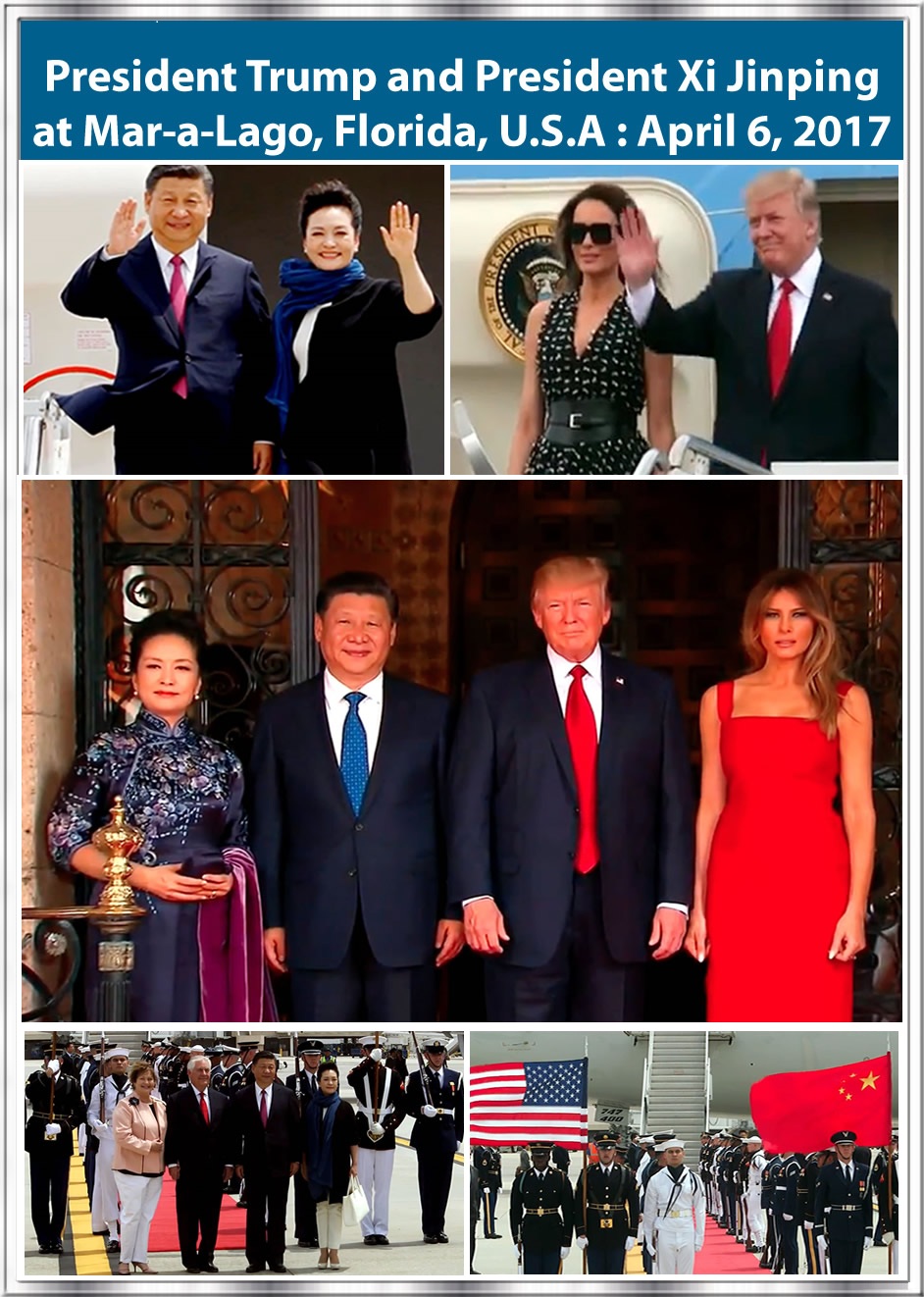
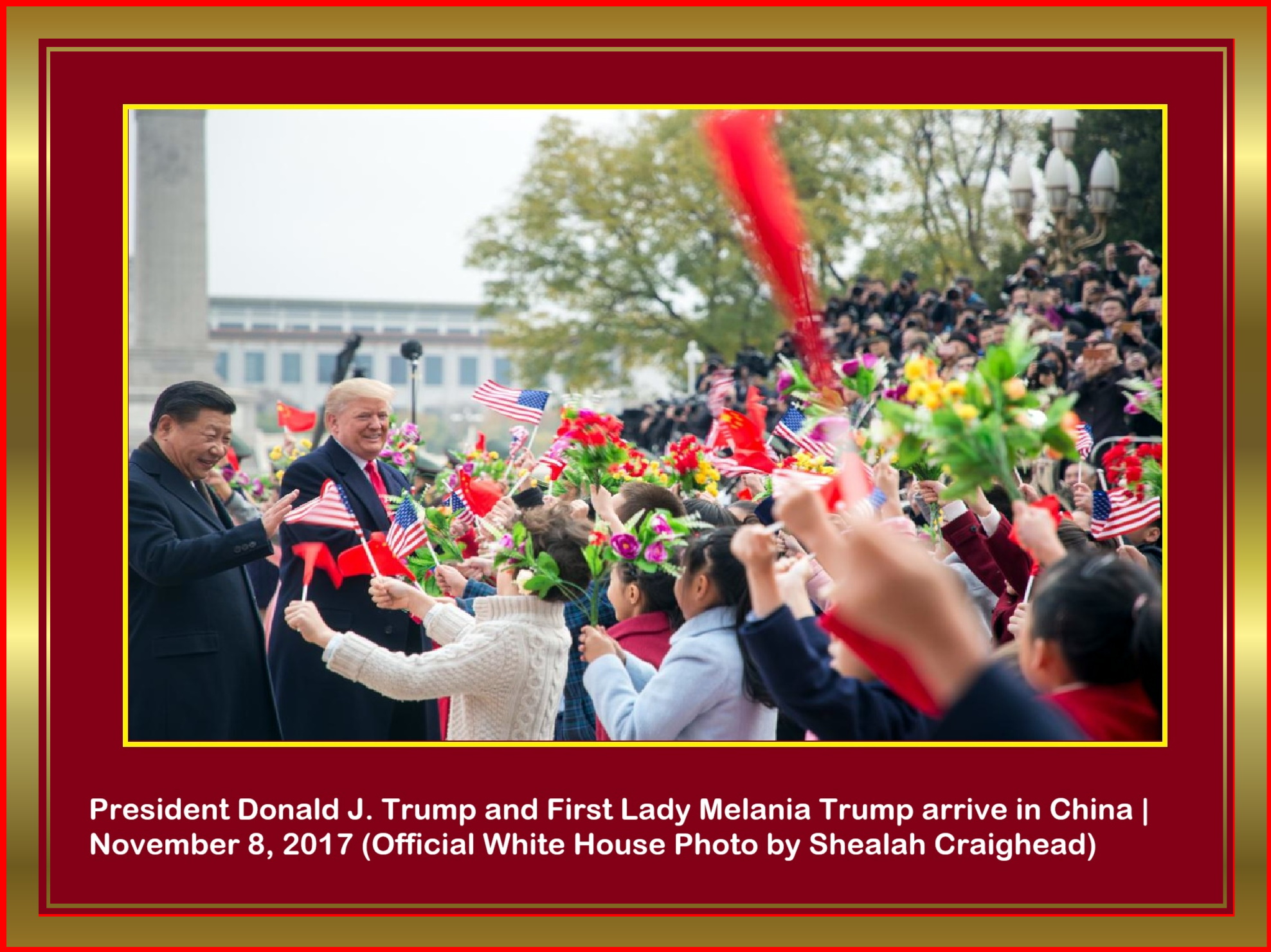
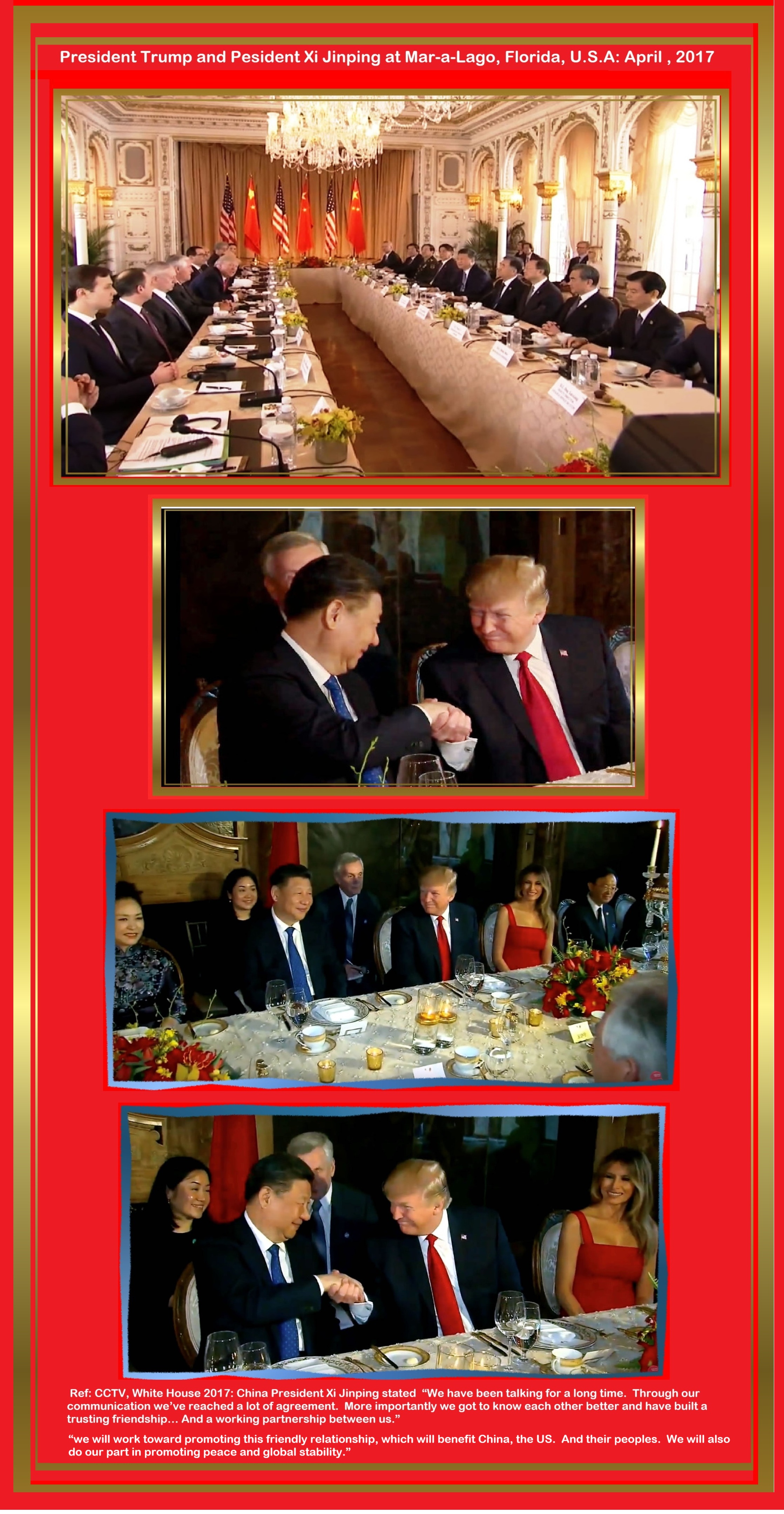
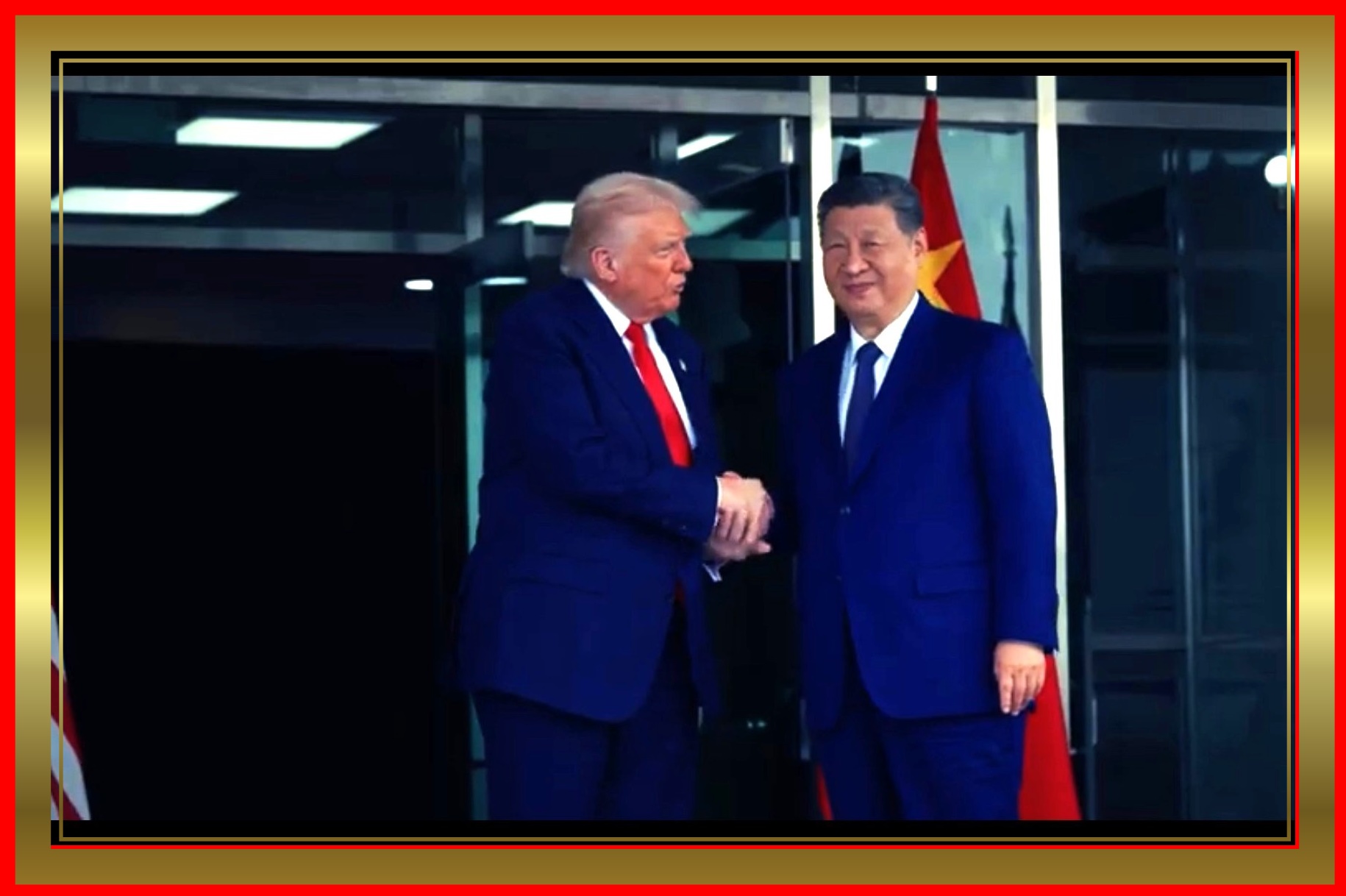
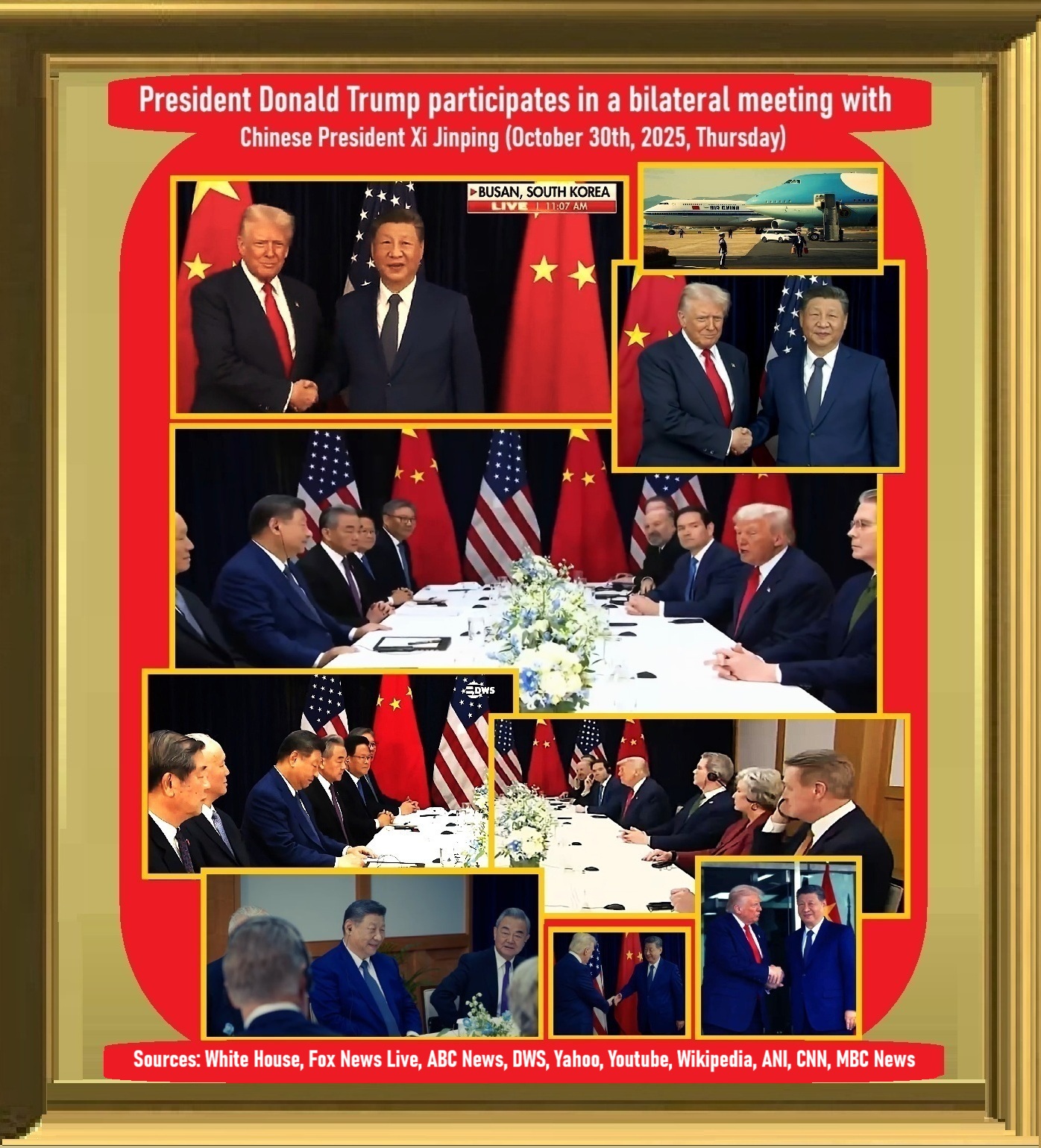
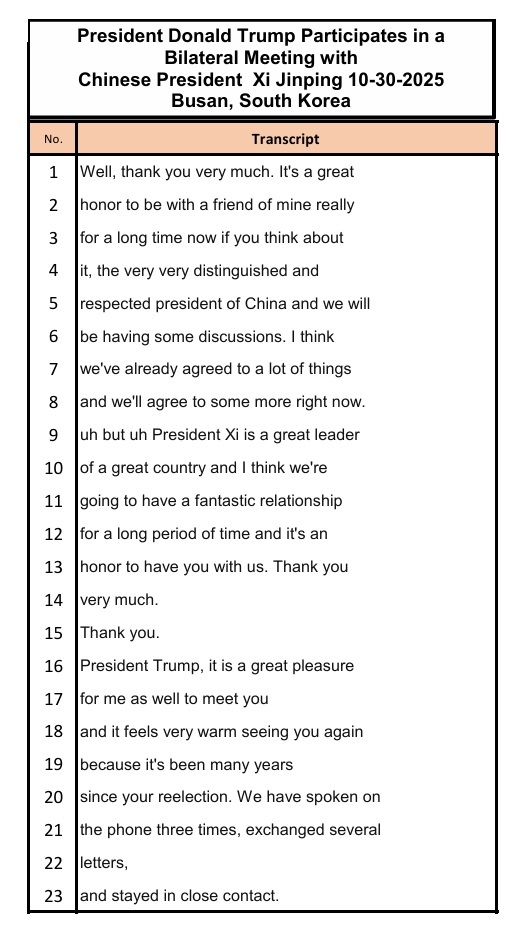
Following my meeting with President Xi Jinping of the People’s Republic of China on October 30, 2025, in the Republic of Korea, the United States and the PRC reached a historic and monumental deal on economic and trade relations (Kuala Lumpur Joint Arrangement or Arrangement). Under the Arrangement, the PRC has committed to, among other things, postpone and effectively eliminate the PRC’s current and proposed coercive global export controls on rare earth elements and other critical minerals, and address Chinese retaliation against United States semiconductor manufacturers and other major companies in the semiconductor supply chain. The PRC has also committed to purchase United States agricultural exports integral to the economy and general welfare of the United States, including soybeans, sorghum, and logs. And the PRC has committed to suspend or remove many retaliatory actions against the United States, including suspending tariffs on a vast swath of United States agricultural products until December 31, 2026, and extending the PRC’s market-based tariff exclusion process for United States imports until November 10, 2026.
The United States, in turn, committed to, among other things, maintain the suspension of heightened reciprocal tariffs on imports of the PRC until 12:01 a.m. eastern standard time on November 10, 2026.
In my judgment, the Arrangement will help remedy non‑reciprocal trade arrangements and address the United States’ economic and national security concerns. The Arrangement will reduce the United States’ trade deficit, boost the economy of the United States, and address the consequences of the United States’ trade deficit by, among other things, ensuring that the United States has access to materials vital to national defense, the energy sector, and other aspects of the United States’ economy and national security; strengthening the agricultural infrastructure of the United States; and strengthening the manufacturing and defense industrial base of the United States.
Accordingly, I have determined that it is necessary and appropriate to deal with the national emergency declared in Executive Order 14257 by implementing the Arrangement between the United States and the PRC. Therefore, I determine that it is necessary and appropriate to continue the suspension of the heightened reciprocal tariffs on imports of the PRC until 12:01 a.m. eastern standard time on November 10, 2026.
Sec. 2. Implementation. Heading 9903.01.63 and subdivision (v)(xvii)(10) of U.S. note 2 to subchapter III of chapter 99 of the Harmonized Tariff Schedule of the United States shall continue to be suspended until 12:01 a.m. eastern standard time on November 10, 2026.
Sec. 3. Monitoring and Recommendations. (a) The Secretary of the Treasury, the Secretary of Commerce, and the United States Trade Representative, in consultation with the Secretary of State and any other officials they deem appropriate, shall continue to monitor the conditions underlying the national emergency declared in Executive Order 14257, including the United States’ trade deficit, the lack of reciprocity in our bilateral trade relationships, disparate tariff rates and non-tariff barriers, United States trading partners’ economic policies that suppress domestic wages and consumption imports, the strength of our domestic manufacturing base, the strength of our defense industrial base, and any other relevant factors. The Secretary of the Treasury, the Secretary of Commerce, and the United States Trade Representative shall, from time to time, update me on the status of these conditions. In particular, the Secretary of the Treasury and the United States Trade Representative shall update me on the status and progress of the PRC’s implementation of its commitments under the Arrangement.
(b) Should the PRC fail to implement its commitments under the Arrangement, I may modify this order as necessary to deal with the emergency declared in Executive Order 14257.
(c) The Secretary of the Treasury, the Secretary of Commerce, and the United States Trade Representative, in consultation with the Secretary of State, the Secretary of Homeland Security, the Assistant to the President for Economic Policy, the Senior Counselor for Trade and Manufacturing, and the Assistant to the President for National Security Affairs, shall continue to inform me of any circumstance that, in their opinion, might indicate the need for further action and shall continue to recommend to me additional action that, in their opinion, will more effectively deal with the emergency declared in Executive Order 14257.
Sec. 4. Delegation. Consistent with applicable law, the Secretary of the Treasury, the Secretary of Commerce, the Secretary of Homeland Security, and the United States Trade Representative are directed and authorized to take such actions, including adopting rules, regulations, or guidance, and to employ all powers granted to the President, including those granted by IEEPA, as may be necessary to implement and effectuate this order. The Secretary of the Treasury, the Secretary of Commerce, the Secretary of Homeland Security, and the United States Trade Representative, consistent with applicable law, may redelegate any of these functions within their respective department or agency. All executive departments and agencies shall take all appropriate measures within their authority to implement this order.
Sec. 5. Severability. If any provision of this order, or the application of any provision of this order to any individual or circumstance, is held to be invalid, the remainder of this order and the application of its provisions to any other individuals or circumstances shall not be affected.
Sec. 6. General Provisions. (a) Nothing in this order shall be construed to impair or otherwise affect:
(i) the authority granted by law to an executive
department or agency, or the head thereof; or
(ii) the functions of the Director of the Office of Management and Budget relating to budgetary, administrative, or legislative proposals.
(b) This order shall be implemented consistent with applicable law and subject to the availability of appropriations.
(c) This order is not intended to, and does not, create any right or benefit, substantive or procedural, enforceable at law or in equity by any party against the United States, its departments, agencies, or entities, its officers, employees, or agents, or any other person.
(d) The costs for publication of this order shall be borne by the Office of the United States Trade Representative.
DONALD J. TRUMP
|
|||||||||||||||||||||||||||||||||||||||||||||||||||||||||||||||||||||||||||||||
|
MODIFYING DUTIES ADDRESSING
Executive Orders | November 4, 2025
By the authority vested in me as President by
the Constitution and the laws of the United States of America, including the
International Emergency Economic Powers Act (50 U.S.C. 1701 et
seq.) (IEEPA), the National Emergencies Act (50 U.S.C. 1601 et seq.),
section 604 of the Trade Act of 1974, as amended (19 U.S.C. 2483), and section
301 of title 3, United States Code, I hereby determine and order: In Executive Order 14228 of March 3, 2025
(Further Amendment to Duties Addressing the Synthetic Opioid Supply Chain in
the People’s Republic of China), I raised from 10 percent to 20 percent the
additional ad valorem rate of duty established in Executive
Order 14195, as amended, in response to the PRC’s failure to take adequate
steps to alleviate the illicit drug crisis described in Executive Order 14195. After discussions between the United States and
the PRC, among other things, the PRC has committed to take steps to alleviate
the national emergency declared in Executive Order 14195. Specifically,
the PRC has committed to take significant measures to end the flow of fentanyl
to the United States, including stopping the shipment of certain designated
chemicals to North America and strictly controlling exports of certain other
chemicals to all destinations in the world. In light of the PRC’s commitment,
the United States committed to, among other things, reduce the additional ad
valorem rate of duty applicable under Executive Order 14195, as
amended, from 20 percent to 10 percent, effective November 10, 2025. Accordingly, I have determined that it is
necessary and appropriate to deal with the national emergency declared in
Executive Order 14195 by reducing the additional ad valorem rate
of duty applicable under Executive Order 14195, as amended, to 10 percent,
effective November 10, 2025. Sec. 2. Implementation.
(a) All articles that are subject to the additional ad
valorem rate of duty of 20 percent under Executive Order 14195, as
amended, shall instead be subject to an additional ad valorem rate
of duty of 10 percent. Accordingly, subchapter III of chapter 99 of the
Harmonized Tariff Schedule of the United States (HTSUS) shall be modified as
follows: Effective with respect to goods entered for
consumption, or withdrawn from warehouse for consumption, on or after 12:01
a.m. eastern standard time on November 10, 2025: (i) heading 9903.01.24 is amended
by deleting “20%” each place that it appears and inserting “10%” in lieu
thereof and by deleting “or U.S. note 2(w) to this subchapter”; and (ii) subdivision (u) of U.S. note 2 is
modified by deleting “20%” and inserting “10%” in lieu thereof and by
deleting “March 4, 2025” and inserting “November 10, 2025” in lieu thereof. (b) The Secretary of Homeland Security,
in consultation with the United States International Trade Commission, shall
determine whether any additional modifications to the HTSUS are necessary to
effectuate this order and shall make such modifications through notice in
the Federal Register. Sec. 3. Monitoring
and Recommendations. (a) The Secretary of Homeland Security, in
consultation with the Secretary of State, the Secretary of the Treasury, and
any other officials the Secretary of Homeland Security deems appropriate, shall
continue to monitor the conditions underlying the national emergency declared
in Executive Order 14195, including the status and progress of the PRC’s
implementation of its commitments to alleviate the national emergency declared
in Executive Order 14195, and any other relevant factors. The Secretary
of Homeland Security shall, from time to time, update me on the status of these
conditions. Should the PRC fail to implement its commitments as described
in section 1 of this order, I may modify this order as necessary to deal with
the emergency declared in Executive Order 14195. (b) The Secretary of Homeland Security,
in consultation with the Secretary of State, the Attorney General, the
Assistant to the President for National Security Affairs, and the Assistant to
the President for Homeland Security, shall continue to inform me of any
circumstance that, in their opinion, might indicate the need for further action
and shall continue to recommend to me additional action that, in their opinion,
will effectively deal with the emergency declared in Executive Order 14195. Sec. 4. Delegation.
Consistent with applicable law, the Secretary of Homeland Security is directed
and authorized to take such actions, including adopting rules, regulations, or
guidance, and to employ all powers granted to the President, including those
granted by IEEPA, as may be necessary to implement and effectuate this
order. The Secretary of Homeland Security, consistent with applicable
law, may redelegate any of these functions within the Department of Homeland
Security. All executive departments and agencies shall take all
appropriate measures within their authority to implement this order. Sec. 5. Severability.
If any provision of this order, or the application of any provision of this
order to any individual or circumstance, is held to be invalid, the remainder
of this order and the application of its provisions to any other individuals or
circumstances shall not be affected. Sec. 6. General
Provisions. (a) Nothing in this order shall be construed to
impair or otherwise affect: (i) the authority granted by law to
an executive department or agency, or the head thereof; or (ii) the functions of the Director of the
Office of Management and Budget relating to budgetary, administrative, or
legislative proposals. (b) This order shall be implemented
consistent with applicable law and subject to the availability of
appropriations. (c) This order is not intended to, and
does not, create any right or benefit, substantive or procedural, enforceable
at law or in equity by any party against the United States, its departments,
agencies, or entities, its officers, employees, or agents, or any other person. (d) The costs for publication of this
order shall be borne by the Department of Homeland Security. DONALD J. TRUMP THE WHITE HOUSE, November 4, 2025. |
|||||||||||||||||||||||||||||||||||||||||||||||||||||||||||||||||||||||||||||||
Joint Statement on U.S.-China Economic and
The White House August 11, 2025 The Government of the United States of America (the “United States”) and the Government of the People’s Republic of China (“China”),
Recalling the Joint Statement on U.S.-China Economic and Trade Meeting in Geneva on May 12, 2025 (“Geneva Joint Statement”); and
Reflecting on their meetings in London on June 9 and 10, 2025, and in Stockholm on July 28 and 29, 2025;
The Parties recall the commitments under the Geneva Joint Statement and agree to take the following actions by August 12, 2025:
The United States will continue to modify the application of the additional ad valorem rate of duty on articles of China (including articles of the Hong Kong Special Administrative Region and the Macau Special Administrative Region) set forth in Executive Order 14257 of April 2, 2025, by suspending 24 percentage points of that rate for an additional period of 90 days, starting on August 12, 2025, while retaining the remaining ad valorem rate of 10 percent on those articles pursuant to the terms of said Order.
China will continue to (1) modify the application of the additional ad valorem rate of duty on articles of the United States set forth in the Announcement of the Customs Tariff Commission of the State Council No. 4 of 2025, by suspending 24 percentage points of that rate for an additional period of 90 days, starting on August 12, 2025, while retaining the remaining additional ad valorem rate of 10 percent on those articles, and (2) adopt or maintain all necessary administrative measures to suspend or remove the non-tariff countermeasures taken against the United States as agreed in the Geneva Joint Statement.
This Joint Statement is based on the discussions that took place during the U.S.-China Economic and Trade Meeting in Stockholm, which was held under the mechanism established by the Geneva Joint Statement. The representative from the Chinese side for this meeting was He Lifeng, Vice Premier of the State Council, and the representatives from the U.S. side were Scott Bessent, Secretary of Treasury, and Jamieson Greer, United States Trade Representative.
--------------------------------------------------------------------------------
Fox News : US-China trade talks heading in 'positive' direction: White House White House National Economic Council director Kevin Hassett discusses the ongoing trade talks, the recent NVIDIA chip deal, and more on 'The Story.'
US-China Hold Trade Talks in Stockholm, 90-Day Truce Extension Expected | US-China Trade Talks N18G
Jul 28, 2025 #USChina #Tariffs #Stockholm The United States and China are holding crucial trade talks in Stockholm, with no statements issued after a five-hour meeting on the first day, Monday. Analysts expect a 90-day truce extension as China faces an August 12 tariff deadline.
WSJ News: U.S.-China Trade Officials Discuss Tariff Truce Extension | WSJ News
Bessent: Trump Will Make Final Call On China Tariff Truce (Full Q&A)
Treasury Secretary Scott Bessent said that the US and China will continue talks over maintaining a tariff truce before it expires in two weeks and that President Donald Trump will make the final call on any extension. Bessent, who led the US delegation with Trade Representative Jamieson Greer, said in Stockholm that he’ll brief Trump on Wednesday on the remaining issues. “There’s still a couple of technical details to work out,” Bessent told reporters Tuesday, after two days of meetings with officials from Beijing led by Vice Premier He Lifeng. On the heels of Washington’s preliminary tariff deals with Japan and the European Union, Bessent said his Chinese counterparts were “more of a mood for a wide-ranging discussion.”
Adding an extra 90 days is one option, Bessent said. Chinese trade negotiator Li Chenggang told reporters that both sides agree on maintaining the truce, without elaborating on how long. He added that the conversations in the Swedish capital were candid, in-depth and geared for continued close communication.
Magnet Talks At issue in the ongoing dialog is how the two countries seek to maintain a stable trading relationship while applying barriers like tariffs and export controls to limit each other’s progress in critical sectors ranging from battery technology and defense to semiconductors. Greer said the US wants assurances that critical materials like magnets keep flowing so the two sides can focus on other priorities. “We don’t ever want to talk about magnets again,” he said. Greer said the resumption of China’s rare earths exports is Beijing’s biggest concession so far. Asked if the US made any commitments to China on its pending 232 investigations, Greer said China asked for status updates on them, but stressed that the eventual duties would be applied globally and not have any exemptions for particular countries. He also said China asked about the Trump administration’s so-called 232 investigations into sectors such as copper, semiconductors and pharmaceuticals, and the US explained that those involve global tariffs with no exceptions for individual countries.
Reducing the 20% tariffs that Trump imposed over US claims that Chinese companies supply chemicals used to make the illegal drug fentanyl is also a high priority for Beijing, Eurasia Group analysts wrote in a note last week. The sticking points in the relationship extend beyond cross-border commerce. Earlier, Taiwanese President Lai Ching-te appeared to call off an overseas trip planned for next week after the Trump administration failed to approve his stopover in the US. Trade tensions have risen recently as both sides try to apply industrial leverage. China has recently exerted its dominance in rare earth minerals for concessions from the US on advanced chips needed for Beijing’s ambitions in artificial intelligence. ‘No Interest!’ That softening from US President Donald Trump has worried China hawks in Washington that the administration is giving up too much by easing export controls to strike a deal and hold a summit with President Xi Jinping. The US president late Monday in Scotland pushed back at such suggestion, posting on social media that he’s not pushing for a summit with Xi. “I am not SEEKING anything! I may go to China, but it would only be at the invitation of President Xi, which has been extended. Otherwise, no interest!” Trump wrote. In the background of the latest trade talks between Washington and Beijing is the race by several economies to sign tariff deals with Trump before Aug. 1, when he’s threatening to impose so-called reciprocal import taxes on the US’s major trading partners. On Sunday, he announced a preliminary deal with the European Union to apply 15% tariffs on EU goods shipped to the US.
Nvidia and AMD to pay 15% of sales to China to US
Two of the world’s top chipmakers will reportedly pay the United States 15% of their sales to China to obtain export licenses for the Chinese market.
WION: US-China Trade Talks: Tech Deals & Deadline Looms | WION Business Watch
The temporary trade truce between the U.S. and China is set to expire, with key talks underway. As the august 12 deadline looms, major tech firms like nvidia and amd have agreed to share 15% of their China chip sales revenue with the U.S. Government in exchange for export licenses. Meanwhile, tensions rise over additional tariffs and the future of advanced chip sales. Watch this segment as we explain how the trade dynamics shift, and how key players make crucial moves in this high-stakes negotiation.
----------------------------- NBC: Nvidia and AMD agree to give U.S. 15% of revenue from sales to China August 11 Two semiconductor makers, Nvidia and AMD, agreed to give the U.S. government a 15% share of their revenue from sales to China. NBC News' Brian Cheung reports on how the U.S. government is expanding its role in the business of private enterprises.
-------------------------------------------------------------------------------
|
|||||||||||||||||||||||||||||||||||||||||||||||||||||||||||||||||||||||||||||||
|
|||||||||||||||||||||||||||||||||||||||||||||||||||||||||||||||||||||||||||||||
|
|
)
)
)
)
)
)
)
)
)
)
)
)
)
)
)
)
)
)
)
)
)
)
)
)
)
)
)
)
)
)
)
)
)
)
)
)
)
)
)
)
)
)
)
)
)
)
)
)
)
)
)
)
)
)
)
)
)
)
)
)
)
)
)
)
)
)
)
)
)
)
)
.jpg)