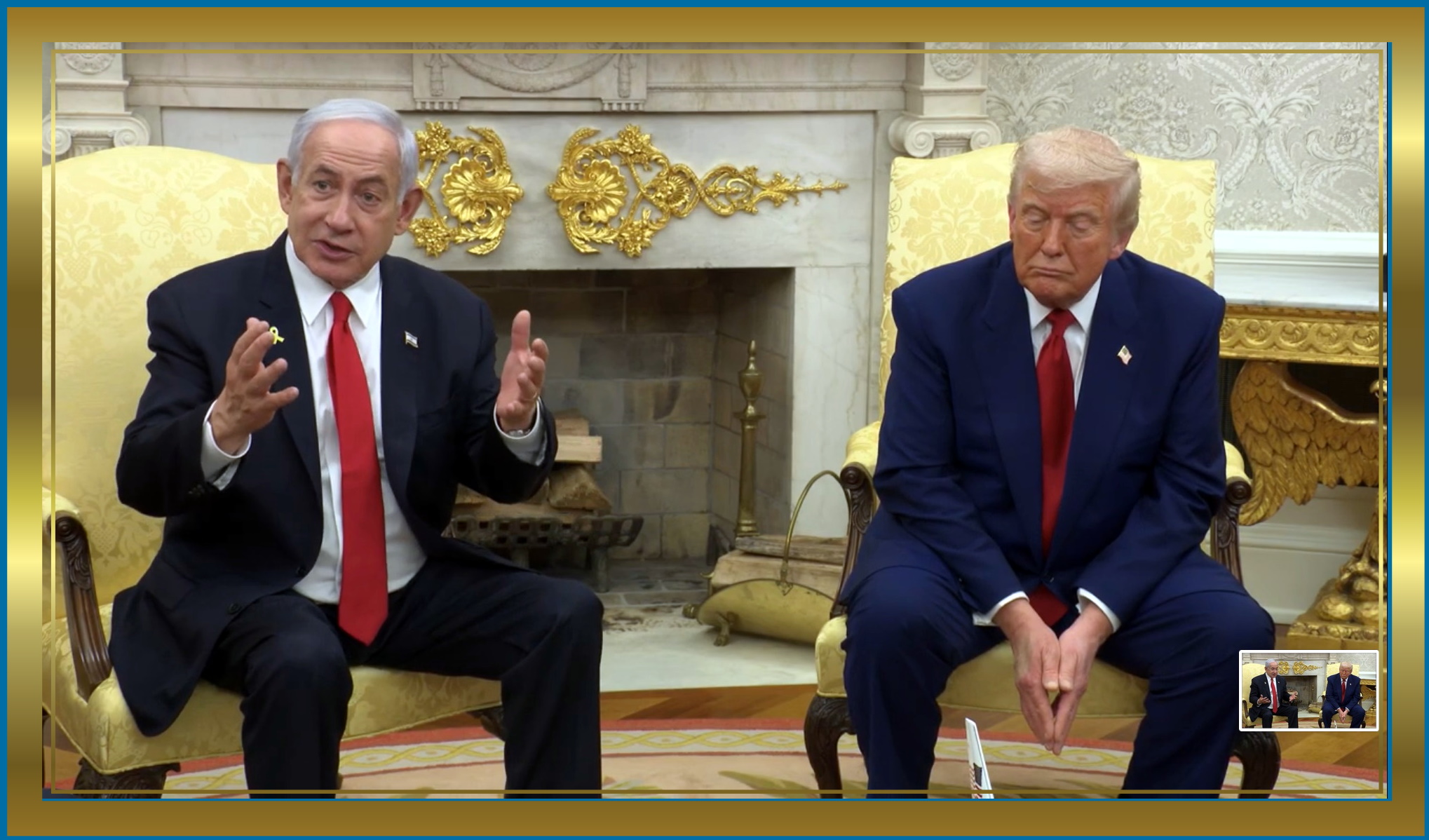
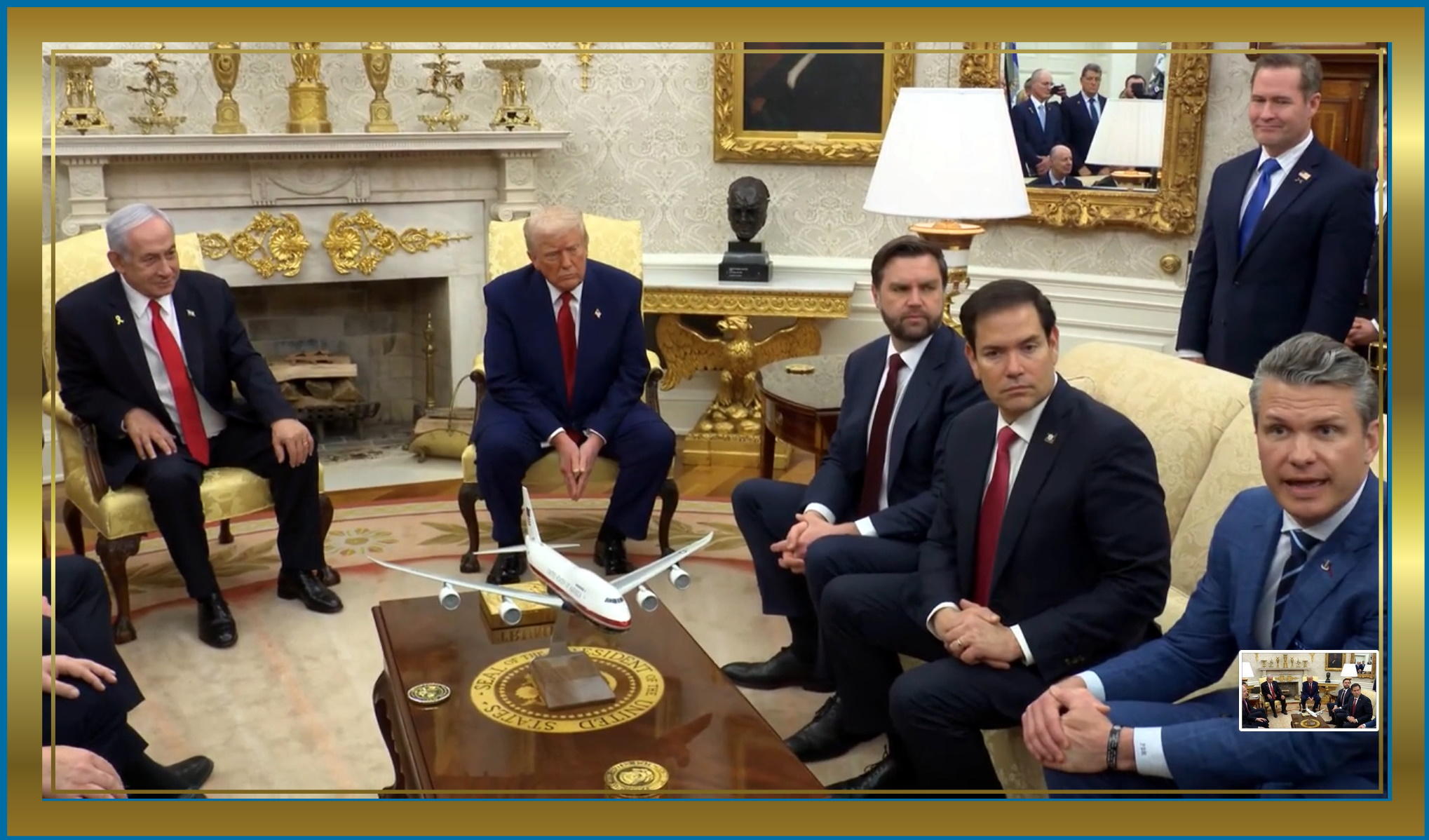
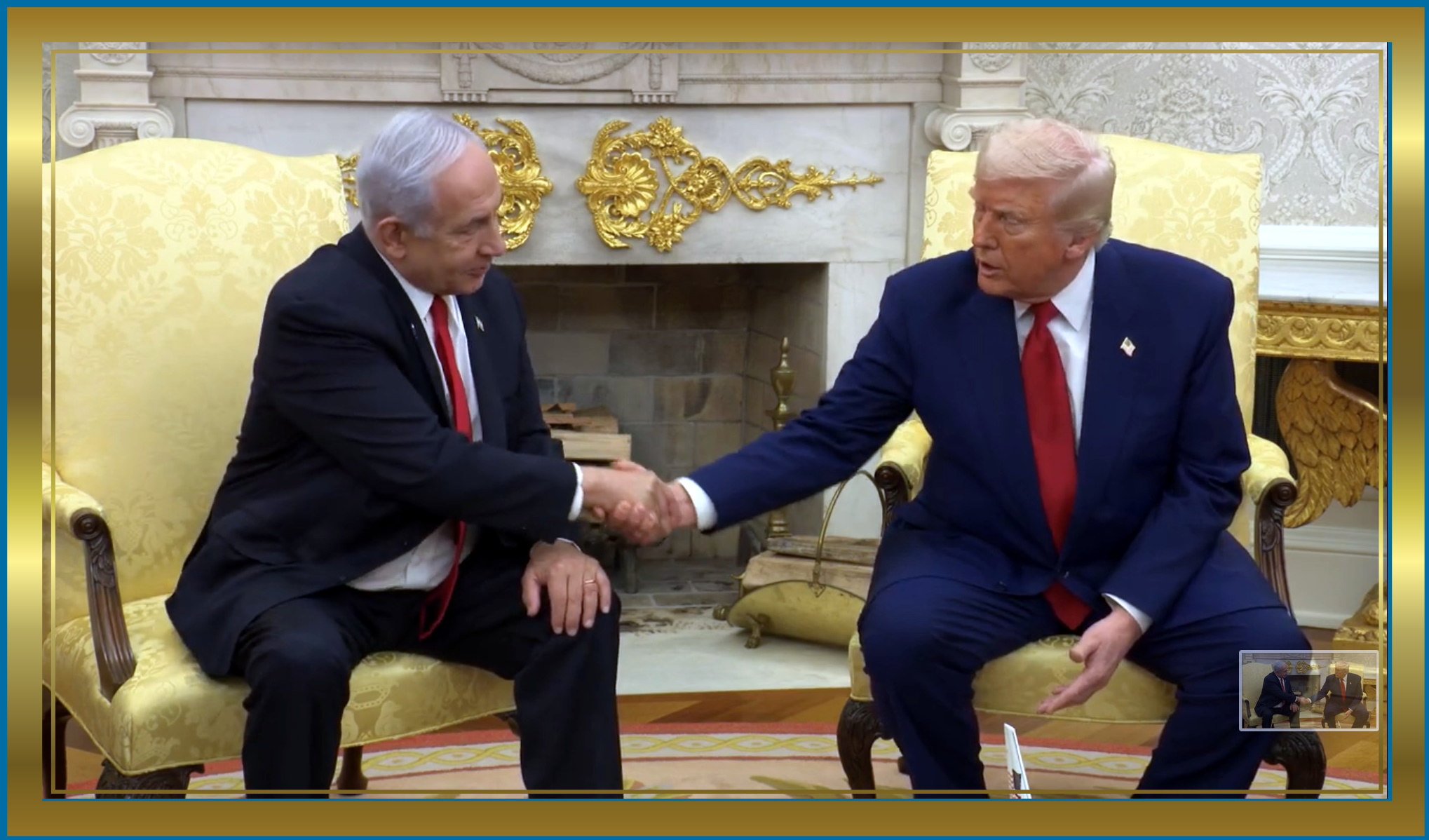
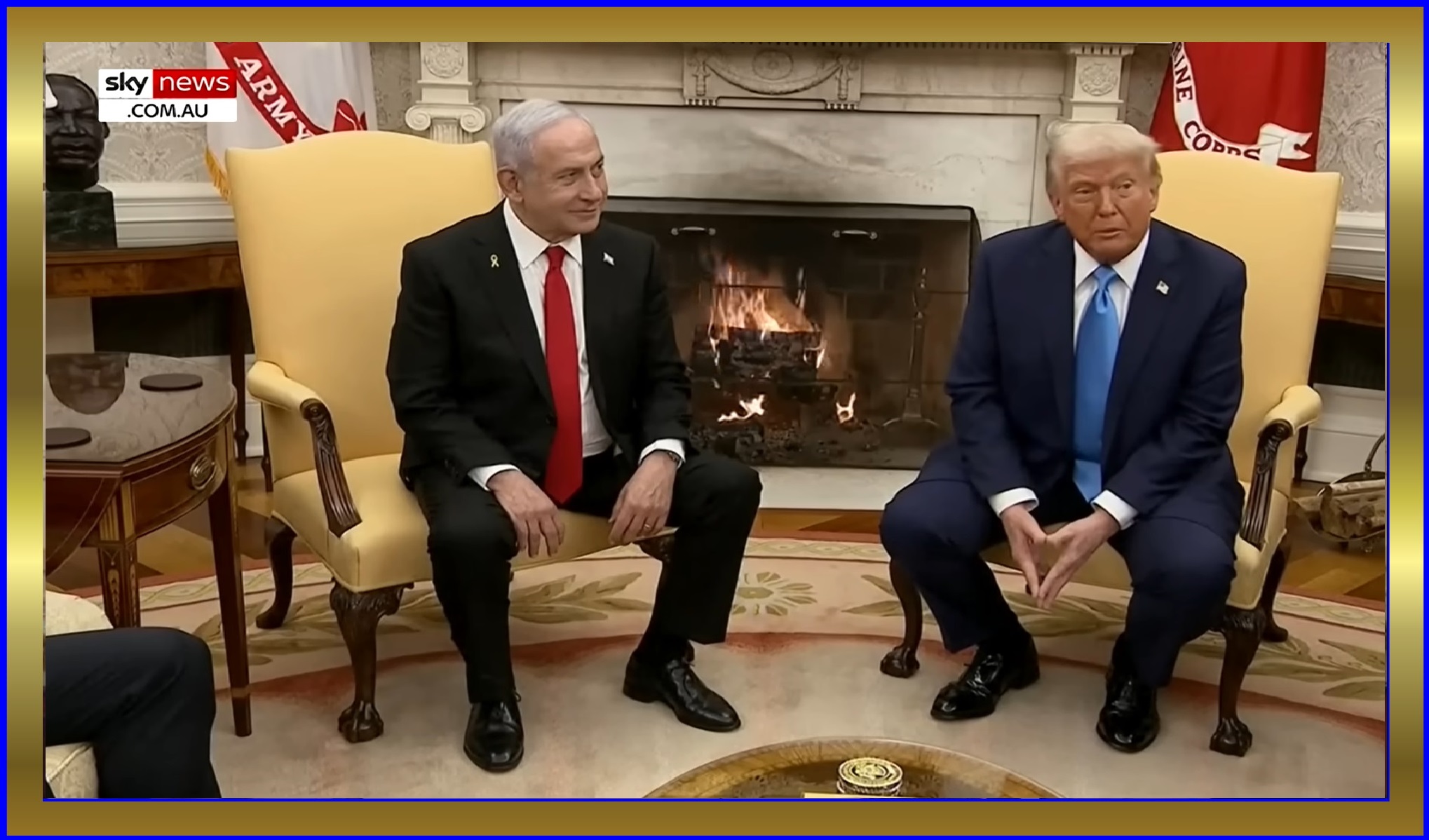
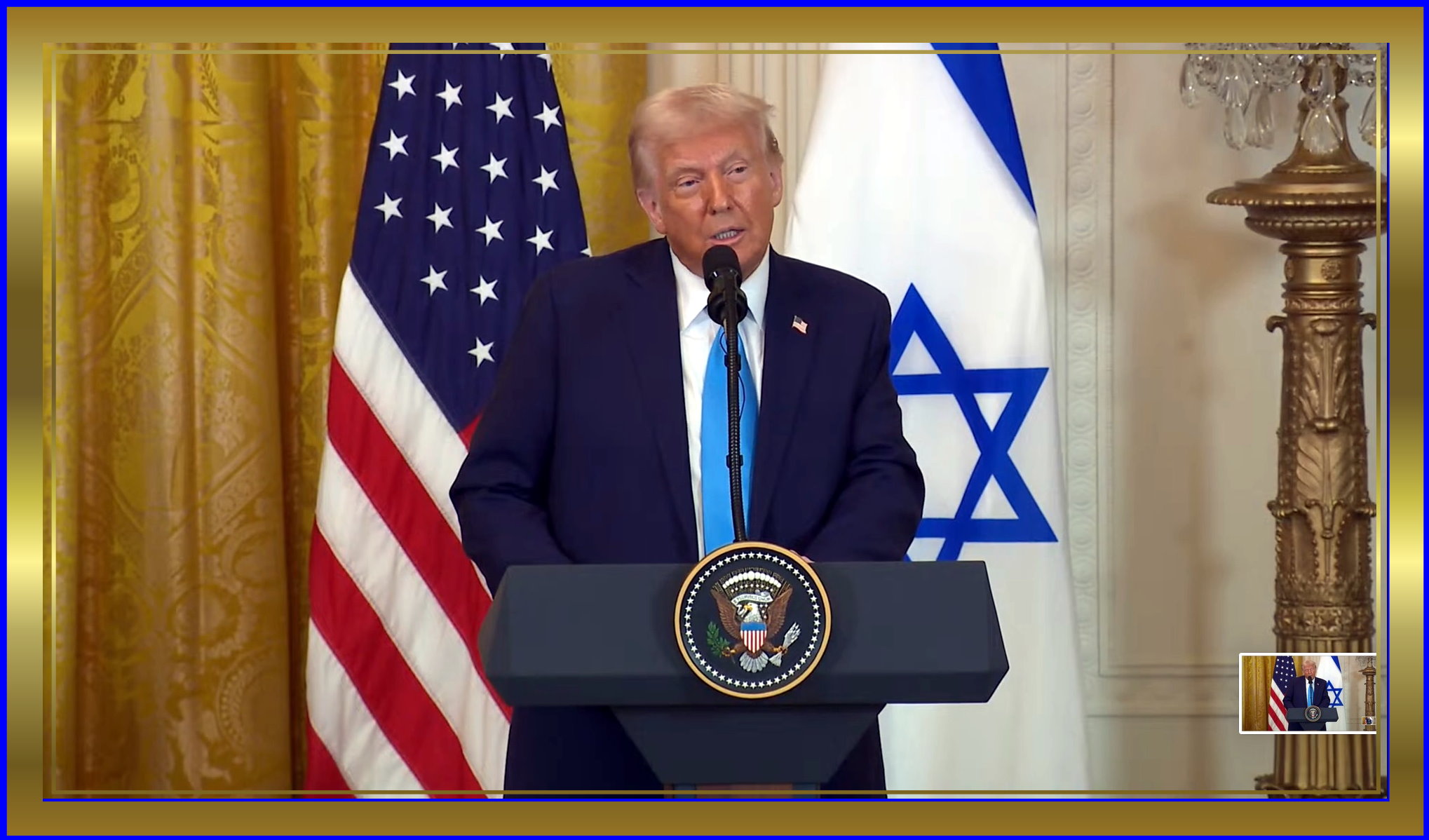
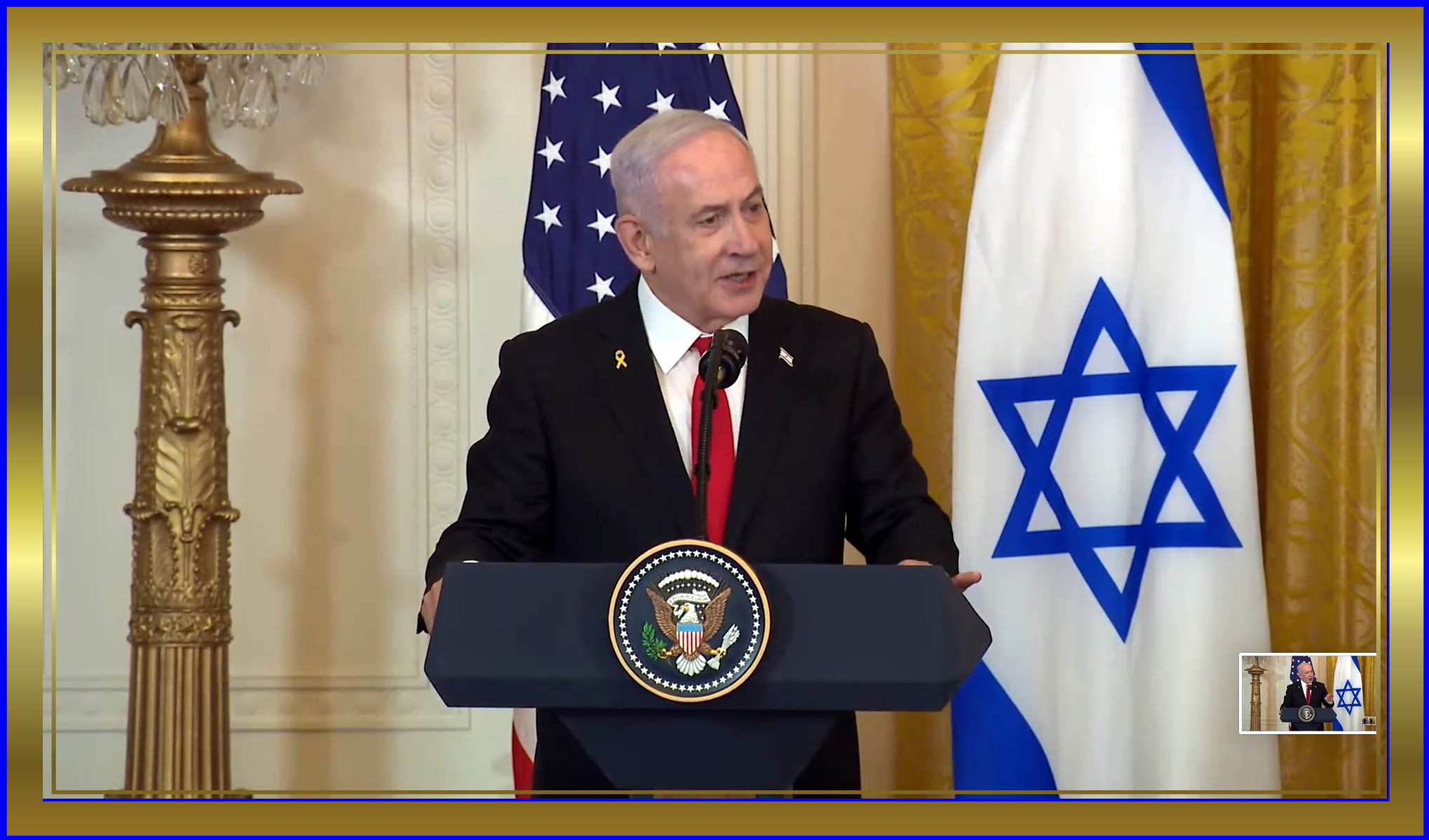
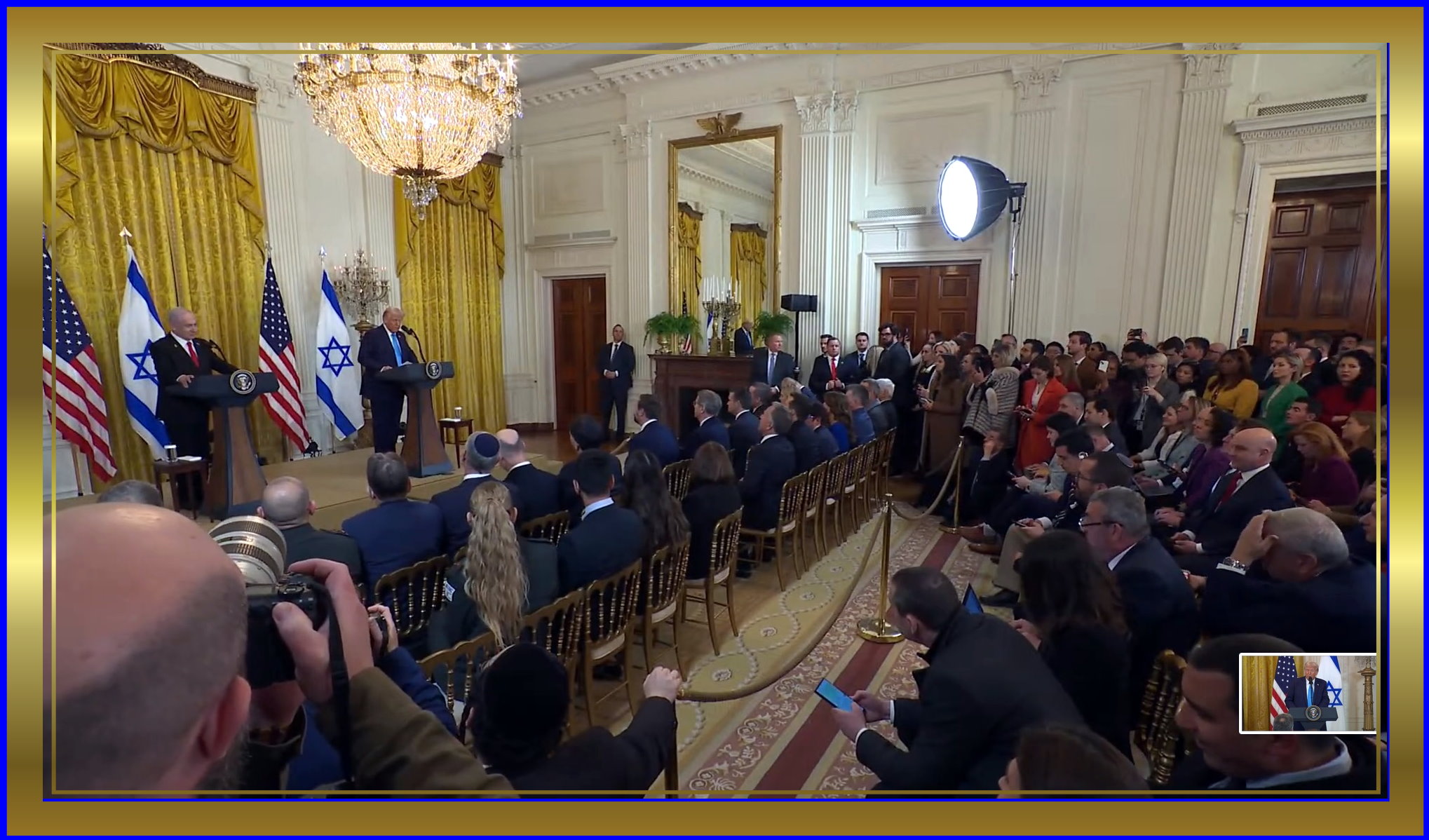
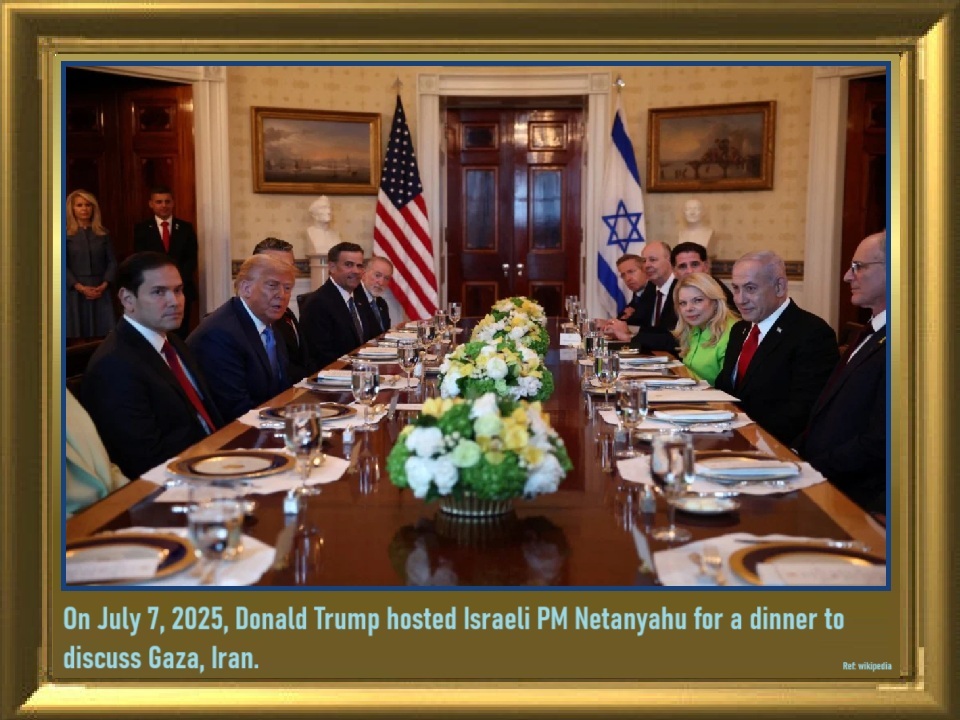
Israeli Prime Minister Benjamin Netanyahu Nominates President Donald J. Trump for Nobel Peace Prize
July 7, 2025
Israeli Prime Minister Benjamin Netanyahu Nominates President Donald J. Trump for Nobel Peace Prize
July 7, 2025
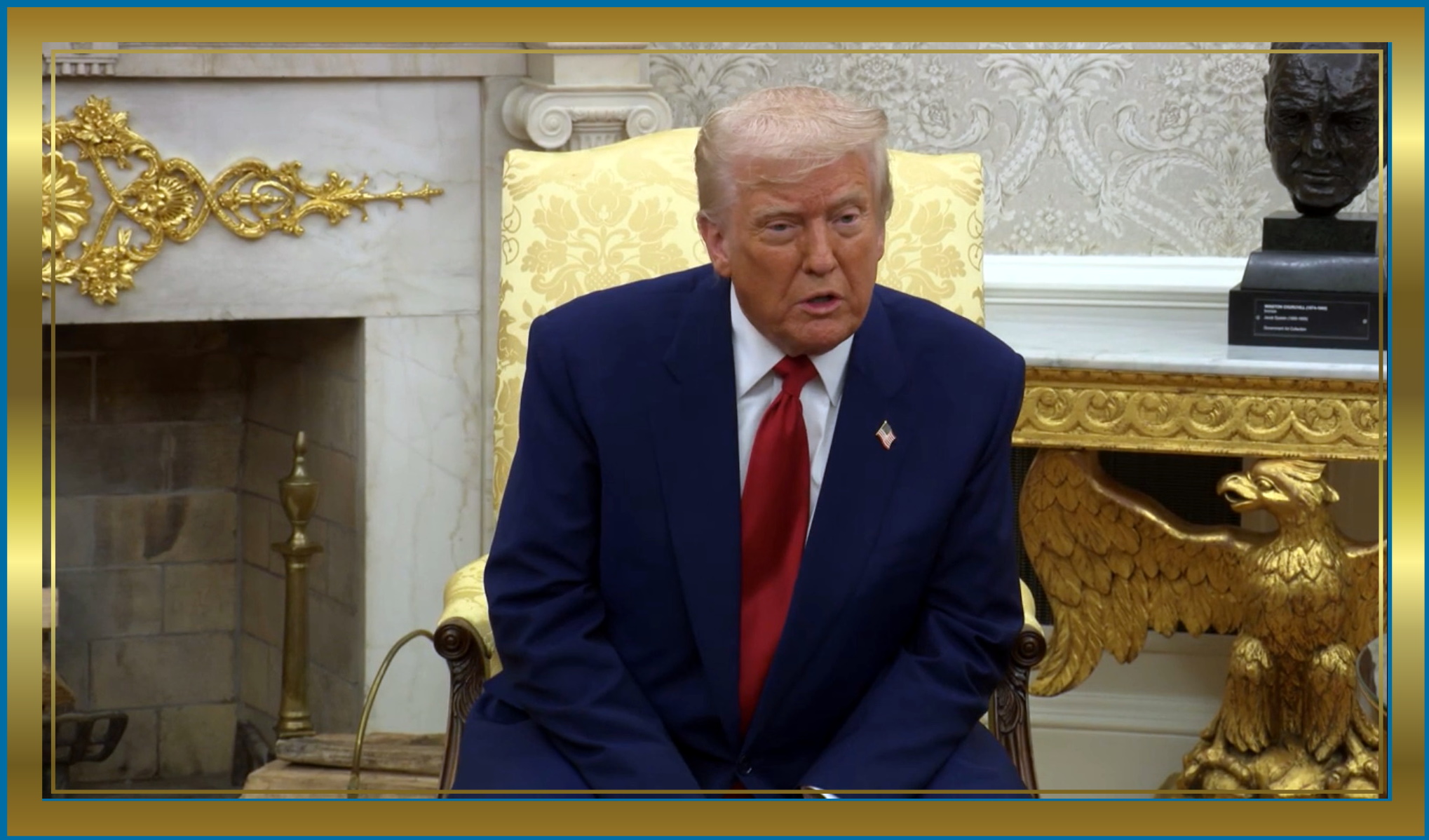
President Trump is "forging peace as we speak, in one country and one region after the other. So, I want to present to you, Mr. President, the letter I sent to the Nobel Prize committee. It's nominating you for the peace prize, which is well-deserved." –Israeli PM Netanyahu -
---------------------------------------
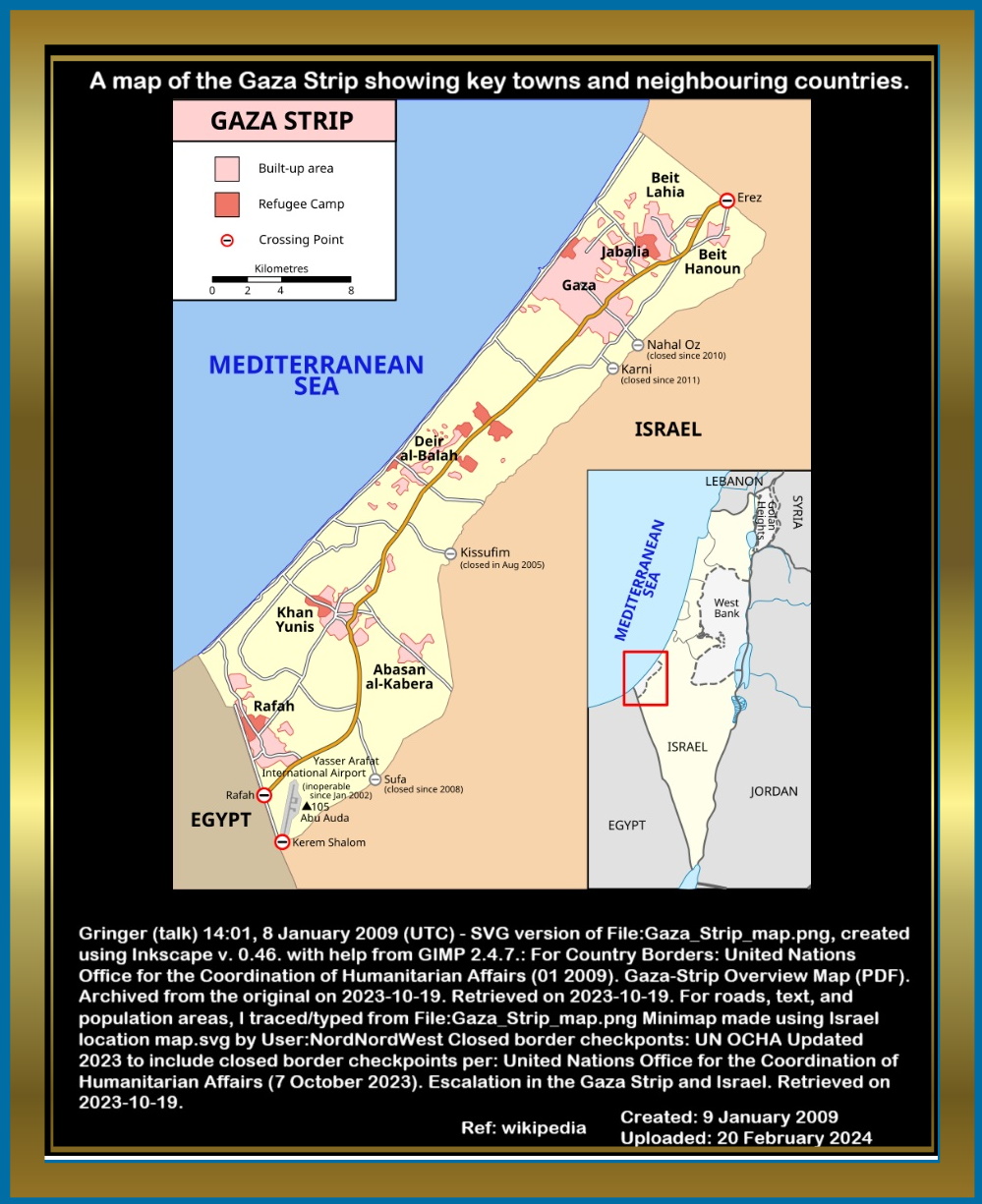
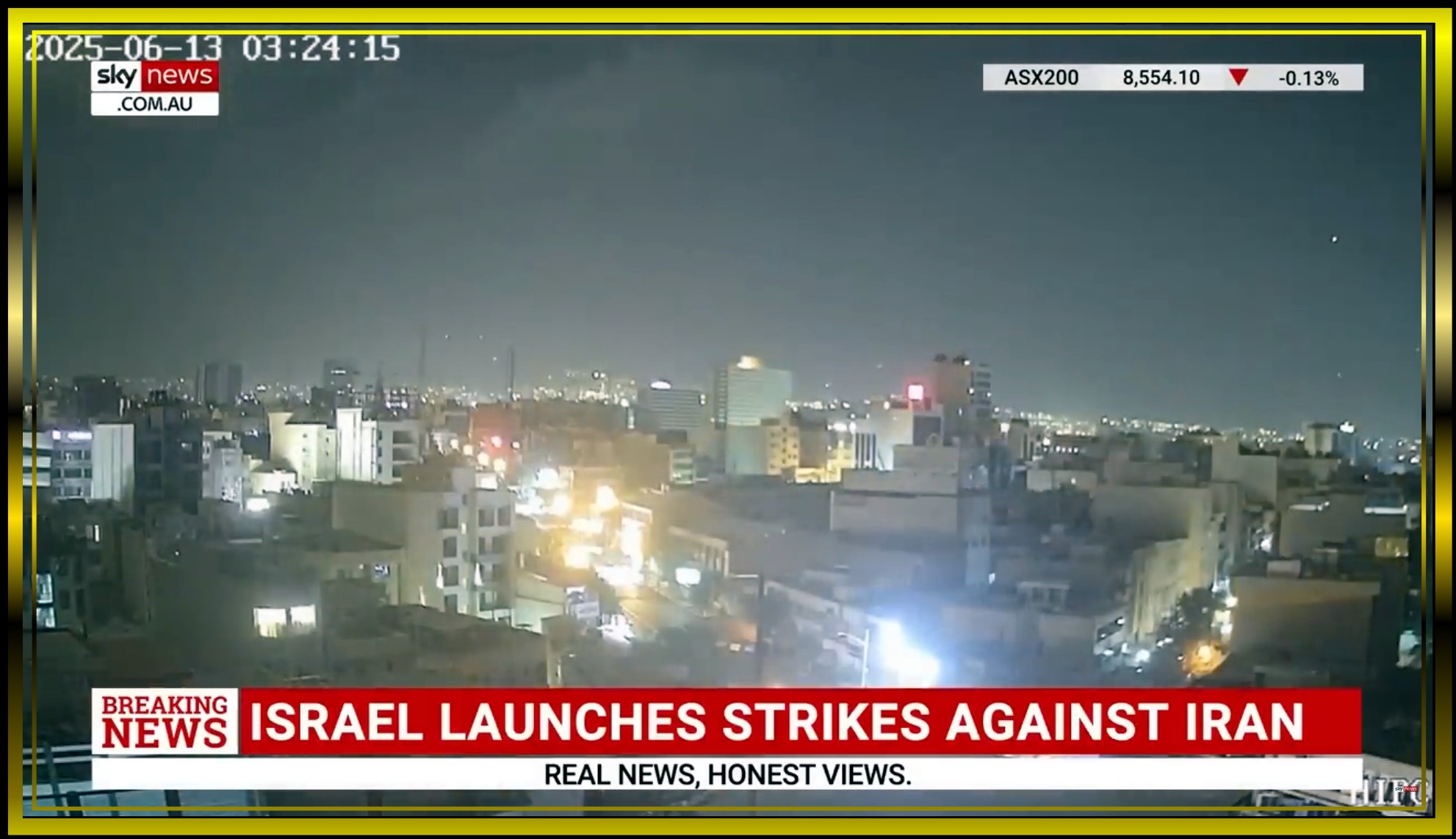
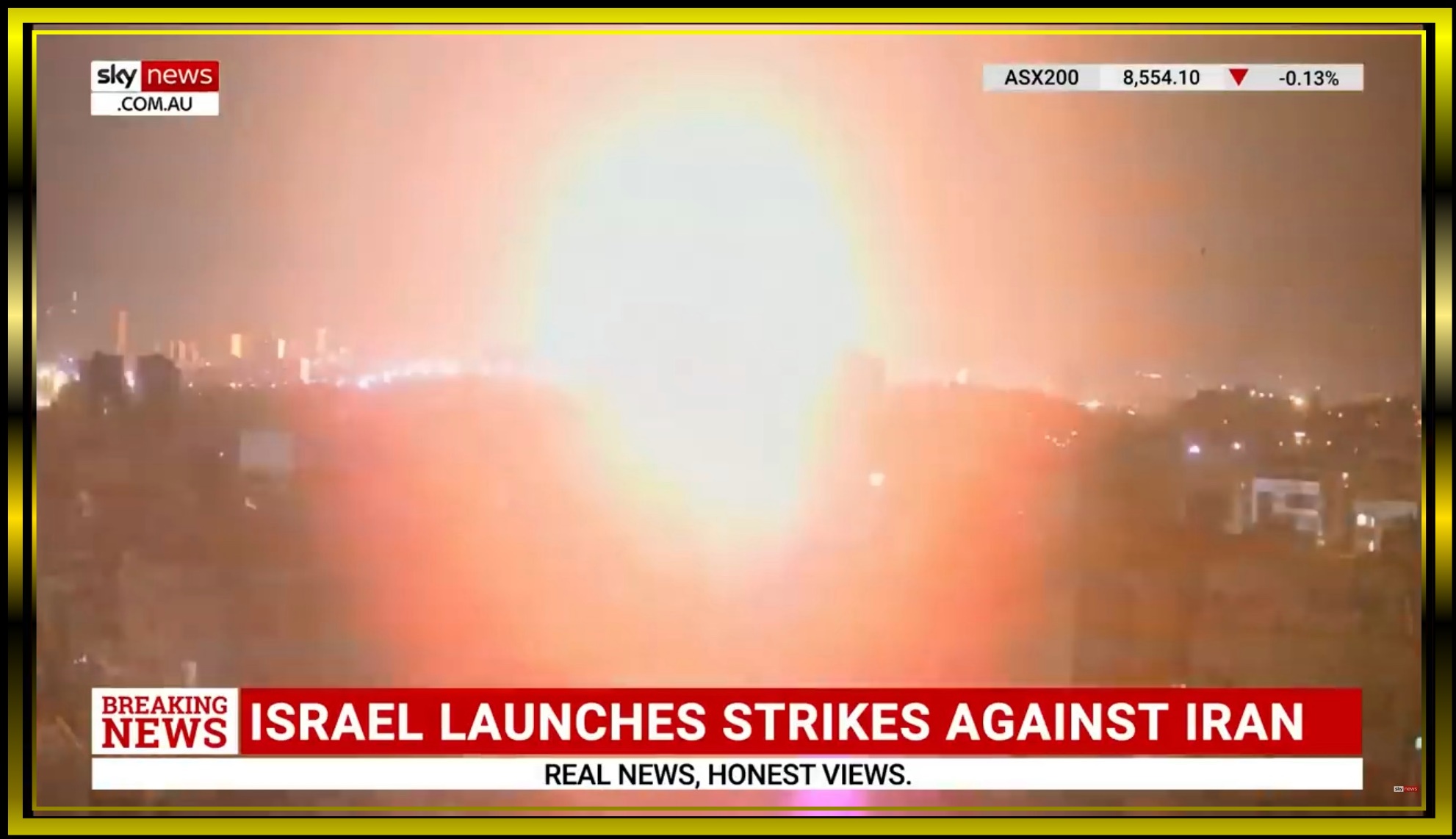
An armed conflict between Iran and Israel began when Israel launched surprise attacks on key military and nuclear facilities in Iran on 13 June 2025, in the midst of the Gaza war and its broader regional spillover. In the opening hours of the war, Israeli air and ground forces assassinated some of Iran's prominent military leaders, nuclear scientists, and politicians; and damaged or destroyed Iran's air defenses and some of its nuclear and military facilities. Israel launched hundreds of airstrikes throughout the war.
Iran retaliated with waves of missile and drone strikes against Israeli cities and military sites; over 550 ballistic missiles and more than 1,000 explosive drones were launched by Iran during the war. The Iran-allied Houthis in Yemen also fired several missiles at Israel, in an adjunct of the Red Sea crisis. The United States, which defended Israel against Iranian missiles and drones, took offensive action on the ninth day of the war by bombing three Iranian nuclear sites. Iran retaliated by firing missiles at a US base in Qatar.
On 24 June, Israel and Iran agreed to a ceasefire after insistence from the US, following an appeal by Iran to Qatar, Saudi Arabia and Oman to press US President Donald Trump to use his influence on Israel to agree to an immediate ceasefire with Iran
"PEACE OF MIND"
THE WORLD KNOWS
THERE ARE NO MORE IRAN'S NUCLEAR BOMB MAKERS, ETC. . Experts
Agree: Iran’s Nuclear Facilities Have Been Obliterated
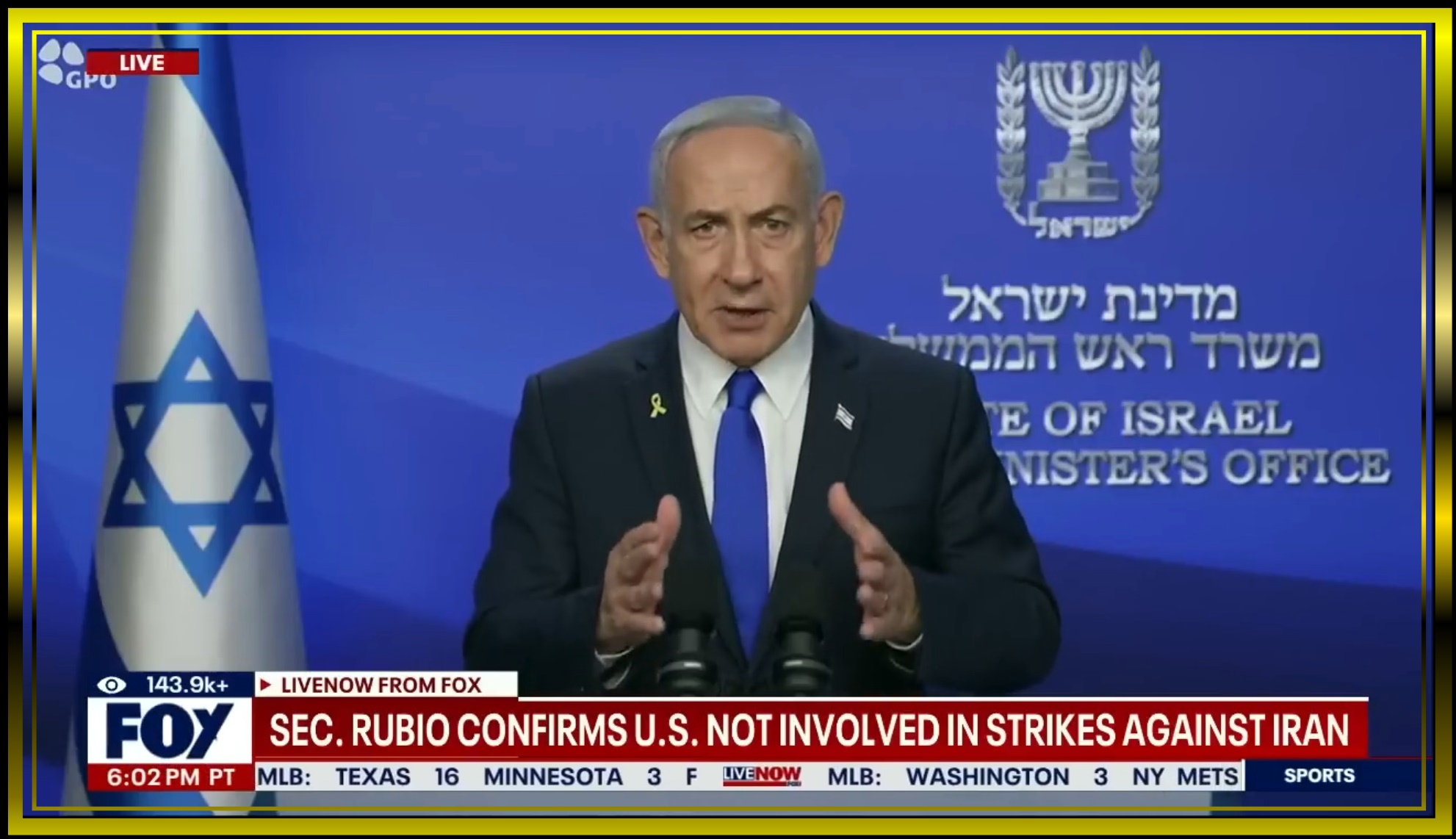
“Tonight, Israel took unilateral action against Iran. We are not involved in strikes against Iran and our top priority is protecting American forces in the region. Israel advised us that they believe this action was necessary for its self-defense. President Trump and the Administration have taken all necessary steps to protect our forces and remain in close contact with our regional partners. Let me be clear: Iran should not target U.S. interests or personnel.”
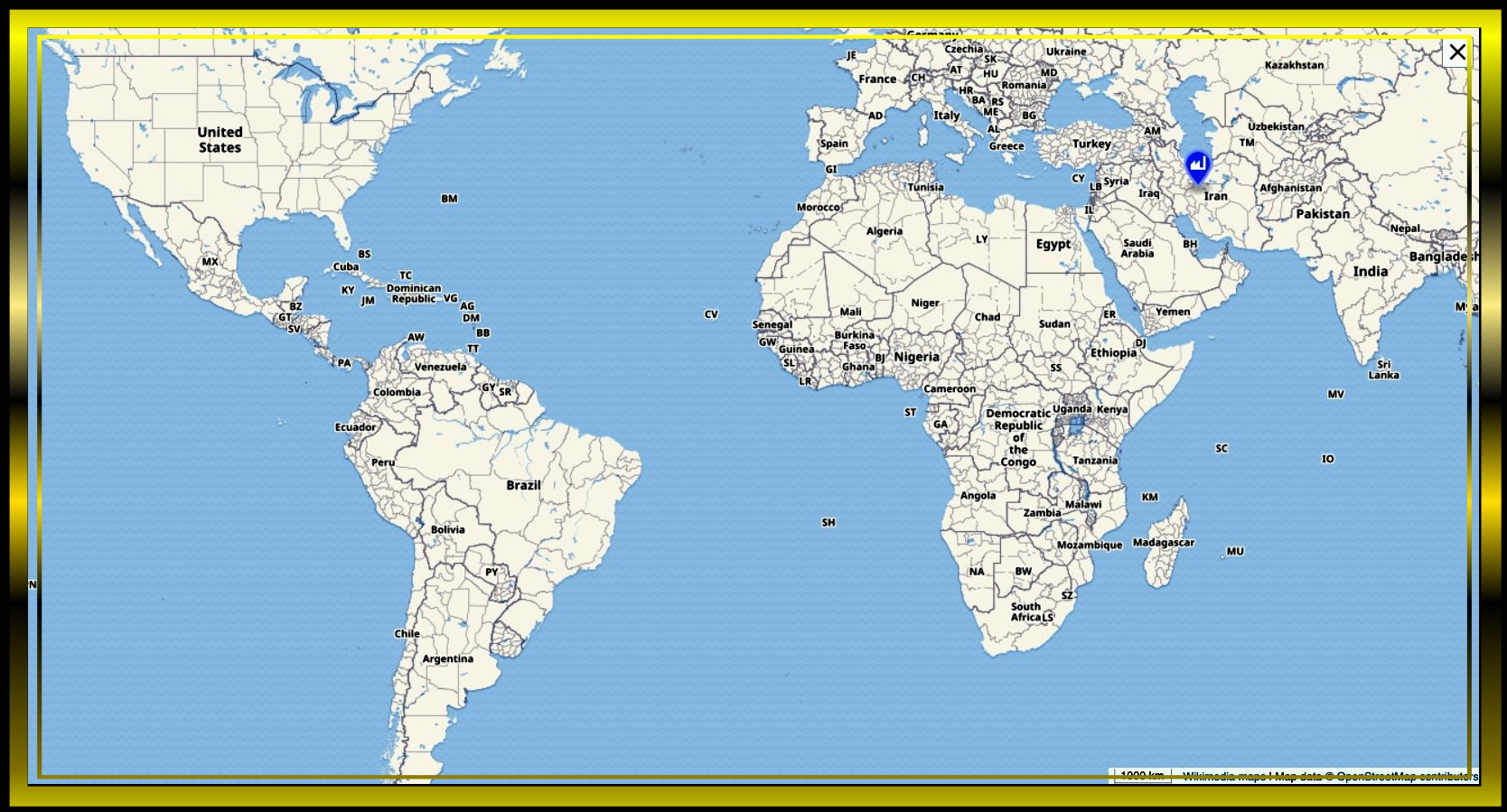
On 12 June 2025,Iran announced the activation of a third uranium enrichment site following the IAEA's first formal censure of Iran in two decades. While the location has not been disclosed, Iranian officials described it as "secure and invulnerable."
Analysts and researchers say that a nuclear-armed Iran poses significant global security risks and undermines the stability of the Middle East about the nuclear program of Iran
International Atomic Energy Agency (IAEA) chief Rafael Grossi warns that an Iranian nuclear weapon could trigger broad nuclear proliferation, as other countries, particularly in the Middle East, may seek similar capabilities in response. Concerns also exist that Iran's nuclear assets could fall into the hands of extremist factions due to internal instability or regime change. Additionally, Iran's success in acquiring nuclear weapons could encourage other regional powers to seek their own nuclear arsenals. The potential transfer of nuclear technology or weapons to radical states and terrorist organizations heightens fears of nuclear terrorism. Scholars argue that a nuclear-armed Iran could feel emboldened to increase its support for terrorism and insurgency, core elements of its strategy, while deterring retaliation through its newfound nuclear leverage.
----------------------------
IAEA, May 2025 reported that there are several undeclared locations in Iran remain at the center of its investigation into Iran's past nuclear activities.
These include Turquzabad, first identified publicly in 2018 when Israeli Prime Minister Benjamin Netanyahu claimed it was a secret nuclear warehouse. Inspectors later detected man-made uranium particles there in 2019. Two other sites, Varamin and Marivan, also yielded traces of undeclared nuclear material when IAEA inspectors were granted access in 2020. A fourth site, Lavisan-Shian, has been under scrutiny as well, though inspectors were never able to visit it because it was demolished after 2003.[101] IAEA concluded that these locations, and possibly others too, were part of an undeclared nuclear program conducted by Iran up until the early 2000s.
——————————————
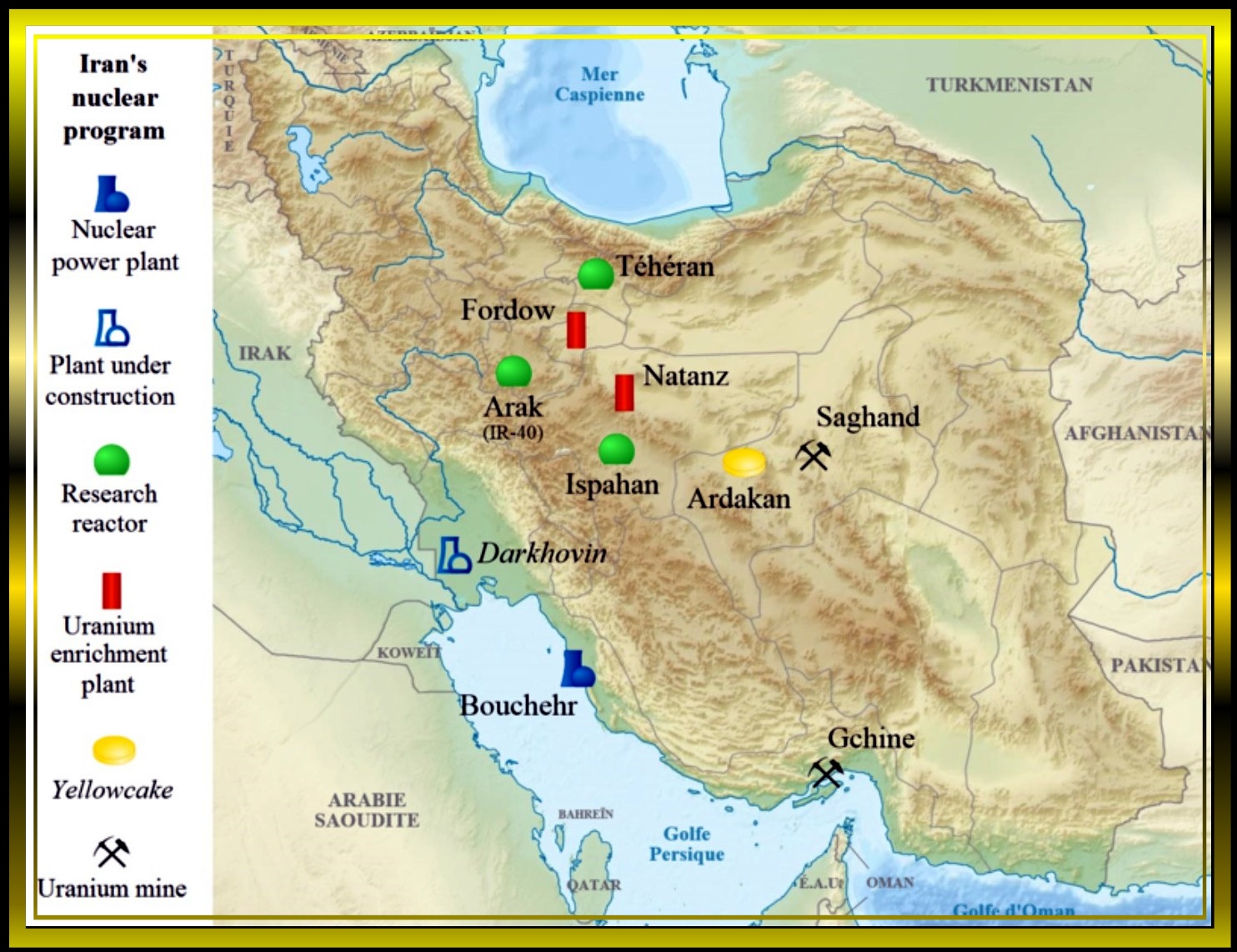
Iran's nuclear program is one of the most scrutinized nuclear programs in the world. While the Islamic Republic of Iran claims its program is for peaceful purposes, it has developed nuclear technologies that provide it the capability to develop a nuclear weapon within weeks if it decides to do so. According to experts, the military capabilities of the program are possible through its mass enrichment activities in facilities such as Natanz and Arak.
In June 2025, the International Atomic Energy Agency (IAEA) found Iran non-compliant with its nuclear obligations for the first time in 20 years.
Iran retaliated by launching a new enrichment site and installing advanced centrifuges.
Iran's nuclear program began in the 1950s under the Pahlavi dynasty with US support. It expanded in the 1970s with plans for power reactors, paused after the 1979 Islamic Revolution, and resumed secretly during the 1980s Iran–Iraq War. In the 1990s, Iran pursued a full nuclear fuel cycle and acquired centrifuge technology through illicit networks, including ties with Pakistan and North Korea. Undeclared enrichment sites at Natanz and Arak were exposed in 2002, and Fordow, an underground fuel enrichment site, was revealed in 2009.
CNN — Iran has warned it will ramp up its nuclear activities after the United Nations nuclear watchdog’s 35-member board of governors adopted a resolution Thursday declaring it in breach of its non-proliferation obligations.
Tehran retaliated by announcing the launch of a new uranium enrichment center and the installation of advanced centrifuges – an escalatory move likely to complicate nuclear talks with the United States set to resume this weekend.
Nations attending the International Atomic Energy Agency (IAEA) board meeting in Vienna voted on the resolution, with 19 in favor, 3 against and 11 abstentions, Reuters reported.
The IAEA has previously accused Iran of non-cooperation but Thursday’s move marks an official finding of non-compliance and raises the prospect of escalating the issue to the UN Security Council.
The resolution was tabled by European countries and the US after a May 31 IAEA report found Iran to be non-compliant in its nuclear duties, including failing to answer questions on uranium particles found in undeclared sites in the country, and its stockpiling of uranium enriched to nearly weapons grade. Iran says the IAEA report was politicized.
US withdraws some diplomats and military families from Middle East amid Iran tensions
Uranium is a nuclear fuel that, when highly enriched, can be used to make a bomb. Iran maintains that its nuclear program is for peaceful purposes.
Tehran condemned the US, the United Kingdom, France and Germany for tabling the resolution and said it has “no option but to respond.”
2025 United States–Iran negotiations
In January 2025, it was reported that Iran is developing long-range missile technology under the Islamic Revolutionary Guard Corps (IRGC), with some designs based on North Korean models. According to the National Council of Resistance of Iran (NCRI), these missiles, such as the Ghaem-100 and Simorgh, could carry nuclear warheads and reach targets as far as 3,000 km away, including parts of Europe.
In March 2025, U.S. President Donald Trump sent a letter to Iran seeking to reopen negotiations. Ayatollah Ali Khamenei later said, "Some bullying governments insist on negotiations not to resolve issues but to impose their own expectations," which was seen as in response to the letter.
In April 2025, Trump revealed that Iran had decided to undertake talks with the United States for an agreement over its nuclear program.
On 12 April, both countries held their first high-level meeting in Oman, followed by a second meeting on 19 April in Italy. On May 16, Trump sent Iran an offer and said they have to move quickly or else bad things would happen. On May 17, Khamenei condemned Trump, saying that he lied about wanting peace and that he was not worth responding to, calling the US demands "outrageous nonsense." Khamenei also reiterated that Israel is "cancerous tumour" that must be uprooted.
On May 31, 2025, IAEA reported that Iran had sharply increased its stockpile of uranium enriched to 60% purity, just below weapons-grade, reaching over 408 kilograms, a nearly 50% rise since February. The agency warned that this amount is enough for multiple nuclear weapons if further enriched. It also noted that Iran remains the only non-nuclear-weapon state to produce such material, calling the situation a "serious concern." In June 2025, the NCRI said Iran is pursuing nuclear weapons through a new program called the "Kavir Plan". According to the NCRI, the new project involves six sites in Semnan province working on warheads and related technology, succeeding the previous AMAD Project.
On June 10, Trump stated in that Iran was becoming "much more aggressive" in the negotiations.
On 11 June, the Iranian regime threatened US bases in the Middle East, with Defense Minister Aziz Nasirzadeh stating, "If a conflict is imposed on us... all US bases are within our reach, and we will boldly target them in host countries." The U.S. embassy in Iraq evacuated all personnel.[85][86][87] The Iran-backed Yemen-based Houthi movement threatened to attack the United States if a strike on Iran were to occur. CENTCOM presented a wide range of military options for an attack on Iran. UK issued threat advisory for ships on Arabian Gulf. U.S. Secretary of Defense Pete Hegseth told Congress that Iran was attempting a nuclear breakout.
On 12 June 2025, IAEA found Iran non-compliant with its nuclear obligations for the first time in 20 years. Iran retaliated by launching a new enrichment site and installing advanced centrifuges.
Natanz Nuclear Facility
Natanz, located about 220 km southeast of Tehran, is Iran's main uranium enrichment site. The facility includes an underground Fuel Enrichment Plant (FEP) housing large cascades of gas centrifuges, as well as a smaller Pilot Fuel Enrichment Plant (PFEP) above the ground. Iran has installed thousands of first-generation IR-1 centrifuges and more advanced models (IR-2m, IR-4, IR-6) here. As of 2025, Natanz is enriching uranium up to 60% U-235, a level approaching weapons-grade. Iran has also begun excavating a new enrichment hall deep under the adjacent Kūh-e Kolang Gaz Lā (“Pickaxe Mountain”) to harden the site against airstrikes.
In the past, the site saw multiple sabotage attacks (such as the Stuxnet cyberattack and unexplained explosions).
On 13 June 2025, the site was struck by Israeli airstrikes during Operation Rising Lion.
Fordow Fuel Enrichment Plant
Fordow (near the city of Qom, approximately 100 km southwest of Tehran) is an underground enrichment site built inside a mountain. Originally designed to host about 3,000 centrifuges, Fordow was revealed in 2009 and appears engineered to withstand airstrikes. It was re-purposed under the 2015 nuclear deal as a research facility with no enrichment, but Iran resumed enrichment at Fordow after 2019.
By 2025, Iran is using Fordow to enrich uranium up to 60% U-235 as well, deploying advanced IR-6 centrifuges. Fordow's smaller size and heavy fortification make it a particular proliferation concern. The IAEA still inspects Fordow, but Iran's suspension of the Additional Protocol means inspectors no longer have daily access.
In June 2025, Iran revealed plans to install advanced centrifuges at the facility.
Bushehr
Bushehr Nuclear Power Plant
Bushehr is Iran's only commercial nuclear power station, situated on the Persian Gulf coast in southern Iran. The site's first unit, a 1000 MWe pressurized water reactor (VVER-1000) built with Russian assistance, began operation in 2011–2013. Russia supplies the enriched fuel for Bushehr-1 and removes the spent fuel, an arrangement that minimizes proliferation risk. Iran is constructing two additional VVER-1000 reactors at Bushehr with Russian collaboration, slated to come online in the late 2020s. Bushehr is under full IAEA safeguards. Its operation is closely monitored by the Agency, and Iran, like any NPT party, must report and permit inspection of the reactor and its fuel.
Arak IR-40
Arak IR-40 complex, a heavy water reactor and production plant
Arak, about 250 km southwest of Tehran, is the site of Iran's IR-40 heavy water reactor and associated heavy water production plant. The 40 MW (thermal) reactor, still under construction, is designed to use natural uranium fuel and heavy water moderation, which would produce plutonium as a byproduct in the spent fuel. In its original configuration, the Arak reactor could have yielded enough plutonium for roughly 1–2 nuclear weapons per year if Iran built a reprocessing facility (which it does not have). Under the JCPOA, Iran agreed to halt work on Arak and redesign the reactor to a smaller, proliferation-resistant version. In January 2016, Iran removed and filled Arak’s original reactor core with concrete, disabling it. As of mid-2025, Iran, with international input, has been modifying the reactor design to limit its plutonium output, and the reactor has not yet become operational. A heavy water production plant at the Arak site continues to operate (25 tons/year capacity), supplying heavy water for the reactor and medical research; Iran's heavy water stockpile is under IAEA monitoring per its safeguards commitments.
Tehran Research Reactor (TRR)
Located in Tehran at the headquarters of the Atomic Energy Organization of Iran, the Tehran Research Reactor is a 5 MW pool-type research reactor. It was provided by the United States in 1967 as part of the "Atoms for Peace" program. Originally fueled with highly enriched uranium (HEU), the TRR was converted in 1987 to use 19.75% enriched uranium (LEU). The TRR is used to produce medical isotopes (such as molybdenum-99) and for scientific research. Its need for 20% LEU fuel became a point of contention when Iran's external fuel supply ran low in 2009, prompting the decision to enrich uranium to 20%.
By the
authority vested in me as President by the Constitution and the laws of the
United States of America, including the International Emergency Economic Powers
Act (50 U.S.C. 1701 et seq.), the National Emergencies Act
(50 U.S.C. 1601 et seq.), section 212(f) of the Immigration
and Nationality Act of 1952 (8 U.S.C. 1182(f)), and section 301 of title 3,
United States Code, it is hereby ordered:
Section1. Amendments to Executive Order 14144.
Executive Order 14144 of January 16, 2025 (Strengthening and Promoting
Innovation in the Nation’s Cybersecurity), is hereby amended by:
(a)
striking subsections 2(a)-(b) and redesignating subsections 2(c), 2(d), and
2(e) as subsections 2(a), 2(b), and 2(c), respectively;
(b)
striking the first sentence of subsection 2(e);
(c)
striking subsections 3(a)-(b) and redesignating subsections 3(c), 3(d), and
3(e) as subsections 3(a), 3(b), and 3(c), respectively;
(d)
striking from subsection 3(c) the phrase “In Executive Order 14028, I directed
the Secretary of Defense and the Secretary of Homeland Security to establish
procedures to immediately
share threat information to strengthen the
collective defense of Department of Defense and civilian networks.”;
(e)
striking from subsection 3(c)(i)(A) the word “novel”;
(f)
striking subsection 4(b)(iv);
(g)
striking subsections 4(d)(ii)-(iii);
(h)
striking section 5 and redesignating sections 6, 7, 8, 9, 10, and 11 as
sections 5, 6, 7, 8, 9, and 10, respectively; and
(i)
striking from subsection 8(c) the phrase “in the areas of intrusion detection,
use of hardware roots of trust for secure booting, and development and
deployment of security patches.”.
Sec. 2. Further
Amendments to Executive Order 14144. Executive Order 14144 is hereby
amended by:
(a)
striking section 1 and inserting, in lieu thereof, the following:
“Section 1.
Policy. Foreign nations and criminals continue to conduct cyber
campaigns targeting the United States and Americans. The People’s
Republic of China presents the most active and persistent cyber threat to
United States Government, private sector, and critical infrastructure
networks, but significant threats also emanate from Russia, Iran, North Korea,
and others who undermine United States cybersecurity. These campaigns
disrupt the delivery of critical services across the Nation, cost billions of
dollars, and undermine Americans’ security and privacy. More must be done
to improve the Nation’s cybersecurity against these threats. I am
ordering additional actions to improve our Nation’s cybersecurity, focusing on
defending our digital infrastructure, securing the services and capabilities
most vital to the digital domain, and building our capability to address key
threats.”;
(b)
striking subsection 2(c) and inserting, in lieu thereof, the following:
“(c)
Relevant executive departments and agencies (agencies) shall take the following
actions:
(i)
By August 1, 2025, the Secretary of Commerce, acting through the Director of
NIST, shall establish a consortium with industry at the National Cybersecurity
Center of Excellence to develop guidance, informed by the consortium as appropriate,
that demonstrates the implementation of secure software development, security,
and operations practices based on NIST Special Publication 800–218 (Secure
Software Development Framework (SSDF)).
(ii)
By September 2, 2025, the Secretary of Commerce, acting through the Director of
NIST, shall update NIST Special Publication 800–53 (Security and Privacy
Controls for Information Systems and Organizations) to provide guidance on
how to securely and reliably deploy patches and updates.
(iii)
By December 1, 2025, the Secretary of Commerce, acting through the Director of
NIST, in consultation with the heads of such agencies as the Director of NIST
deems appropriate, shall develop and publish a preliminary update to the SSDF.
This preliminary update shall include practices, procedures, controls,
and implementation examples regarding the secure and reliable development and
delivery of software as well as the security of the software itself.
Within 120 days of publishing the preliminary update, the Secretary of
Commerce, acting through the Director of NIST, shall publish a final version of
the updated SSDF.”;
(c)
striking from subsection 4(b) the phrase “The security of Internet traffic
depends on data being correctly routed and delivered to the intended recipient
network. Routing information originated and propagated across the
Internet, utilizing the Border Gateway Protocol (BGP), is vulnerable to attack
and misconfiguration.” and inserting, in lieu thereof, the following:
“Relevant
agencies shall take the following actions:”;
(d)
striking subsection 4(f) and inserting, in lieu thereof, the following:
“(f) A
quantum computer of sufficient size and sophistication — also known as a
cryptanalytically relevant quantum computer (CRQC) — will be capable of
breaking much of the public-key cryptography used on digital systems across the
United States and around the world. National Security Memorandum 10 of
May 4, 2022 (Promoting United States Leadership in Quantum Computing While
Mitigating Risks to Vulnerable Cryptographic Systems), directed the Federal
Government to prepare for a transition to cryptographic algorithms that would
not be vulnerable to a CRQC.
(i)
By December 1, 2025, the Secretary of Homeland Security, acting through the
Director of the Cybersecurity and Infrastructure Security Agency (CISA), and in
consultation with the Director of the National Security Agency, shall release
and thereafter regularly update a list of product categories in which products
that support post-quantum cryptography (PQC) are widely available.
(ii)
By December 1, 2025, to prepare for transition to PQC, the Director of the
National Security Agency with respect to National Security Systems (NSS), and
the Director of OMB with respect to non-NSS, shall each issue requirements for
agencies to support, as soon as practicable, but not later than January 2,
2030, Transport Layer Security protocol version 1.3 or a successor version.”;
(e)
striking former section 6 (newly designated section 5) and inserting, in lieu
thereof, the following:
“Sec. 5.
Promoting Security with and in Artificial Intelligence. Artificial
intelligence (AI) has the potential to transform cyber defense by rapidly
identifying vulnerabilities, increasing the scale of threat detection
techniques, and automating cyber defense.
(a) By
November 1, 2025, the Secretary of Commerce, acting through the Director of
NIST; the Secretary of Energy; the Secretary of Homeland Security, acting
through the Under Secretary for Science and Technology; and the Director of the
National Science Foundation shall ensure that existing datasets for cyber
defense research have been made accessible to the broader academic research
community (either securely or publicly) to the maximum extent feasible, in
consideration of business confidentiality and national security.
(b) By
November 1, 2025, the Secretary of Defense, the Secretary of Homeland Security,
and the Director of National Intelligence, in coordination with appropriate
officials within the Executive Office of the President, to include officials
within the Office of Science and Technology Policy, the Office of the National
Cyber Director, and the Director of OMB, shall incorporate management of AI
software vulnerabilities and compromises into their respective agencies’
existing processes and interagency coordination mechanisms for vulnerability
management, including through incident tracking, response, and reporting, and
by sharing indicators of compromise for AI systems.”;
(f)
striking section 7 and inserting, in lieu thereof, the following:
“Sec. 7.
Aligning Policy to Practice. Agencies’ policies must align
investments and priorities to improve network visibility and security controls
to reduce cyber risks. In consultation with the National Cyber Director,
agencies shall take the following actions:
(a)
Within 3 years of the date of this order, the Director of OMB shall issue
guidance, including any necessary revision to OMB Circular A–130, to address
critical risks and adapt modern practices and architectures across Federal
information systems and networks.
(b)
Within 1 year of the date of this order, the Secretary of Commerce, acting
through the Director of NIST; the Secretary of Homeland Security, acting
through the Director of CISA; and the Director of OMB shall establish a pilot
program of a rules-as- code approach for machine-readable versions of policy
and guidance that OMB, NIST, and CISA publish and manage regarding
cybersecurity.
(c)
Within 1 year of the date of this order, agency members of the FAR Council
shall, as appropriate and consistent with applicable law, jointly take steps to
amend the FAR to adopt requirements for agencies to, by January 4, 2027,
require vendors to the Federal Government of consumer Internet-of-Things
products, as defined by 47 CFR 8.203(b), to carry United States Cyber Trust
Mark labeling for those products.”; and
(g)
striking subsection 8(a) and inserting, in lieu thereof, the following:
“(a)
Except as specifically provided for in subsection 4(f) of this order,
sections 1 through 7 of this order shall not apply to Federal information
systems that are NSS or are otherwise identified by the Department of Defense
or the Intelligence Community as debilitating impact systems.”.
Sec. 3. Amendments
to Executive Order 13694. Executive Order 13694 of April 1, 2015
(Blocking the Property of Certain Persons Engaging in Significant Malicious
Cyber-Enabled Activities), as amended by Executive Order 13757 of December 28,
2016 (Taking Additional Steps to Address the National Emergency With Respect to
Significant Malicious Cyber-Enabled Activities), Executive Order 13984 of
January 19, 2021 (Taking Additional Steps to Address the National Emergency
With Respect to Significant Malicious Cyber-Enabled Activities), and Executive
Order 14144, is hereby further amended by:
(a)
striking from subsection 1(a)(ii) the phrase “any person” and inserting in lieu
thereof “any foreign person”; and
(b)
striking from subsection 1(a)(iii) the phrase “any person” and inserting in
lieu thereof “any foreign person.”.
Sec. 4. General
Provisions. (a) Nothing in this order shall be construed to
impair or otherwise affect:
(i)
the authority granted by law to an executive department or agency, or the head
thereof; or
(ii)
the functions of the Director of OMB relating to budgetary, administrative, or
legislative proposals.
(b)
This order shall be implemented in a manner consistent with applicable
law and subject to the availability of appropriations.
(c)
This order is not intended to, and does not, create any right or benefit,
substantive or procedural, enforceable at law or in equity by any party against
the United States, its departments, agencies, or entities, its officers,
employees, or agents, or any other person.
(d)
The costs for publication of this order shall be borne by the Department
of Homeland Security.
COMBATING
TERRORISM THROUGH COMMON SENSE SECURITY STANDARDS: Today, President Donald J.
Trump signed a Proclamation to protect the nation from foreign terrorist and
other national security and public safety threats from entry into the United
States.
Pursuant to President Trump’s
Executive Order 14161, issued on January 20, 2025, titled “Protecting the
United States from Foreign Terrorists and Other National Security and
Public Safety Threats,” national security agencies engaged in a robust
assessment of the risk that countries posed to the United States,
including regarding terrorism and national security.
In Trump v. Hawaii,
the Supreme Court upheld the President’s authority to use section 212(f)
of the Immigration and Nationality Act to protect the United States
through entry restrictions.
The Proclamation fully restricts
and limits the entry of nationals from 12 countries found to be deficient
with regards to screening and vetting and determined to pose a very high
risk to the United States: Afghanistan, Burma, Chad, Republic of the Congo,
Equatorial Guinea, Eritrea, Haiti, Iran, Libya, Somalia, Sudan, and Yemen.
The Proclamation partially
restricts and limits the entry of nationals from 7 countries who also pose
a high level of risk to the United States: Burundi, Cuba, Laos, Sierra
Leone, Togo, Turkmenistan, and Venezuela.
The Proclamation includes
exceptions for lawful permanent residents, existing visa holders, certain
visa categories, and individuals whose entry serves U.S. national
interests.
SECURING
OUR BORDERS AND INTERESTS: The restrictions and limitations imposed by the Proclamation are
necessary to garner cooperation from foreign governments, enforce our
immigration laws, and advance other important foreign policy, national
security, and counterterrorism objectives.
It is the President’s sacred
duty to take action to ensure that those seeking to enter our country will
not harm the American people.
After evaluating a report
submitted by the Secretary of State, in coordination with other cabinet
officials, President Trump has determined that the entry of nationals from
certain countries must be restricted or limited to protect U.S. national
security and public safety interests.
The restrictions are
country-specific in order to encourage cooperation with the subject
countries in recognition of each country’s unique circumstances.
Some of the named countries have
inadequate screening and vetting processes, hindering America’s ability to
identify potential security threats before entry.
Certain countries exhibit high
visa overstay rates, demonstrating a disregard for U.S. immigration laws
and increasing burdens on enforcement systems.
Other countries lack cooperation
in sharing identity and threat information, undermining effective U.S.
immigration vetting.
Some countries have a
significant terrorist presence or state-sponsored terrorism, posing direct
risks to U.S. national security.
Several countries have
historically failed to accept back their removable nationals, complicating
U.S. efforts to manage immigration and public safety.
MAKING
AMERICA SAFE AGAIN: President
Trump is keeping his promise to restore the travel ban and secure our borders.
President Trump: “We will
restore the travel ban, some people call it the Trump travel ban, and keep
the radical Islamic terrorists out of our country that was upheld by the
Supreme Court.”
In his first term, President
Trump successfully implemented a travel ban that restricted entry from
several countries with inadequate vetting processes or significant
security risks.
The Supreme Court upheld the travel
ban, ruling that it “is squarely within the scope of Presidential
authority” and noting that it is “expressly premised on legitimate
purposes.”
This Proclamation builds on
President Trump’s first-term travel ban, incorporating an updated
assessment of current global screening, vetting, and security risks.
JUSTIFICATION
FOR FULL SUSPENSION BY COUNTRY
Afghanistan
The Taliban, a Specially
Designated Global Terrorist (SDGT) group, controls Afghanistan.
Afghanistan lacks a competent or cooperative central authority for issuing
passports or civil documents and it does not have appropriate screening
and vetting measures. According to the Fiscal Year 2023 Department
of Homeland Security (DHS) Entry/Exit Overstay Report (“Overstay Report”),
Afghanistan had a business/tourist (B1/B2) visa overstay rate of 9.70
percent and a student (F), vocational (M), and exchange visitor (J) visa
overstay rate of 29.30 percent.
Burma
According to the Overstay
Report, Burma had a B1/B2 visa overstay rate of 27.07 percent and an F, M,
and J visa overstay rate of 42.17 percent. Additionally, Burma has
historically not cooperated with the United States to accept back their
removable nationals.
Chad
According to the Overstay
Report, Chad had a B1/B2 visa overstay rate of 49.54 percent and an F, M,
and J visa overstay rate of 55.64 percent. According to the Fiscal
Year 2022 Overstay Report, Chad had a B1/B2 visa overstay rate of 37.12
percent. The high visa overstay rate for 2022 and 2023 is
unacceptable and indicates a blatant disregard for U.S. immigration
laws.
Republic
of the Congo
According to the Overstay
Report, the Republic of the Congo had a B1/B2 visa overstay rate of 29.63
percent and an F, M, and J visa overstay rate of 35.14 percent.
Equatorial
Guinea
According to the Overstay
Report, Equatorial Guinea had a B1/B2 visa overstay rate of 21.98 percent
and an F, M, and J visa overstay rate of 70.18 percent.
Eritrea
The United States questions the
competence of the central authority for issuance of passports or civil
documents in Eritrea. Criminal records are not available to the United
States for Eritrean nationals. Eritrea has historically refused to
accept back its removable nationals. According to the Overstay
Report, Eritrea had a B1/B2 visa overstay rate of 20.09 percent and an F,
M, and J visa overstay rate of 55.43 percent.
Haiti
According to the Overstay
Report, Haiti had a B1/B2 visa overstay rate of 31.38 percent and an F, M,
and J visa overstay rate of 25.05 percent. Additionally, hundreds of
thousands of illegal Haitian aliens flooded into the United States during
the Biden Administration. This influx harms American communities by
creating acute risks of increased overstay rates, establishment of
criminal networks, and other national security threats. As is widely
known, Haiti lacks a central authority with sufficient availability and
dissemination of law enforcement information necessary to ensure its
nationals do not undermine the national security of the United
States.
Iran
Iran is a state sponsor of
terrorism. Iran regularly fails to cooperate with the United States
Government in identifying security risks, is the source of significant
terrorism around the world, and has historically failed to accept back its
removable nationals.
Libya
There is no competent or
cooperative central authority for issuing passports or civil documents in
Libya. The historical terrorist presence within Libya’s territory
amplifies the risks posed by the entry into the United States of its
nationals.
Somalia
Somalia lacks a competent or
cooperative central authority for issuing passports or civil documents and
it does not have appropriate screening and vetting measures. Somalia
stands apart from other countries in the degree to which its government
lacks command and control of its territory, which greatly limits the
effectiveness of its national capabilities in a variety of respects.
A persistent terrorist threat also emanates from Somalia’s
territory. The United States Government has identified Somalia as a
terrorist safe haven. Terrorists use regions of Somalia as safe
havens from which they plan, facilitate, and conduct their
operations. Somalia also remains a destination for individuals
attempting to join terrorist groups that threaten the national security of
the United States. The Government of Somalia struggles to provide
governance needed to limit terrorists’ freedom of movement.
Additionally, Somalia has historically refused to accept back its
removable nationals.
Sudan
Sudan lacks a competent or
cooperative central authority for issuing passports or civil documents and
it does not have appropriate screening and vetting measures.
According to the Overstay Report, Sudan had a B1/B2 visa overstay rate of
26.30 percent and an F, M, and J visa overstay rate of 28.40
percent.
Yemen
Yemen lacks a competent or
cooperative central authority for issuing passports or civil documents and
it does not have appropriate screening and vetting measures. The
government does not have physical control over its own territory.
Since January 20, 2025, Yemen has been the site of active U.S. military
operations.
JUSTIFICATION
FOR PARTIAL SUSPENSION BY COUNTRY (Immigrants and Nonimmigrants on B-1, B-2,
B-1/B-2, F, M, and J Visas)
Burundi
According to the Overstay
Report, Burundi had a B1/B2 visa overstay rate of 15.35 percent and an F,
M, and J visa overstay rate of 17.52 percent.
Cuba
Cuba is a state sponsor of
terrorism. The Government of Cuba does not cooperate or share
sufficient law enforcement information with the United States. Cuba
has historically refused to accept back its removable nationals.
According to the Overstay Report, Cuba had a B1/B2 visa overstay rate of
7.69 percent and a F, M, and J visa overstay rate of 18.75 percent.
Laos
According to the Overstay
Report, Laos had a B1/B2 visa overstay rate of 34.77 percent and a F, M,
and J visa overstay rate of 6.49 percent. Laos has historically
failed to accept back its removable nationals.
Sierra
Leone
According to the Overstay
Report, Sierra Leone had a B1/B2 visa overstay rate of 15.43 percent and a
F, M, and J visa overstay rate of 35.83 percent. Sierra Leone has
historically failed to accept back its removable nationals.
Togo
According to the Overstay
Report, Togo had a B1/B2 visa overstay rate of 19.03 percent and a F, M,
and J visa overstay rate of 35.05 percent.
Turkmenistan
According to the Overstay
Report, Turkmenistan had a B1/B2 visa overstay rate of 15.35 percent and a
F, M, and J visa overstay rate of 21.74 percent.
Venezuela
Venezuela lacks a competent or
cooperative central authority for issuing passports or civil documents and
it does not have appropriate screening and vetting measures.
Venezuela has historically refused to accept back its removable
nationals. According to the Overstay Report, Venezuela had a B1/B2
visa overstay rate of 9.83 percent.
President Trump Holds Bilateral Meeting with Prime Minister Benjamin Netanyahu White House. Apr. 7, 2025
President Trump held a Bilateral meeting with Israeli Prime Minister Benjamin Netanyahu, where he proposed a bold vision for securing a lasting peace in Gaza.
President Trump secured Israel’s end of war in Gaza ultimatum demanding the safe return of the remaining hostages held by Hamas.
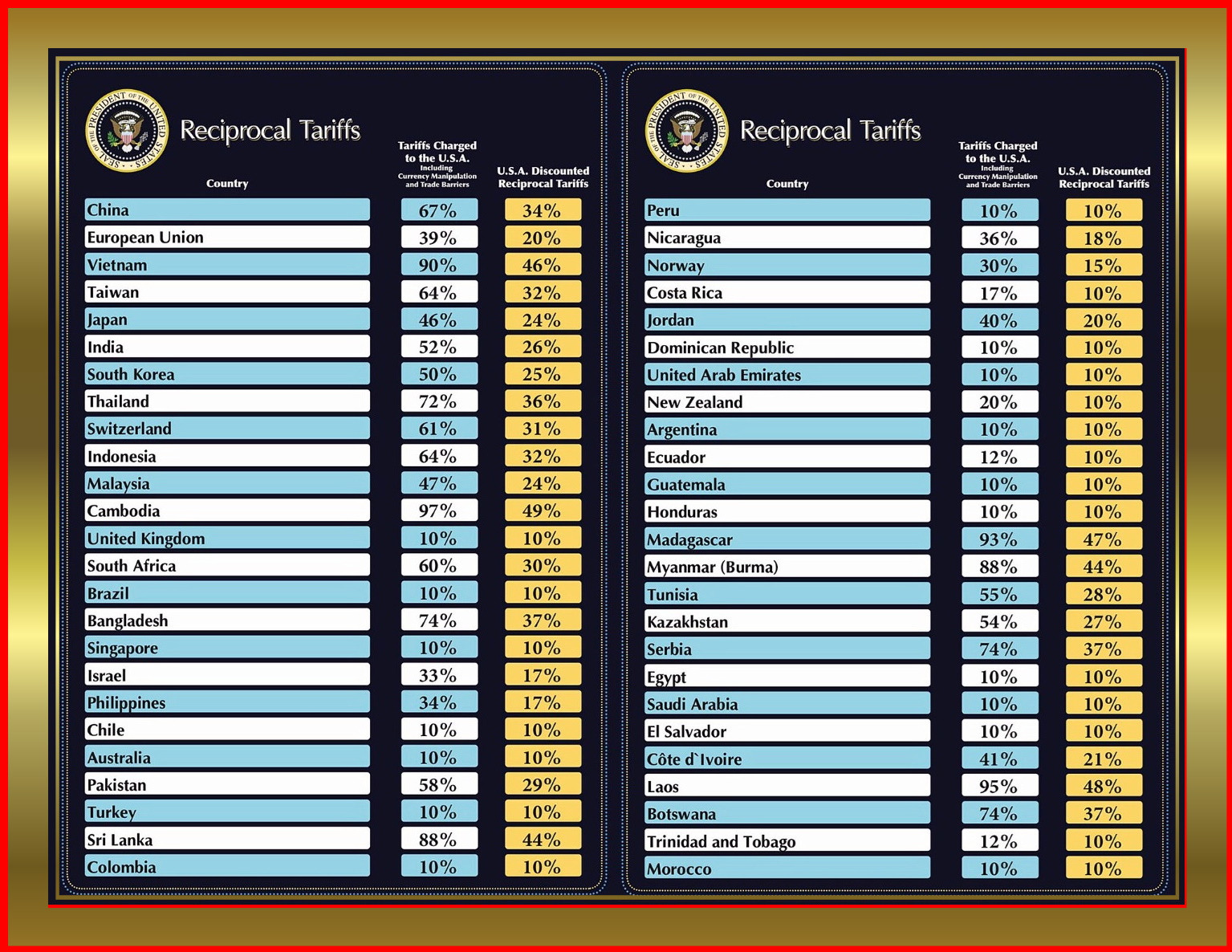
Prime Minister Benjamin Netanyahu: We will eliminate the trade deficit with the United States we intend to do it very quickly we think it's the right thing to do and we're going to also eliminate trade barriers a variety of trade barriers that have been put up unnecessarily.
And I think Israel can serve as a model for many countries that should do the same.
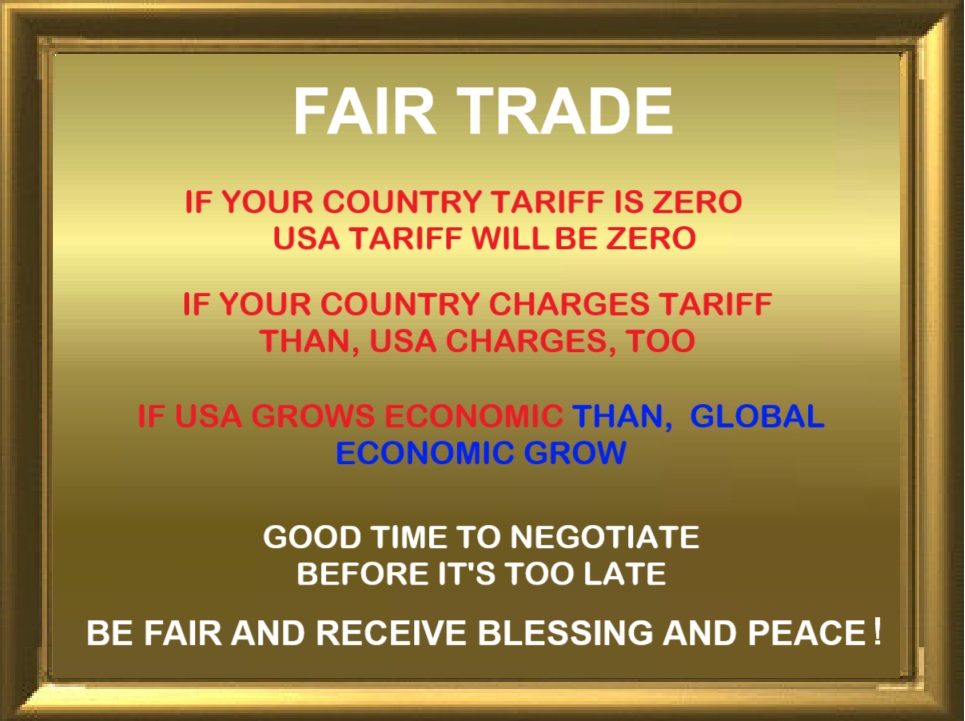
I recognize the position of the United States it says you know we're allowing other countries to put tariffs on us but we don't put tariffs on them.
And you know I'm a free-trade champion and free trade has to be fair trade and I think that's basically the position that you have put forward Mr. President, We are going to eliminate the tariffs and rapidly I had the opportunity to speak to Secretary Lutnik yesterday we talked about how we could affect this quickly and I hope to bring a solution very quickly.
We are not talking about intentions. We are not talking about words. We are talking about results. And those results are going to come.
That's the first.
President Trump: Thank you very much that's very nice! Thank you!
Addressing Egregious Actions of
The Republic of South Africa
EXECUTIVE ORDER
February 7, 2025
By the authority vested in me as President by the
Constitution and the laws of the United States of America, it is hereby ordered
as follows:
Section 1.Purpose. In shocking
disregard of its citizens’ rights, the Republic of South Africa (South Africa)
recently enacted Expropriation Act 13 of 2024 (Act), to enable the government
of South Africa to seize ethnic minority Afrikaners’ agricultural property
without compensation. This Act follows countless government policies
designed to dismantle equal opportunity in employment, education, and business,
and hateful rhetoric and government actions fueling disproportionate violence
against racially disfavored landowners.
In addition, South Africa has taken aggressive positions towards the United
States and its allies, including accusing Israel, not Hamas, of genocide in the
International Court of Justice, and reinvigorating its relations with Iran to
develop commercial, military, and nuclear arrangements.
The United States cannot support the government of South
Africa’s commission of rights violations in its country or its ‘undermining
United States foreign policy, which poses national security threats to our
Nation, our allies, our African partners, and our interests.
Sec. 2.Policy. It is the policy of
the United States that, as long as South Africa continues these unjust and
immoral practices that harm our Nation:
(a) the United States shall not
provide aid or assistance to South Africa; and
(b) the United States shall
promote the resettlement of Afrikaner refugees escaping government-sponsored
race-based discrimination, including racially discriminatory property
confiscation.
Sec. 3. Assistance. (a) All executive
departments and agencies (agencies), including the United States Agency for
International Development, shall, to the maximum extent allowed by law, halt
foreign aid or assistance delivered or provided to South Africa, and shall
promptly exercise all available authorities and discretion to halt such aid or
assistance.
(b) The head of each agency may
permit the provision of any such foreign aid or assistance that, in the
discretion of the relevant agency head, is necessary or appropriate.
Sec. 4. Refugee Resettlement and Other Humanitarian
Considerations. The Secretary of State and the Secretary of Homeland
Security shall take appropriate steps, consistent with law, to prioritize
humanitarian relief, including admission and resettlement through the United
States Refugee Admissions Program, for Afrikaners in South Africa who are
victims of unjust racial discrimination. Such plan shall be submitted to
the President through the Assistant to the President and Homeland Security
Advisor.
Sec. 5. General Provisions. (a) Nothing
in this order shall be construed to impair or otherwise affect:
(i) the authority granted
by law to an executive department or agency, or the head thereof; or
(ii) the functions of the
Director of the Office of Management and Budget relating to budgetary,
administrative, or legislative proposals.
(b) This order shall be implemented consistent with
applicable law and subject to the availability of appropriations.
(c) This order is not intended to, and does not,
create any right or benefit, substantive or procedural, enforceable at law or
in equity by any party against the United States, its departments, agencies, or
entities, its officers, employees, or agents, or any other person.
White House, FOX NEWS, ABC NEWS, MBC, DW, YAHOO, CNN18, wikipedia, sky News, GNO, Washington Post, Forbes, X News, IAEA, CNN, The times of Israel, CNN, CIA,TRUTH
February 7th,, Rev. February 11th, 2025 , April 7, 2025, Rev. April 8th, 2025, June, 14, 2025, July 8, 2025, Rev. July 10th, 2025
Catch4all.com
is proud to provide positive websites for the communities and for
the positive viewers from all over the world.....
.jpeg)
.jpeg)
.jpeg)
.jpeg)

.jpeg', 'nph_window', 'width=800,height=600,toolbar=no,menubar=no,status=no,scrollbars=yes,resizable=yes'))
.jpeg', 'nph_window', 'width=800,height=600,toolbar=no,menubar=no,status=no,scrollbars=yes,resizable=yes'))
.jpeg', 'nph_window', 'width=800,height=600,toolbar=no,menubar=no,status=no,scrollbars=yes,resizable=yes'))
.jpeg', 'nph_window', 'width=800,height=600,toolbar=no,menubar=no,status=no,scrollbars=yes,resizable=yes'))
.jpeg', 'nph_window', 'width=800,height=600,toolbar=no,menubar=no,status=no,scrollbars=yes,resizable=yes'))
.jpeg', 'nph_window', 'width=800,height=600,toolbar=no,menubar=no,status=no,scrollbars=yes,resizable=yes'))
.jpeg', 'nph_window', 'width=800,height=600,toolbar=no,menubar=no,status=no,scrollbars=yes,resizable=yes'))
.jpeg', 'nph_window', 'width=800,height=600,toolbar=no,menubar=no,status=no,scrollbars=yes,resizable=yes'))
.jpeg', 'nph_window', 'width=800,height=600,toolbar=no,menubar=no,status=no,scrollbars=yes,resizable=yes'))
.jpeg', 'nph_window', 'width=800,height=600,toolbar=no,menubar=no,status=no,scrollbars=yes,resizable=yes'))
.jpeg', 'nph_window', 'width=800,height=600,toolbar=no,menubar=no,status=no,scrollbars=yes,resizable=yes'))
.jpeg', 'nph_window', 'width=800,height=600,toolbar=no,menubar=no,status=no,scrollbars=yes,resizable=yes'))
.jpeg', 'nph_window', 'width=800,height=600,toolbar=no,menubar=no,status=no,scrollbars=yes,resizable=yes'))
.jpeg', 'nph_window', 'width=800,height=600,toolbar=no,menubar=no,status=no,scrollbars=yes,resizable=yes'))
.jpeg', 'nph_window', 'width=800,height=600,toolbar=no,menubar=no,status=no,scrollbars=yes,resizable=yes'))
.jpeg', 'nph_window', 'width=800,height=600,toolbar=no,menubar=no,status=no,scrollbars=yes,resizable=yes'))
.jpeg', 'nph_window', 'width=800,height=600,toolbar=no,menubar=no,status=no,scrollbars=yes,resizable=yes'))
.jpeg', 'nph_window', 'width=800,height=600,toolbar=no,menubar=no,status=no,scrollbars=yes,resizable=yes'))
.jpeg', 'nph_window', 'width=800,height=600,toolbar=no,menubar=no,status=no,scrollbars=yes,resizable=yes'))
.jpeg', 'nph_window', 'width=800,height=600,toolbar=no,menubar=no,status=no,scrollbars=yes,resizable=yes'))
.jpeg', 'nph_window', 'width=800,height=600,toolbar=no,menubar=no,status=no,scrollbars=yes,resizable=yes'))
.jpeg', 'nph_window', 'width=800,height=600,toolbar=no,menubar=no,status=no,scrollbars=yes,resizable=yes'))
.jpeg', 'nph_window', 'width=800,height=600,toolbar=no,menubar=no,status=no,scrollbars=yes,resizable=yes'))
.jpeg', 'nph_window', 'width=800,height=600,toolbar=no,menubar=no,status=no,scrollbars=yes,resizable=yes'))
.jpeg', 'nph_window', 'width=800,height=600,toolbar=no,menubar=no,status=no,scrollbars=yes,resizable=yes'))
.jpeg', 'nph_window', 'width=800,height=600,toolbar=no,menubar=no,status=no,scrollbars=yes,resizable=yes'))
.jpeg', 'nph_window', 'width=800,height=600,toolbar=no,menubar=no,status=no,scrollbars=yes,resizable=yes'))
.jpeg', 'nph_window', 'width=800,height=600,toolbar=no,menubar=no,status=no,scrollbars=yes,resizable=yes'))
.jpeg', 'nph_window', 'width=800,height=600,toolbar=no,menubar=no,status=no,scrollbars=yes,resizable=yes'))
.jpeg', 'nph_window', 'width=800,height=600,toolbar=no,menubar=no,status=no,scrollbars=yes,resizable=yes'))
.jpeg', 'nph_window', 'width=800,height=600,toolbar=no,menubar=no,status=no,scrollbars=yes,resizable=yes'))
.jpeg', 'nph_window', 'width=800,height=600,toolbar=no,menubar=no,status=no,scrollbars=yes,resizable=yes'))
.jpeg', 'nph_window', 'width=800,height=600,toolbar=no,menubar=no,status=no,scrollbars=yes,resizable=yes'))
.jpeg', 'nph_window', 'width=800,height=600,toolbar=no,menubar=no,status=no,scrollbars=yes,resizable=yes'))
.jpeg', 'nph_window', 'width=800,height=600,toolbar=no,menubar=no,status=no,scrollbars=yes,resizable=yes'))
.jpeg', 'nph_window', 'width=800,height=600,toolbar=no,menubar=no,status=no,scrollbars=yes,resizable=yes'))
.jpeg', 'nph_window', 'width=800,height=600,toolbar=no,menubar=no,status=no,scrollbars=yes,resizable=yes'))

)
)
)
)
)
)
)
)
)
)
)
)
)
)
)
)
)
)
)
)
)
)
)
)
)
)
)
)
)
)
)
)
)
)
)
)
)
)
)
)
)
)
)
)
)
)
)
)
)
)
)
)
)
)
)
)