.

    The Government of the United States of America, represented by the Office of Science and Technology Policy, and the Government of Japan, represented by the Cabinet Office of Japan for the purposes of Science and Technology Policy (hereinafter referred to collectively as the “Participants”);

    Expressing mutual interest in science and technology capabilities and standards to usher in the next Golden Age of Innovation to fortify freedom and prosperity for generations to come;
    Affirming the value of bilateral science and technology collaboration to enrich the lives and livelihoods of citizens in both countries;

    Recognizing that the rapid advancement of cutting-edge science and technology – including artificial intelligence (AI), quantum technology, and biotechnology – has strategic implications for the future prosperity of our respective nations and underscores the importance of bilateral cooperation in these fields;

    Noting the longstanding collaboration established under the existing Agreement between the Government of the United States of America and the Government of Japan on Cooperation in Research and Development in Science and Technology;

    Recognizing also the importance of deepening ties in science and technology with strategic partners across the Indo-Pacific as a means to strengthen stability in the region.

    Have reached the following recognition:

    I. Purpose
    The purpose of this Memorandum of Cooperation (hereinafter “MOC”) is to strengthen collaboration towards joint opportunities of mutual interest in strategic science and technology disciplines.

    II. Areas of Cooperation
    The Participants intend to collaborate in a number of disciplines, including but not limited to the following:

    Accelerating AI Adoption and Innovation

    AI promises a new Golden Age of Innovation by empowering individuals and supercharging progress across sectors like healthcare, biotechnology, and education. The Participants intend to collaborate closely on promoting pro-innovation AI policy frameworks, promoting exports across our full AI stack, ensuring the rigorous enforcement of existing protection measures while acknowledging the importance of strengthening such measures related to critical and emerging technologies, advancing shared work on industry standards, and safeguarding our children’s digital wellbeing, with a shared commitment to promoting a secure and trustworthy AI ecosystem in a mutually beneficial manner. Focus areas for collaboration are intended to include:

    • Driving innovative research to accelerate the application of AI for science, industry, and society through use-inspired initiatives supported by the U.S. National Science Foundation, Japan Science and Technology Agency, Japan Society for the Promotion of Science, RIKEN, and other relevant research institutions and funders;
       
    • Deepening cooperation to advance high-performance computing, leading-edge semiconductor technologies, and quantum computing that underpin the AI era to enhance the foundational infrastructure essential for AI performance and applications;
       
    • Advancing pro-innovation AI policy frameworks and initiatives to support the adoption of a U.S. and Japan-led AI technology ecosystem;
       
    • Promoting exports across the full stack of U.S. and Japanese AI infrastructure, hardware, models, software, applications, and related standards;
       
    • Partnering to ensure the rigorous enforcement of existing protection measures, strengthen protection measures related to critical and sensitive technologies, and enhance supply chain resilience for the AI tech stack;
       
    • Promoting mutual understanding of guidelines and frameworks for AI development and adoption from the respective Participants, with the goal of harmonizing practices as applicable to encourage interoperability;
       
    • Advancing and refocusing the partnership between the U.S. Center for AI Standards and Innovation and the Japan AI Safety Institute towards a shared mission to promote AI innovation by fostering a secure and trustworthy AI ecosystem, including through working towards best practices in metrology for AI and industry standards development, improving understanding of both advanced AI models and sector-specific applications to drive continued AI adoption; and
       
    • Promoting education, innovation, and technology for children to flourish in the digital era and preparing future generations for the workplace of tomorrow.

    Trusted Technology Leadership
    The Participants intend to enhance longstanding collaboration on key technologies and practices to enable technology leadership in the global arena, including:

    • Research Security
      Recognizing the importance of shared research security goals across critical and emerging technology research and development, the Participants intend to deepen collaboration to protect their technologies and their people. The Participants intend to collaborate on research security and identify and mitigate threats to the research enterprise including through supporting capacity building for universities, research organizations, and industry; and collaborating with allies and partners to share similarly rigorous practices to facilitate a trusted ecosystem of innovation.
       
    • Advanced Radio Access Networks, Beyond 5G/6G, and Connectivity
      Expanding their partnership in telecommunications innovation and supply chain resilience, the Participants intend to collaborate on building a trusted, interoperable supply chain, using advancements such as Open RAN and AI-RAN, through a partnership between the U.S. National Telecommunications and Information Administration and Japan’s Ministry of Internal Affairs and Communications. Participants also intend to collaborate on all-photonics networks and quantum networks, and to enable joint research and development in Beyond 5G/6G-relevant technologies through the U.S. National Science Foundation and Japan’s National Institute of Information and Communications Technology, and other relevant agencies. This work is intended to be supported by joint efforts in standards bodies and in close partnership with industry, including in open testbeds, to shape global telecommunications standards with the Participants’ shared priorities and accelerate trusted technology solutions to market. Recognizing Japan’s critical role as a connectivity hub between North America and Asia, the Participants intend to expand ongoing collaboration on submarine cables in the Indo-Pacific region.
       
    • Securing Pharmaceutical and Biotechnology Supply Chains
      Highlighting the need to secure their mutual pharmaceutical and biotechnology supply chains, intellectual property, and innovation ecosystem, the Participants intend to accelerate progress towards the identification and remediation of vulnerabilities. The Participants intend to collaborate on supply chain security throughout all phases of development and across academic, government, and industry stakeholders, including contract research organizations and contract development and manufacturing organizations, to support resilient and healthy economies.
       
    • Quantum Information Science and Technology (QIST)
      Recognizing the universe of possibilities that quantum technologies unlock, the Participants intend to collaborate through leading quantum institutions and national laboratories to assess quantum performance, develop quantum algorithms, overcome challenges for quantum technologies in real-world environments, and enable scientific discovery. The Participants also intend to support the development of the next generation of scientists and engineers. These activities are expected to be supported by aligning efforts in securing technology and supply chains to build a trusted ecosystem for the research, development, and adoption of new quantum technologies.
       
    • Unlocking the Promise of Fusion Energy
      Appreciating the potential for fusion technologies to deliver safe, resilient, and abundant energy, the Participants intend to work together to facilitate a world-leading fusion industrial ecosystem. Areas of collaboration include supply chains for magnets and high-power components, fusion fuel cycle and blanket integration systems, neutronics modeling, and fusion materials. Participants intend to collaborate on fusion research and development, including the JT-60SA test facility, with the goal of supporting the commercial development and deployment of fusion reactors.
       
    • Space
      Recognizing that research and development investments in space, including building capacity for human missions to the Moon and Mars, contribute to civilian mission needs, the Participants intend to continue their strong partnership in civil space and on aeronautics, science, and human exploration. Areas of collaboration include the International Space Station, future Artemis lunar surface exploration missions, and supporting enhancement of commercial space. The Participants intend to encourage further collaborative efforts to mitigate and remediate orbital debris and improve global coordination on space situational awareness.

    III. Legal Character
    This MOC does not create legally binding rights and obligations under domestic laws of either the United States and Japan or under international law. Nothing in this MOC is intended to affect any existing agreements between the Participants. Cooperation under this MOC is intended to take place within the respective legal framework. Nothing in this MOC commits the Participants to the expenditure of funds. Each of the United States and Japan declares their intention to abide by their respective domestic laws and international law.

    IV. Modification and Discontinuation
    This MOC becomes operative when both Participants have signed. The Participants may modify this MOC by written decision of both Participants. Either Participant may discontinue this MOC and in such case should provide written notice of discontinuation to the other Participant. The discontinuation is expected to commence on a date mutually determined by the Participants or, if the Participants cannot mutually determine a date, 180 days after the date on which notice of discontinuation is delivered.

    The foregoing represents the recognition reached between the Participants on the matters referred to in this MOC.

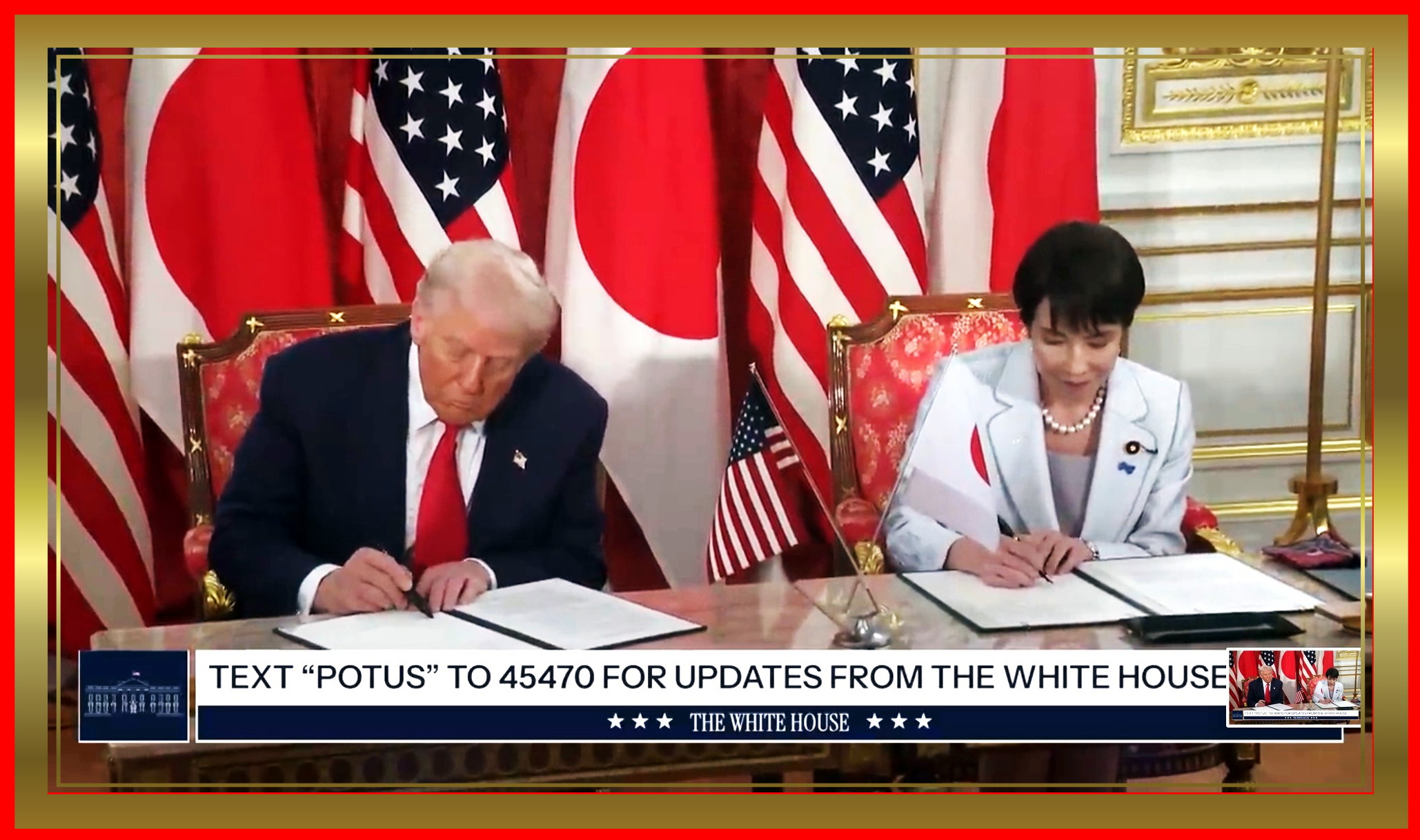
    Signed at Tokyo on October 28, 2025, in duplicate, in the English language.

    ------------------------------------------------------

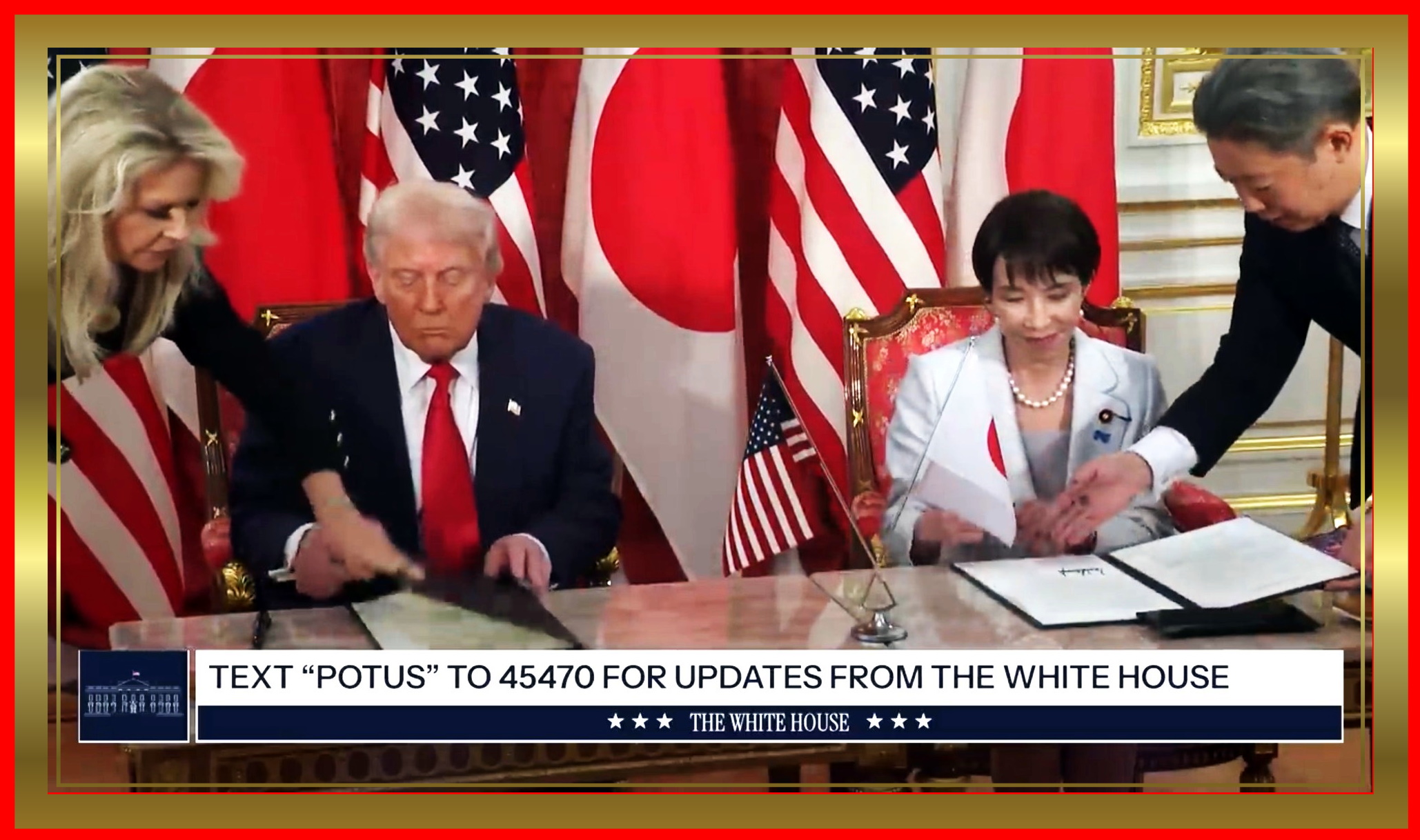
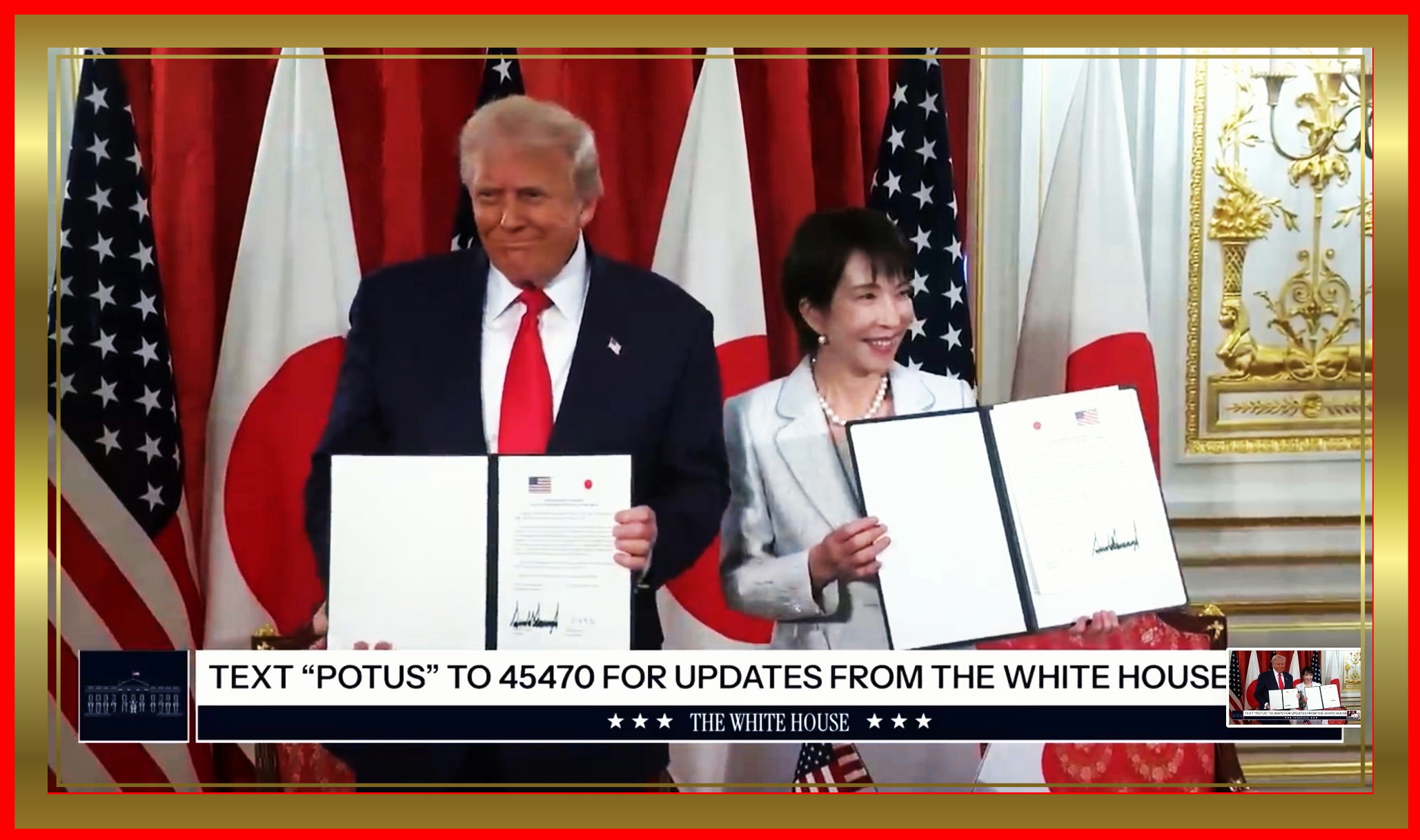
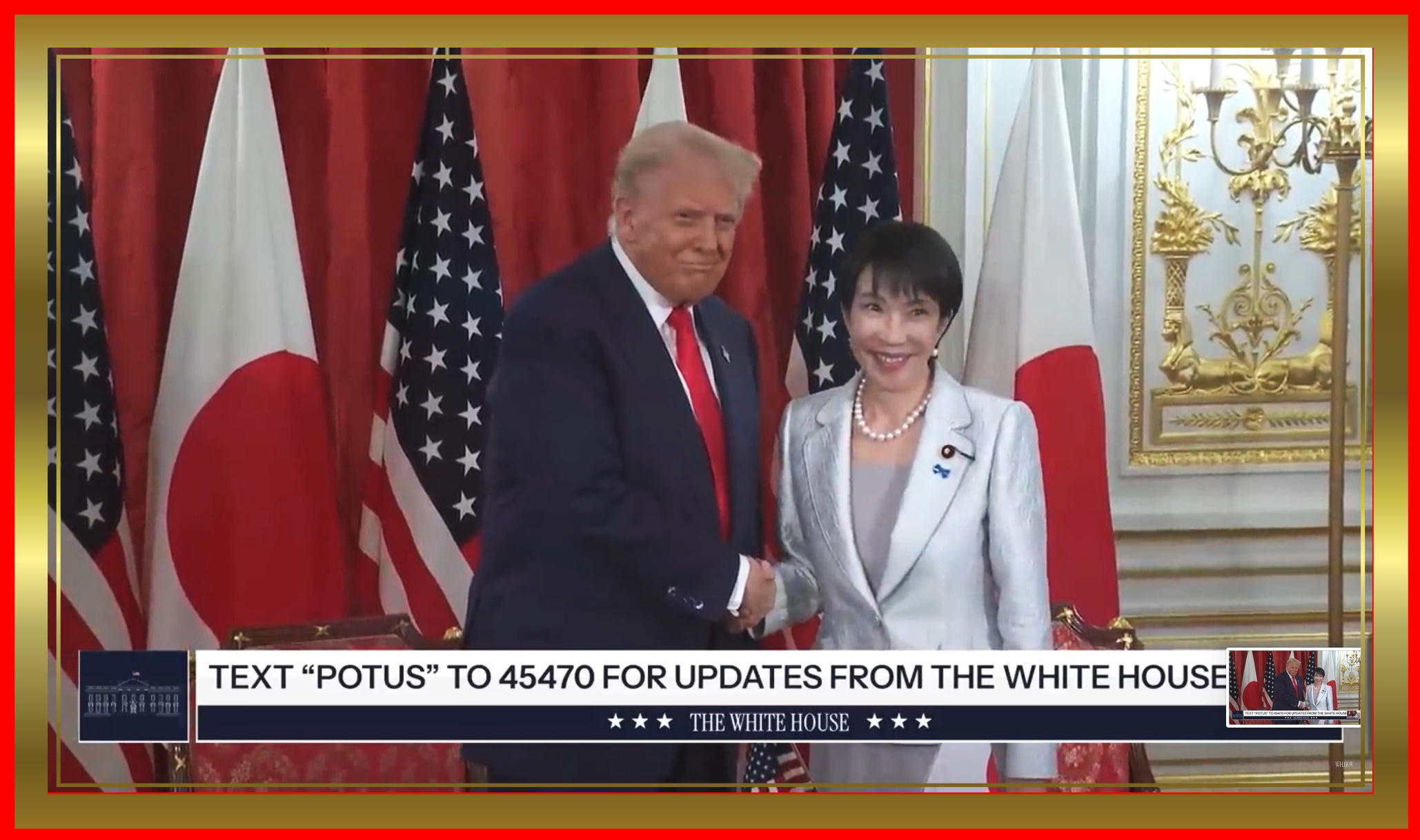
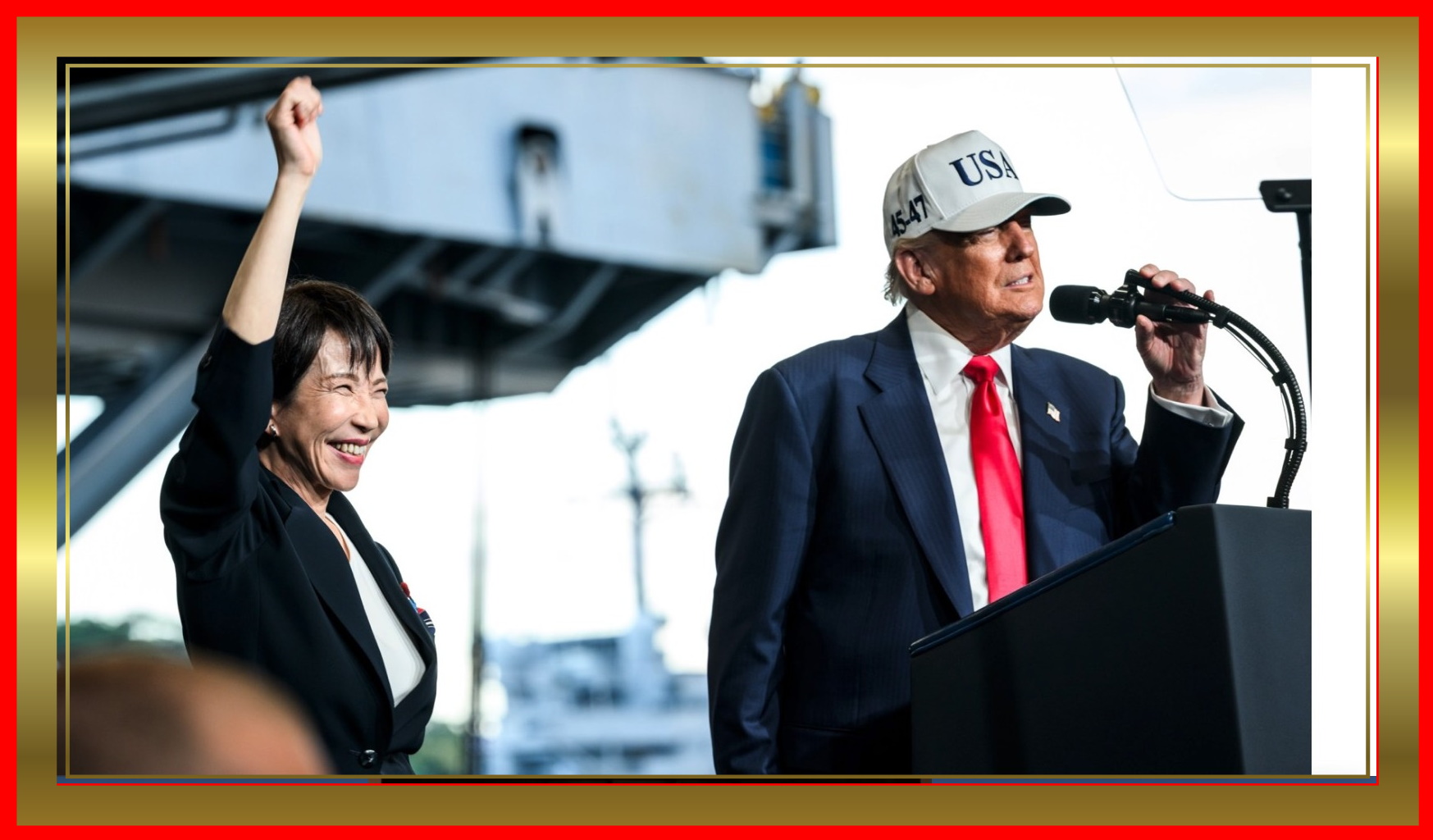
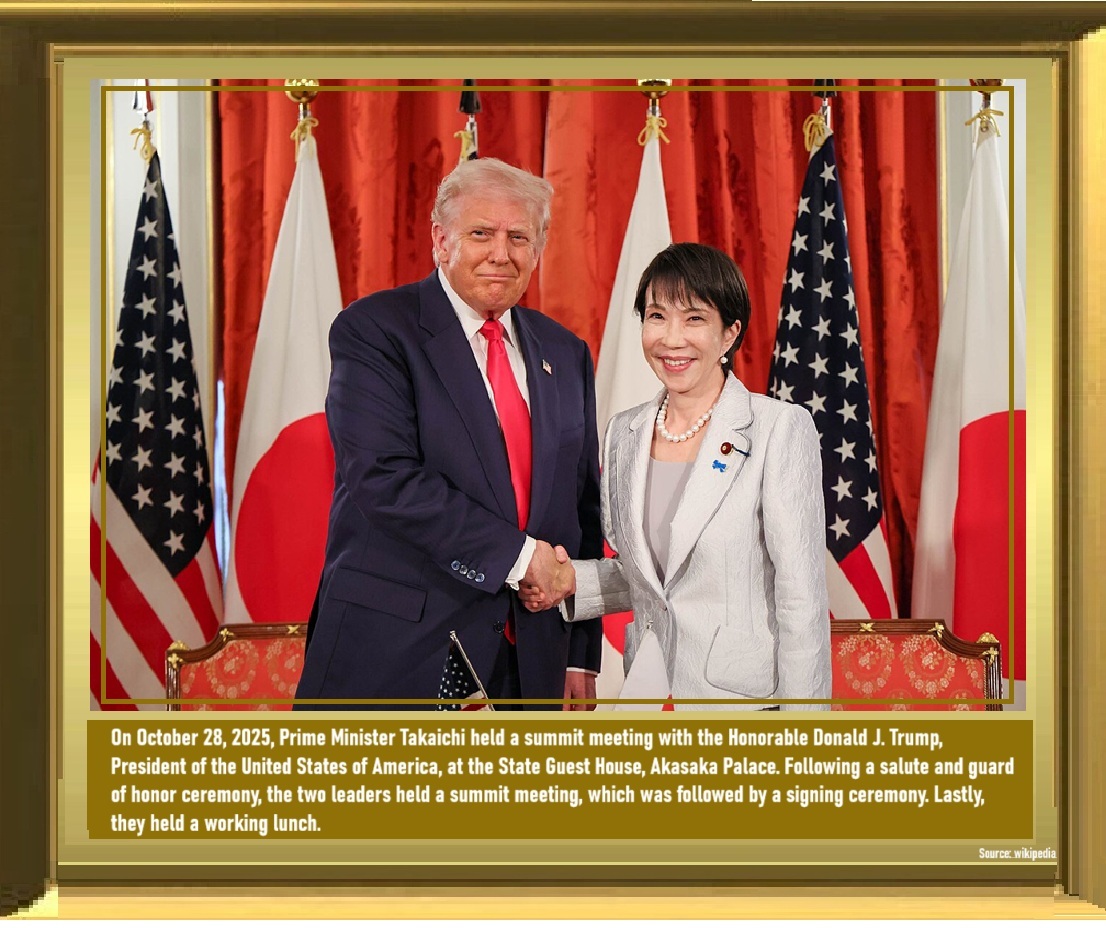
    President of the United States of America, Donald J. Trump, and Prime Minister of Japan, Takaichi Sanae, met in Tokyo, Japan, on October 28, 2025.

    Recalling the historic Agreement between the United States and Japan on July 22, 2025, followed by the Executive Order 14345, the Joint Statement on the Agreement, as well as the Memorandum of Understanding with respect to strategic investments, announced on September 4, 2025, the two leaders noted with satisfaction swift and continued efforts by both countries, and confirmed their strong commitment to implementing this GREAT DEAL.  The Agreement will help both countries to strengthen economic security, promote economic growth, and thereby continuously lead to global prosperity.

    The two leaders instructed relevant ministers and secretaries to take further steps for a NEW GOLDEN AGE of the ever-growing U.S.-Japan Alliance.

    Signed in Tokyo this 28th day of October, two thousand and twenty-five.  

    For the Government of the                                 For the Government of Japan

    United States of America:                                

    Donald J. Trump                                                Takaichi Sanae

    President                                                            Prime Minister

 

    -----------------------------------------------------------------------------------------------------------------------------------------------------------------

    10.50.32 AM.jpeg 10.51.39 AM.jpeg 10.51.41 AM.jpeg 10.51.44 AM.jpeg 10.51.47 AM.jpeg
    10.52.12 AM.jpeg 10.52.14 AM.jpeg 10.52.36 AM.jpeg 10.52.40 AM.jpeg 10.52.59 AM.jpeg
    10.53.08 AM.jpeg 10.53.10 AM.jpeg 10.53.14 AM.jpeg 10.53.19 AM.jpeg 10.53.25 AM 1.jpeg
    10.53.26 AM 1.jpeg 10.53.26 AM.jpeg 10.53.27 AM.jpeg 10.53.29 AM.jpeg 10.53.30 AM.jpeg


    4.12.32 AM.jpeg

    4.13.04 AM.jpeg

    4.14.53 AM.jpeg

    4.15.11 AM.jpeg

    4.15.29 AM.jpeg

    4.16.03 AM.jpeg

    4.16.44 AM.jpeg

    4.17.10 AM.jpeg

    4.18.32 AM.jpeg

    4.18.53 AM.jpeg

    United States - Japan Framework

    For Securing the Supply of

    Critical Minerals and Rare Earths

    through Mining and Processing

    The White House | October 27, 2025

    Whereas, critical minerals and rare earths are essential for the production of advanced technologies;

    Whereas, the United States of America (the “United States” or “U.S.”) and Japan (together, the “Participants”) intend to support the supply of raw and processed critical minerals and rare earths crucial to the domestic industries of the United States and Japan;

    Whereas, the Participants plan to accomplish this through use of economic policy tools and coordinated investment to accelerate development of diversified, liquid, and fair markets for critical minerals and rare earths;

    Whereas, the Participants’ objective is to assist both countries in achieving resilience and security of critical minerals and rare earths supply chains, including mining, separation, and processing;

    Whereas, the Participants intend to capitalize on their respective existing mining and processing operations in critical minerals and heavy and light rare earths as well as new capacity;


    Whereas, the Participants recognize that this Framework will continue as long as both Participants work in good faith and with a cooperative attitude to strengthen the supply chains between the two countries;


    Whereas, the Participants recognize that U.S. and Japanese companies, through upstream to downstream, are implementing concrete projects to establish new and secure supply chains, and welcome the continued advancement of such efforts;


    Therefore, the Participants have reached the following recognition on a common policy framework for the mining and processing of critical minerals and rare earths.


      Section I

      Critical Minerals and Rare Earths


      1.    Securing supply:  The Participants are intensifying their cooperative efforts to accelerate the secure supply of critical minerals and rare earths necessary to support domestic industries, including advanced technologies and their respective industrial bases, by leveraging policy tools such as the United States’ and Japan’s financial support mechanisms, trade measures where appropriate, and critical minerals stockpiling systems. The participants will intensify efforts to promote dialogue amongst upstream and downstream companies to facilitate the diversification of supply chains.

      2.    Investment in mining and processing:  The Participants intend to mobilize government and private sector support including for capital and operational expenditures via grants, guarantees, loans, or equity; offtake arrangements; insurance; or regulatory facilitation.

      o   a. Project selection:  The Participants intend to jointly identify projects of interest to address gaps in supply chains for critical minerals and rare earths, including derivative products such as permanent magnets, batteries, catalysts, and optical materials.

      o   b. Financing: In addition to the steps above, within six months of the date of this Framework, the Participants intend to take measures to provide financial support to selected projects to generate end product for delivery to buyers in the United States and Japan and, as appropriate, like-minded countries.

      o   c. Investment support:  The Participants intend to work together to develop new or bespoke mechanisms to mobilize private capital and strengthen critical minerals and rare earths supply chains.

      o   d. Ministerial:  The Participants have decided to promote investment in mining by convening a bilateral Mining, Minerals and Metals Investment Ministerial within 180 days of the date of this Framework within which a dialogue with relevant stakeholders will be held to identify approaches and priorities for investment to meet our joint objectives.

      3.    Permitting:  The Participants are taking measures to accelerate, streamline, or deregulate permitting timelines and processes, including for permits for critical minerals and rare earths mining, separation, and processing within their respective domestic regulatory systems, consistent with applicable law.

      4.    Fair Competition and Pricing Mechanisms:  The Participants will work to secure their critical minerals and rare earths supply chains by addressing non-market policies and unfair trade practices, including by establishing high-standard marketplaces that reflect the real costs of responsible extraction, processing, and trade of critical minerals and rare earths, and pricing measures to support alternative projects and such high-standard markets, in line with their respective policy tools.  The Participants will work with international partners to advance these intentions.

      5.    Asset Sales:  The Participants commit to work together toward developing new authorities or strengthening existing authorities and diplomatic tools that review and deter critical minerals and rare earths asset sales on national security grounds, in accordance with their respective domestic laws.

      6.    Scrap:  The Participants commit to investing in minerals recycling technologies and to working together to ensure management of critical minerals and rare earth scrap that supports supply chain diversification.

      7.    Third parties:  The Participants intend to work together with other international partners as appropriate to ensure supply chain security and utilize existing engagement mechanisms.

      8.    Geological mapping:  The Participants intend to cooperate to assist in mapping mineral resources as mutually determined in the United States, Japan, and elsewhere, to support diversified critical mineral and rare earths supply chains.

      9.    Rapid Response:  The Participants are establishing a U.S.-Japan Critical Minerals Supply Security Rapid Response Group under the leadership of the U.S. Secretary of Energy and the Japanese Minister of Economy, Trade, and Industry, to identify priority minerals and supply vulnerabilities, and develop a coordinated plan to accelerate delivery of processed minerals under this Framework.

      10.    Stockpiling:  The Participants intend to work together to consider a mutually complementary stockpiling arrangement, utilizing existing national systems in accordance with each country’s regulations.


      Section II

      General Matters

      1.    The appropriate authorities of the Participants intend to monitor and review projects identified under Section I,
      paragraph 2.  The Participants will develop the elements of the project reviews in accordance with their respective domestic laws.

      2.    The Participants plan to meet, virtually or in-person, at the written request of the other Participant within 10 days of the receipt of the request.

      3.    Either Participant may discontinue its participation in this Framework by giving written notification to the other Participant.  Absent notice to the contrary from the discontinuing Participant, this framework would be discontinued on the thirtieth day after the date of receipt of the written notification by the other Participant.

      4.    This Framework sets out a policy and programmatic action plan that does not constitute or create rights or obligations under domestic or international law, does not give rise to any legal process, and does not constitute or create any legally binding or enforceable obligations, express or implied.

      Signed in Tokyo this 28th day of October, two thousand and twenty-five.


      For the Government of the                                 For the Government of Japan

      United States of America:                                

      Donald J. Trump                                                Takaichi Sanae

      President                                                            Prime Minister
    White House,wikipedia, FOX NEWS, Fox News Live, ABC,, DRM News, Yahoo, Youtube


    October 28, 2025, Rev. October 30,  2025


Catch4all.com is proud to provide positive websites for the communities and for
the positive viewers from all over the world.....

Positive Viewers' Menu
2003 to 2025

Thank you for visiting Catch4all.com. Please be sure bookmark our site.
Since 1999 ©Catch4all.com. All rights reserved.rved.rved.rved.rved.