Persistent internal disagreements remain among Iranian regime leaders over the concessions that the regime should accept in negotiations with the United States. Islamic Revolutionary Guards Corps (IRGC) Commander Major General Ahmad Vahidi and his inner circle appear to continue to seek an agreement that meets Iranian maximalist demands and would be tantamount to a US surrender. Other Iranian officials appear to have disputed a draft memorandum leaked by IRGC-linked and state media.
2
Conflicting US and Iranian accounts of the MoU suggest that the United States and Iran remain far apart on several core issues, however. It remains unclear whether these public statements accurately reflect each side’s negotiating position or the contents of the agreement, given competition between the IRGC and the formal negotiating team.
3
Iranian statements and Iran’s continued use of force and coercion in the Strait of Hormuz indicate that the regime remains unwilling to relinquish its claims to control over the waterway. Any US-Iran agreement must require Iran to abandon efforts to establish long-term authority over the strait. Iranian forces continue to employ coercive measures to force vessels to transit through Iran’s illegal traffic separation scheme and comply with its protection racket.
4
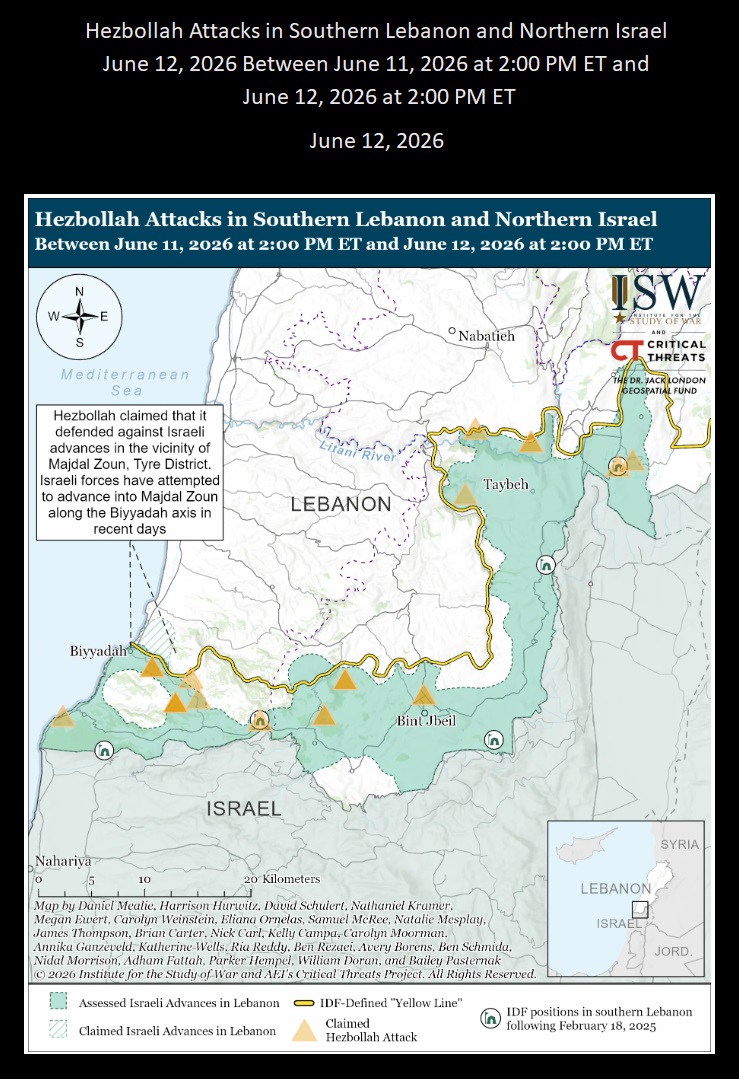
Hezbollah’s efforts to decentralize its military structure may be enabling the group to conduct more effective defenses of specific areas in southern Lebanon than it was able to muster in Fall 2024. The IRGC reportedly reorganized Hezbollah’s C2 system starting in late 2024, and the shift towards unit independence and mobility would theoretically enable Hezbollah fighters to execute more effective defenses against Israeli advances in several sectors across southern Lebanon.
5
“IRGC-linked” figures acting on Iran’s behalf reportedly warned unspecified Iranian-backed Iraqi militia leaders to resist surrendering militia weapons to the Iraqi state in the days after Iraqi Prime Minister Ali al Zaydi’s successful formation of a new government in May 2026. Iran’s reported opposition to Iraqi militia disarmament at this time conflicts with several other reports that Iran has encouraged some Iraqi militias to end their kinetic operations in exchange for solidifying Iranian-backed Iraqi control over the Iraqi state, however.
US-Iran Negotiations and Maritime Activity in the Strait of Hormuz and Persian Gulf June 12, 2026
Persistent internal disagreements remain among Iranian regime leaders over the concessions that the regime should accept in negotiations with the United States. Islamic Revolutionary Guards Corps (IRGC) Commander Major General Ahmad Vahidi and his inner circle, whom ISW-CTP currently assesses are driving regime decision-making, appear to continue to seek an agreement that meets Iranian maximalist demands and would be tantamount to a US surrender. Islamic Development Organization (IDO)-affiliated outlet Mehr News Agency published a version of the draft US-Iran memorandum of understanding (MoU) on June 12 that includes all key Iranian demands, including Iran’s retention of “management” of the Strait of Hormuz, the release of frozen Iranian assets, and a US-funded reconstruction plan for Iran.[1] Multiple Iranian outlets, including IRGC-affiliated outlets and state media, recirculated this report or similar readouts of the draft MoU.[2] That IRGC-affiliated outlets are circulating this maximalist draft of the MOU suggests that this purported draft reflects the views of IRGC leaders. ISW-CTP continues to assess that the IRGC, particularly Vahidi and his inner circle, currently dominates regime decision-making and has repeatedly pushed for uncompromising, maximalist negotiating positions, suggesting that the regime is likely to adopt a similar approach.[3] Some outlets that are not affiliated with the IRGC also circulated this “draft” and expressed hardline and maximalist demands, however.[4]
Other Iranian officials appear to have disputed the MOU leaked by IRGC-linked and state media, which suggests that Iranian officials continue to disagree about which concessions the regime should accept, if any. Iranian Foreign Affairs Minister and lead negotiator Abbas Araghchi called on media outlets on June 12 to avoid publishing speculation about the MoU’s content.[5] US President Donald Trump later reposted Araghchi’s statement on TruthSocial.[6] Araghchi may have issued his statement in response to the circulating “draft“ MOU readouts in Iranian media, Western media reports that are discussing the MoU’s details, or both. Iranian Parliamentarian and Paydari Front member Mahmoud Nabavian published a statement criticizing the details of the deal and described terms of the deal that are notably different from those reported by IRGC- and IDO-affiliated outlets.[7] The Paydari Front is a separate faction that is more hardline than the faction of Vahidi and the IRGC traditionally are. Nabavian stated that the agreement would end the IRGC’s current control over the strait immediately after the agreement is signed and that it does not explicitly address US sanctions on Iran.[8] Iranian state media outlet IRNA’s readout explicitly notes that the agreement does not require Iran to relinquish management over the strait and lifts sanctions on Iranian oil exports.[9] These competing accounts suggest either that the publicly circulated reports do not accurately reflect the current draft under discussion or that multiple drafts are circulating among rival factions within the regime.
The opposing viewpoints in Iran should not be surprising, considering the fractured nature of Iranian leadership and politics at present. Iran is in the middle of a transition period from Supreme Leader Ali Khamenei to his son, Mojtaba. Various power centers are jockeying for power and attempting to influence negotiations. ISW-CTP continues to assess that IRGC commander Major General Ahmad Vahidi’s circle retains the most relative power based on its closeness to Supreme Leader Mojtaba Khamenei.[10] Vahidi, according to reports in April, is serving as an interlocutor between Mojtaba and the government.[11] This suggests Vahidi has assumed a chief of staff-esque position, which is relatively unprecedented for an IRGC commander.
Conflicting reporting about the MOU’s contents and progress likely reflects not only the persistent divisions between the IRGC and the formal Iranian negotiating team but also the way in which both parties are engaging with mediators separately from one another. Araghchi posted on X on June 12 that an agreement has “never been closer.”[12] The Wall Street Journal, citing unspecified mediators, reported that neither Supreme Leader Mojtaba Khamenei nor the IRGC has approved the latest MoU, however.[13] The IRGC in this context presumably refers to Vahidi, who is the IRGC commander. The report added that different mediators are separately engaging the ”diplomatic channel” and the IRGC.[14] That mediators are engaging the formal Iranian negotiating team and IRGC separately is likely indicative of the fissures between the two camps and suggests that the two camps have been unable to reach any internal consensus. The two camps could even be competing to influence the final agreement. US officials told Axios in April that the IRGC effectively told the Iranian negotiating delegation upon their return to Tehran that the negotiating team ”[does not] speak for” the IRGC.[15]
Conflicting US and Iranian accounts of the MoU suggest that the United States and Iran remain far apart on several core issues, however. It remains unclear whether these public statements accurately reflect each side’s negotiating position or the contents of the agreement, given competition between the two camps. A senior Trump administration official told CNN that the agreement includes provisions requiring Iran to dismantle its nuclear program and end support for the Axis of Resistance.[16] A senior US official echoed those Iranian commitments to ABC and added that Iran also agreed to dismantle its nuclear program.[17] Several Iranian media outlets, however, stated on June 12 that neither Iran’s missile program nor its support for the Axis of Resistance is part of the MoU and emphasized that those issues would not be discussed in future negotiations either.[18] These outlets further claimed that the current agreement does not discuss the nuclear issue and imposes no new nuclear commitments on Iran.[19]
Iranian media reporting on the MoU also presents a sequence of events that aims to frontload US concessions and strip the United States of leverage in future nuclear negotiations. Mehr News reported that final negotiations could not begin until Iran receives half of its frozen assets and the United States lifts oil sanctions and its naval blockade.[20] US Vice President JD Vance, in contrast, stated that Iran will receive economic relief only after fulfilling its obligations and that frozen assets will not be released immediately upon signing.[21] These reports, if accurate, reflect deep and serious disagreements over both the sequencing of concessions and the substance of a final agreement.
Iranian statements and Iran’s continued use of force and coercion in the Strait of Hormuz indicate that the regime remains unwilling to relinquish its claims to control over the waterway. Any US-Iran agreement must require Iran to abandon efforts to establish long-term authority over the strait. An unspecified diplomat from a mediating country told Axios that Iran would “reopen” the strait by eliminating tolls and restoring pre-war shipping volumes within 30 days under the MoU.[22] Iranian media reporting describes similar provisions.[23] Iranian state media emphasized that Iran would retain management of the strait under the MoU and that Iran and Oman would jointly determine the future of the strait’s administration, however.[24] The MoU’s terms on re-opening the strait, as rendered by various reports, do not appear to constrain Iran’s broader efforts and capabilities to institutionalize its control over the strait. ISW-CTP previously assessed that Iran’s lack of ability to charge tolls does not constitute a failure of Iran’s broader scheme to control the strait.[25]
Iranian forces continue to employ coercive measures to force vessels to transit through Iran’s illegal traffic separation scheme and comply with its protection racket. Iran fired several drones at commercial vessels attempting to transit the strait on June 11, and US forces reportedly intercepted two Iranian one-way attack drones targeting commercial shipping.[26] An agreement that permits Iran to retain any form of authority over the strait would allow Iran to retain the ability to reimpose restrictions on maritime traffic whenever it chooses, threatening both US interests and global commerce.
ISW:
Iran Update Special Report
June 1, 2026
1. The Iranian regime, which ISW-CTP continues to assess is dominated by Islamic Revolutionary Guards Corps (IRGC) Commander Major General Ahmad Vahidi and his inner circle, suspended US-Iran negotiations on June 1. Vahidi and his inner circle likely calculate that the status quo, in which Iran has neither made concessions to the United States in a diplomatic agreement nor is engaged in a full-scale conflict with the United States, is a favorable situation that advances their objectives. IRGC-affiliated Tasnim News Agency announced on June 1 that the regime has suspended negotiations, ostensibly in response to Israeli operations against Hezbollah in Lebanon.
2. The Iranian regime’s decision to suspend negotiations and emphasize the Lebanon issue is almost certainly a response to US President Donald Trump’s recent amendments to the draft US-Iran memorandum of understanding (MoU).
3. The Iranian regime has likely focused on the Lebanon issue, as opposed to another key sticking point in negotiations, to try to curb Israeli operations against Hezbollah in Lebanon as part of the regime’s broader objective to preserve Hezbollah. The regime also likely seeks to drive a wedge between the United States and Israel by falsely blaming Israel and its operations in Lebanon for the collapse of the US-Iran talks. Vahidi and his inner circle also likely calculate that the status quo will help them advance several other objectives, such as solidifying Iranian control over the Strait of Hormuz and maintaining the Iranian nuclear program.
4. The suspension of negotiations further indicates that Vahidi and his inner circle are driving Iranian decision-making and have likely gained the upper hand over proponents of a deal, particularly Parliament Speaker Mohammad Bagher Ghalibaf.
5. Iran and the United States have exchanged limited fire over the past 48 hours. Islamic Revolutionary Guards Corps (IRGC)-affiliated media announced on May 31 that Iranian air defenses shot down a US MQ-1 Predator drone over “Iranian territorial waters.” US Central Command (CENTCOM) responded by launching defensive strikes against Iranian targets on Qeshm Island and in Goruk, Hormozgan Province. The IRGC retaliated against the US strikes by launching two missiles at US forces in Kuwait on May 31.
6. Iranian forces also likely attacked a civilian cargo vessel located off the coast of Iraq on June 1. United Kingdom Maritime Trade Operations reported on June 1 that an unspecified projectile struck a cargo vessel transiting the northern Persian Gulf approximately 40 nautical miles southeast of the Umm Qasr Port in Iraq.
IMPOSING SANCTIONS ON THE CUBAN REGIME: Today,
President Donald J. Trump signed an Executive Order imposing new sanctions on
the Cuban regime, protecting U.S. national security.
The
Order broadens the existing sanctions on Cuba to include new restrictions
under the International Emergency Economic Powers Act.
The
Order imposes new sanctions on entities, persons, or affiliates that
support the Cuban regime’s security apparatus, are complicit in government
corruption or serious human rights violations, or are agents, officials,
or material supporters of the Cuban government.
The
Order also authorizes new sanctions on covered persons, entities, or
financial institutions that have conducted or facilitated transactions
with persons or entities sanctioned under the Order.
COUNTERING CUBA’S MALIGN INFLUENCE: The
President is addressing the national security threats posed by the communist
Cuban regime by taking decisive action to hold the Cuban regime, and those that
perpetuate it, accountable for its support of hostile actors, terrorism, and
regional instability that endanger American security and foreign policy.
The
Cuban regime aligns itself with countries and malign actors hostile to the
United States, going so far as to facilitate their military and
intelligence operations. For example, Cuba hosts foreign adversary
facilities focused on targeting and exploiting sensitive national security
information from the United States.
Cuba
maintains close ties to other major state sponsors of terrorism, including
the Government of Iran, and provides safe haven for transnational
terrorist groups, including Hezbollah.
The
regime persecutes and tortures political opponents, denies its citizens
free speech rights, and actively spreads communist ideology across the
region while repressing its populace.
Cuba’s
corrupt regime continues to drive migration towards the United States,
with more than 850,000 migrants arriving in America between 2022 and the
fall of 2024.
Cuba
provides a permissive environment for hostile foreign intelligence,
military, and terrorist operations less than 100 miles from the American
homeland.
These
actions constitute an unusual and extraordinary threat to U.S. national
security and foreign policy, requiring immediate response to protect
American citizens and interests.
PUTTING AMERICA FIRST: President
Trump has consistently confronted regimes that threaten U.S. security and
interests, delivering where others have failed to hold adversaries accountable.
President
Trump is continuing efforts from his first term to stand with the Cuban
people and hold the regime accountable.
In
his first term, President Trump implemented a robust policy toward Cuba,
reversing the Obama Administration’s one-sided deal that eased
restrictions without securing meaningful reforms for the Cuban people.
Relying on decades of evidence, President Trump’s first Administration
properly designated Cuba as a State Sponsor of Terrorism.
In
June 2025, President Trump strengthened the United States’ policy pressure
on Cuba through a National Secuirty Presidential Memorandum, ensuring that
engagement between the United States and Cuba advances the interests of
the United States and the Cuban people, including promoting human rights,
fostering a private sector independent of government control, and
enhancing national security.
In
January 2026, President Trump signed an Executive Order declaring a
national emergency and establishing a process to impose tariffs on goods
from countries that sell or otherwise provide oil to Cuba, protecting U.S.
national security and foreign policy from the Cuban regime’s malign
actions and policies.
President
Trump continues to demonstrate his commitment to directly addressing
national security threats from abroad.
Operation
Absolute Resolve captured Venezuelan dictator and indicted narcoterrorist
Nicolas Maduro and his wife to face American justice.
Operation
Southern Spear eliminated 186 narcoterrorists in strikes against
fentanyl-trafficking vessels, stemming the deadly flow of drugs into
America.
In
Operation Midnight Hammer, President Trump decisively eliminated Iran’s
nuclear weapons capability via targeted military strikes, escalated
sanctions, and intelligence operations.
Operation
Epic Fury successfully completed all of its military objectives in less
than six weeks. Iran no longer poses the nuclear and terror threat it
did, and no longer has the nuclear ambitions it held before. Now, the
U.S. naval blockade and Operation Economic Fury have dissipated Iran’s
economy.
By the authority vested in me
as President by the Constitution and the laws of the United States of America,
including the International Emergency Economic Powers Act (50 U.S.C.
1701 et seq.) (IEEPA), the National Emergencies Act (50 U.S.C.
1601 et seq.) (NEA), and section 301 of title 3, United States
Code, I hereby determine and order:
Section1.
National Emergency. As President of the United States,
I have an imperative duty to protect the national security and foreign policy
of this country. I find that the policies, practices, and actions of the
Government of Cuba constitute an unusual and extraordinary threat, which has
its source in whole or substantial part outside the United States, to the
national security and foreign policy of the United States.
The Government of Cuba has
taken extraordinary actions that harm and threaten the United States. The
regime aligns itself with — and provides support for — numerous hostile
countries, transnational terrorist groups, and malign actors adverse to the United
States, including the Government of the Russian Federation (Russia), the
People’s Republic of China (PRC), the Government of Iran, Hamas, and Hezbollah.
For example, Cuba blatantly hosts dangerous adversaries of the United
States, inviting them to base sophisticated military and intelligence
capabilities in Cuba that directly threaten the national security of the United
States. Cuba hosts Russia’s largest overseas signals intelligence
facility, which tries to steal sensitive national security information of the
United States. Cuba continues to build deep intelligence and defense
cooperation with the PRC. Cuba welcomes transnational terrorist groups,
such as Hezbollah and Hamas, creating a safe environment for these malign
groups so that these transnational terrorist groups can build economic,
cultural, and security ties throughout the region and attempt to destabilize
the Western Hemisphere, including the United States. Cuba has long
provided defense, intelligence, and security assistance to adversaries in the
Western Hemisphere, attempting to thwart United States and international
sanctions designed to enforce the stability of the region, uphold the rule of
law, and safeguard the national security and foreign policy of the United
States. Cuba continues to try to thwart United States efforts to address
threats to the United States posed by hostile countries, transnational
terrorist groups, and malign actors, including in the Western Hemisphere.
Further, contrary to the
interests and foreign policy of the United States, the Cuban communist regime
supports terrorism and destabilizes the region through migration and violence.
The communist regime persecutes and tortures its political opponents;
denies the Cuban people free speech and press; corruptly profits from their
misery; and commits other human-rights violations. For example, families
of political prisoners face retaliation for peacefully protesting the improper
confinement of their loved ones. Cuban authorities harass worshippers,
block free association by civil society organizations, prohibit free press, and
deny the ability to speak freely, including on the internet. The Cuban
regime continues to spread its communist ideas, policies, and practices around
the Western Hemisphere, threatening the foreign policy of the United States.
The United States has zero
tolerance for the depredations of the communist Cuban regime. The United
States will act to protect the foreign policy, national security, and national
interests of the United States, including by holding the Cuban regime
accountable for its malign actions and relationships, while also remaining
committed to supporting the Cuban people’s aspirations for a free and
democratic society.
I find that the policies,
practices, and actions of the Government of Cuba directly threaten the safety,
national security, and foreign policy of the United States. The policies,
practices, and actions of the Government of Cuba are designed to harm the
United States and support hostile countries, transnational terrorist groups,
and malign actors that seek to destroy the United States. The policies,
practices, and actions of the Government of Cuba are also repugnant to the
moral and political values of democratic and free societies and conflict with
the foreign policy of the United States to encourage peaceful change in Cuba
and to promote democracy, the principle of free expression and press, the rule
of law, and respect for human rights throughout the world.
NOW, THEREFORE, I, DONALD J.
TRUMP, President of the United States of America, find that the situation
with respect to Cuba constitutes an unusual and extraordinary threat, which has
its source in whole or substantial part outside the United States, to the
national security and foreign policy of the United States and hereby declare a
national emergency with respect to that threat.
To deal with the national
emergency declared in this order, I determine that it is necessary and
appropriate to establish a tariff system, as described below. Under
this system, an additional ad valorem duty may be imposed on
imports of goods that are products of a foreign country that directly or
indirectly sells or otherwise provides any oil to Cuba. In my judgment,
the tariff system, as described below, is necessary and appropriate to address
the national emergency declared in this order.
Sec. 2. Imposition
of Tariffs. (a) Beginning on the effective date of this order,
an additional ad valorem rate of duty may be imposed on goods
imported into the United States that are products of any other country that
directly or indirectly sells or otherwise provides any oil to Cuba, in
accordance with subsections (b) and (c) of this section.
(b)(i) The Secretary of
Commerce, in consultation with the Secretary of State and any senior official
the Secretary of Commerce deems appropriate, shall determine whether, after the
effective date of this order, a foreign country directly or indirectly sells or
otherwise provides any oil to Cuba. After the Secretary of Commerce finds
that a foreign country directly or indirectly sells or otherwise provides any
oil to Cuba, the Secretary of Commerce shall inform the Secretary of State of
his finding, including any information relevant to that finding.
(ii) The Secretary of
Commerce may issue rules, regulations, and guidance necessary or appropriate to
implement this order. The Secretary of Commerce may also make any other
determinations or take any other actions necessary or appropriate to implement
this order.
(c)(i) After the
Secretary of Commerce makes an affirmative finding pursuant to subsection
(b)(i) of this section and informs the Secretary of State of his finding, the
Secretary of State, in consultation with the Secretary of the Treasury, the Secretary
of Commerce, the Secretary of Homeland Security, and the United States Trade
Representative, shall determine whether and to what extent an additional ad
valorem rate of duty should be imposed on goods that are products of
the foreign country found to directly or indirectly sell or otherwise provide
any oil to Cuba.
(ii) If the
Secretary of State determines that an additional ad valorem rate
of duty should be imposed on goods that are products of the country found to
directly or indirectly sell or otherwise provide any oil to Cuba, the Secretary
of State shall inform me of his recommendation, and the Secretary of Commerce
shall inform me of his finding related to that recommendation. I will
then consider the recommendation and finding, among other relevant things, in
determining whether and to what extent to impose an additional ad
valorem rate of duty on goods that are products of the country in
question.
(iii) The Secretary of
State may issue rules, regulations, and guidance necessary or appropriate to
implement this order. The Secretary of State may also make any other
determinations or take any other actions necessary or appropriate to implement
this order.
Sec. 3. Modification
Authority. (a) To ensure that the national emergency declared
in this order is dealt with, I may modify this order, including in light of
additional information, recommendations from senior officials, or changed
circumstances.
(b) Should a foreign
country retaliate against the United States in response to this order or any
action taken pursuant to this order, I may modify this order or actions taken
pursuant to this order to ensure the efficacy of this order and the actions
taken pursuant to this order to deal with the national emergency declared in
this order.
(c) Should the
Government of Cuba or another foreign country affected by this order take
significant steps to address the national emergency declared in this order and
align sufficiently with the United States on national security and foreign
policy matters, I may modify this order.
Sec. 4. Monitoring
and Recommendations. (a) The Secretary of State, in
consultation with any senior official the Secretary of State deems
appropriate, shall monitor the circumstances involving the national emergency
declared in this order. The Secretary of State shall inform me of
any circumstance that, in his opinion, might indicate the need for further
Presidential action to deal with the national emergency declared in this order.
(b) The Secretary of
State, in consultation with the Secretary of the Treasury, the Secretary of
Commerce, the Secretary of Homeland Security, the United States Trade
Representative, and any other senior official the Secretary of State deems
appropriate, shall recommend to me additional action, if necessary, if the
actions in this order or taken pursuant to this order are not effective in
dealing with the national emergency declared in this order.
(c) The Secretary of
Commerce shall monitor whether a foreign country directly or indirectly
sells or otherwise provides any oil to Cuba. The Secretary of Commerce
shall continue such monitoring after a foreign country has been found to
do so.
Sec. 5. Delegation.
Consistent with applicable law, the Secretary of State and the Secretary of
Commerce are directed and authorized to take all actions necessary to implement
and effectuate this order — including through temporary suspension or amendment
of regulations or through notices in the Federal Register and
by adopting rules, regulations, or guidance — and to employ all powers granted
to the President, including by IEEPA, as may be necessary to implement this
order. The head of each executive department and agency (agency) is
authorized to and shall take all appropriate measures within the agency’s
authority to implement this order. The head of each agency may,
consistent with applicable law, including section 301 of title 3, United States
Code, redelegate the authority to take such appropriate measures within the
agency.
Sec. 6.
Reporting Directives. The Secretary of State, in
consultation with any senior official he deems appropriate, is hereby
authorized and directed to submit recurring and final reports to the Congress
on the national emergency declared in, and authorities exercised by, this
order, consistent with section 401 of the NEA (50 U.S.C. 1641) and section
204(c) of IEEPA (50 U.S.C. 1703(c)).
Sec. 7.
Definitions. For the purposes of this order:
(a) The term “oil” means
crude oil or petroleum products.
(b) The term
“indirectly” includes selling to or otherwise providing oil to Cuba through
intermediaries or third countries, with knowledge that such oil may be provided
to Cuba, as determined by the Secretary of Commerce.
(c) The term “Cuba”
means the territory of Cuba and any other territory or marine area, including
the exclusive economic zone and continental shelf, over which the Government of
Cuba claims sovereignty, sovereign rights, or jurisdiction, provided that the
Government of Cuba exercises partial or total de facto control over the area or
derives a benefit from economic activity in the area pursuant to international
arrangements.
(d) The term “Government
of Cuba” includes the Government of Cuba, any political subdivision, agency, or
instrumentality thereof, and any person owned or controlled by, or acting for
or on behalf of, the Government of Cuba.
Sec. 8.
Effective Date. This order is effective at 12:01 a.m.
eastern standard time on January 30, 2026.
Sec. 9. Interaction
With Other Presidential Actions. Any provision of previous
proclamations and Executive Orders that is inconsistent with the actions
directed in this order is superseded to the extent of such inconsistency.
Sec. 10.
Severability. If any provision of this order or the
application of any provision of this order to any individual or circumstance is
held to be invalid, the remainder of this order and the application of its
provisions to any other individuals or circumstances shall not be
affected. If the action in this order or any action taken pursuant to
this order is held invalid, the other actions imposed to deal with the national
emergencies declared with respect to the Government of Cuba shall not be
affected and shall remain in effect.
Sec. 11.
General Provisions. (a) Nothing in this order shall be
construed to impair or otherwise affect:
(i) the authority
granted by law to an executive department or agency, or the head thereof; or
(ii) the functions of
the Director of the Office of Management and Budget relating to budgetary,
administrative, or legislative proposals.
(b) This order shall be
implemented consistent with applicable law and subject to the availability of
appropriations.
(c) This order is not
intended to, and does not, create any right or benefit, substantive or
procedural, enforceable at law or in equity by any party against the United
States, its departments, agencies, or entities, its officers, employees, or agents,
or any other person.
(d) The costs for
publication of this order shall be borne by the Department of State.
CONFRONTING THE CUBAN REGIME: Today, President Donald J. Trump signed an Executive Order declaring a national emergency and establishing a process to impose tariffs on goods from countries that sell or otherwise provide oil to Cuba, protecting U.S. national security and foreign policy from the Cuban regime’s malign actions and policies.
• The Order imposes a new tariff system that allows the United States to impose additional tariffs on imports from any country that directly or indirectly provides oil to Cuba.
• The Order authorizes the Secretary of State and Secretary of Commerce to take all necessary actions, including issuing rules and guidance, to implement the tariff system and related measures
• The President may modify the Order if Cuba or affected countries take significant steps to address the threat or align with U.S. national security and foreign policy objectives.
COUNTERING CUBA’S MALIGN INFLUENCE: The President is addressing the depredations of the communist Cuban regime by taking decisive action to hold the Cuban regime accountable for its support of hostile actors, terrorism, and regional instability that endanger American security and foreign policy.
• The Cuban regime aligns itself with numerous hostile countries and malign actors, hosting their military and intelligence capabilities. For example, Cuba hosts Russia’s largest overseas signals intelligence facility focused on stealing sensitive national security information from the United States.
• Cuba provides safe haven for transnational terrorist groups, such as Hezbollah and Hamas, and supports adversaries in the Western Hemisphere, undermining U.S. sanctions and regional stability.
• The regime persecutes and tortures political opponents, denies free speech and press, profits corruptly from the Cuban people’s misery, and incites chaos by spreading communist ideology across the region.
• These actions constitute an unusual and extraordinary threat to U.S. national security and foreign policy, requiring immediate response to protect American citizens and interests.
PUTTING AMERICA FIRST: President Trump has consistently confronted regimes that threaten U.S. security and interests, delivering where others have failed to hold adversaries accountable.
• President Trump is continuing efforts from his first term to stand with the Cuban people and hold the regime accountable.
o In his first term, President Trump implemented a robust policy toward Cuba, reversing the Obama Administration’s one-sided deal that eased restrictions without securing meaningful reforms for the Cuban people.
• In June 2025, President Trump implemented partial travel restrictions on nationals from Cuba due to its role as a state sponsor of terrorism, its failure to cooperate or share sufficient law enforcement information with the United States, its historical refusal to accept back its removable nationals, and its high visa overstay rate.
• In June 2025, President Trump signed a National Security Presidential Memorandum (NSPM) to strengthen the policy of the United States toward Cuba.
• This is not the first time President Trump has taken a tough stance against hostile regimes—in just the past few months, he has ordered strikes on Iran’s nuclear infrastructure and authorized operations to remove Venezuela’s Nicolas Maduro from power, making clear that dictators and state sponsors of terrorism will be held to account.
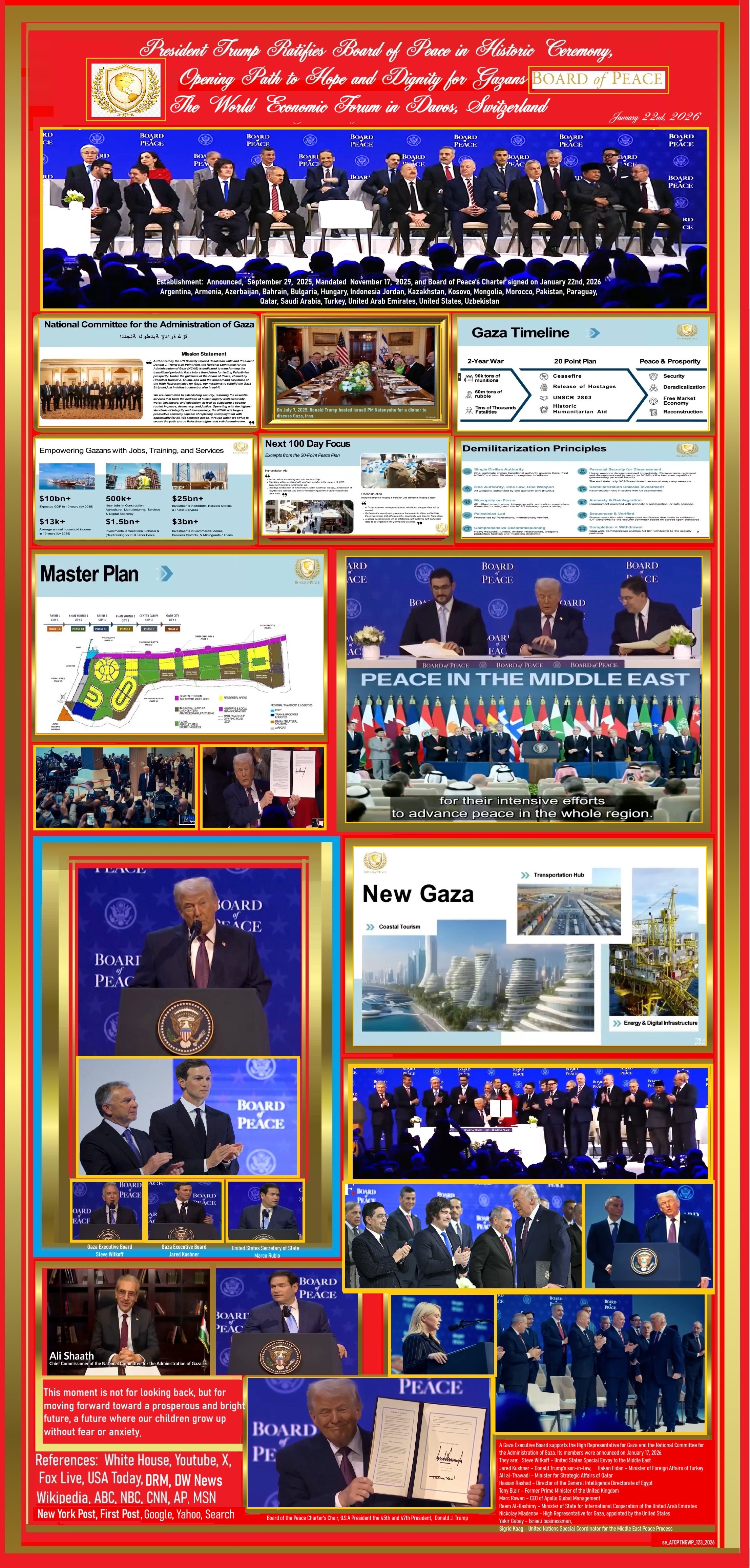
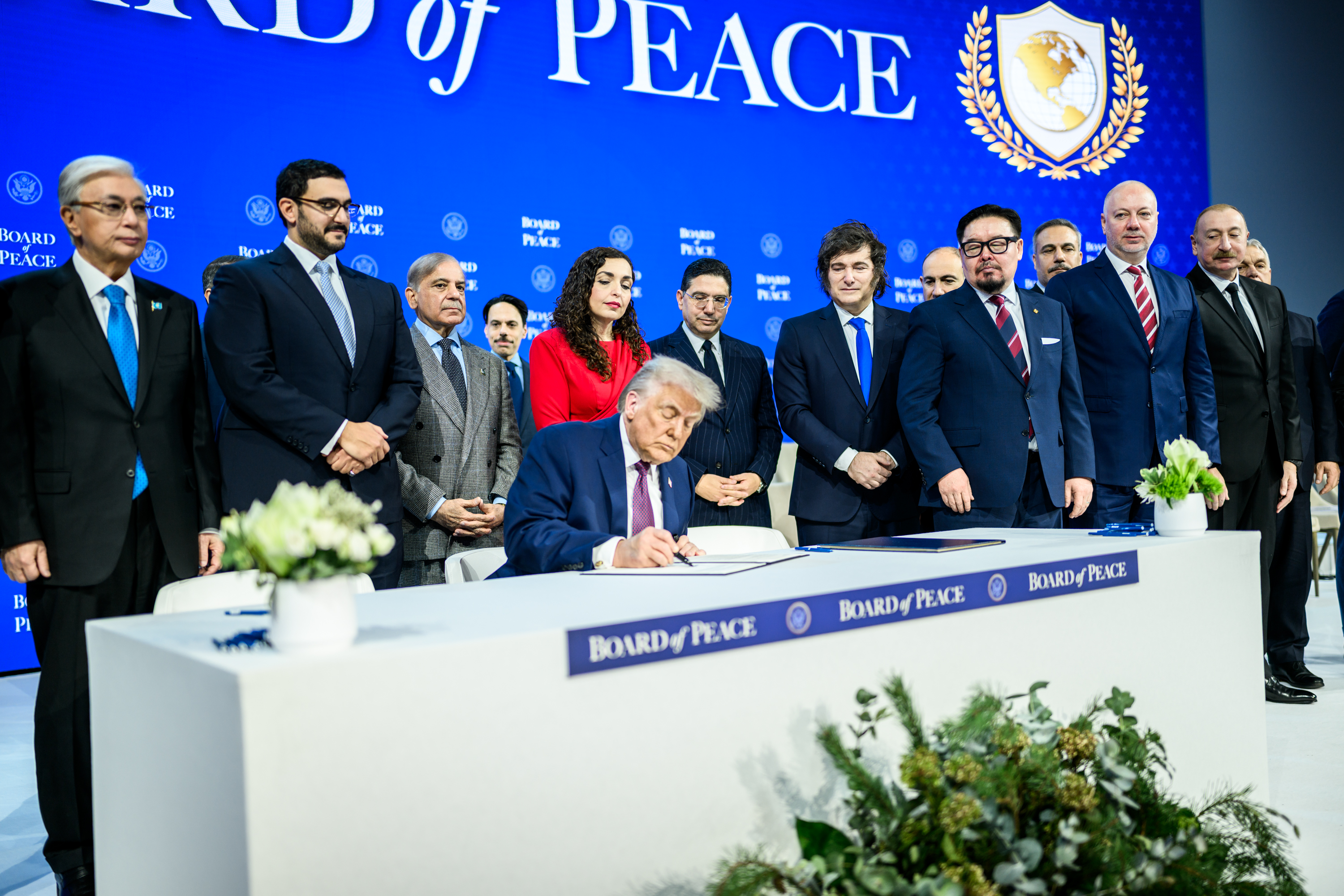
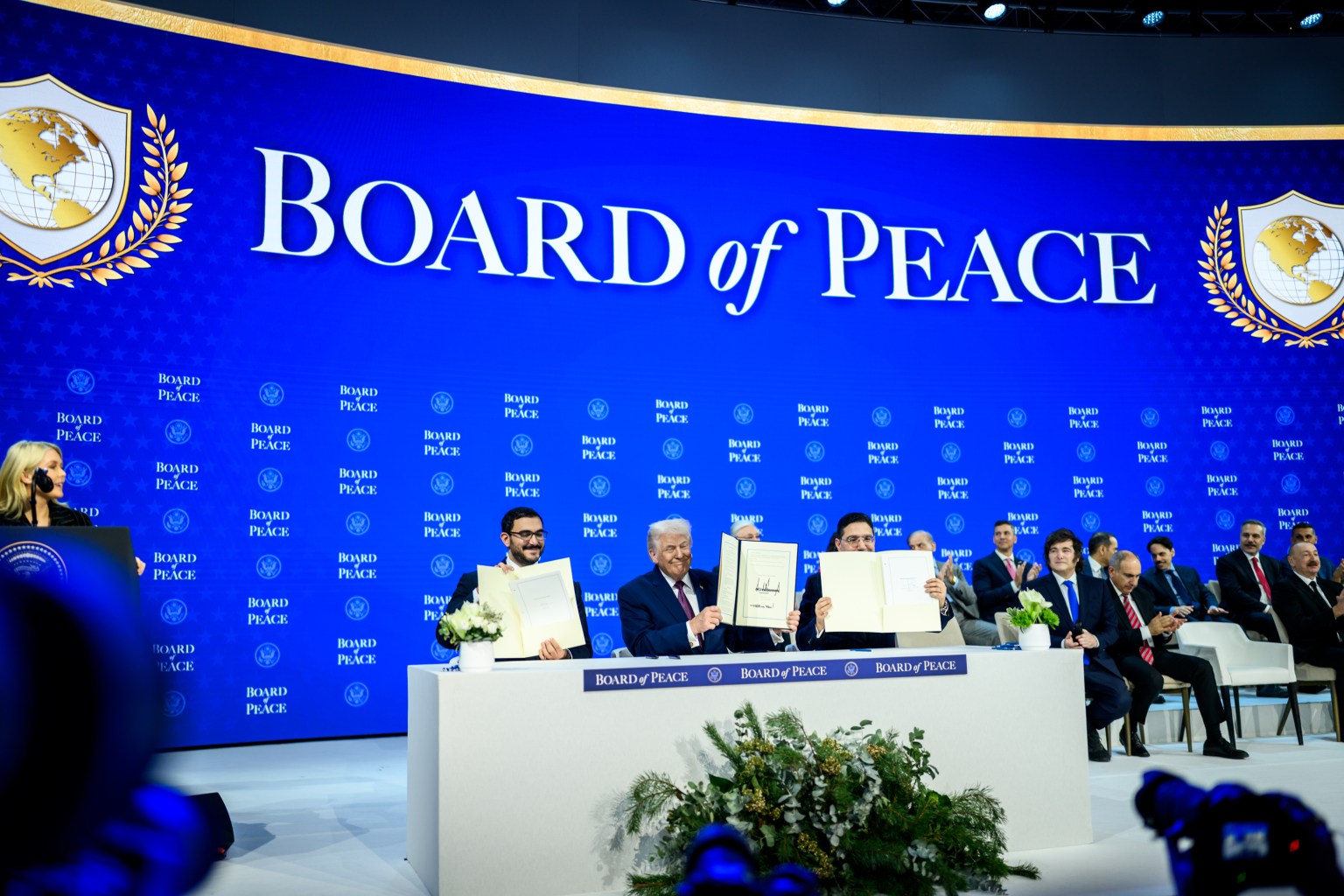
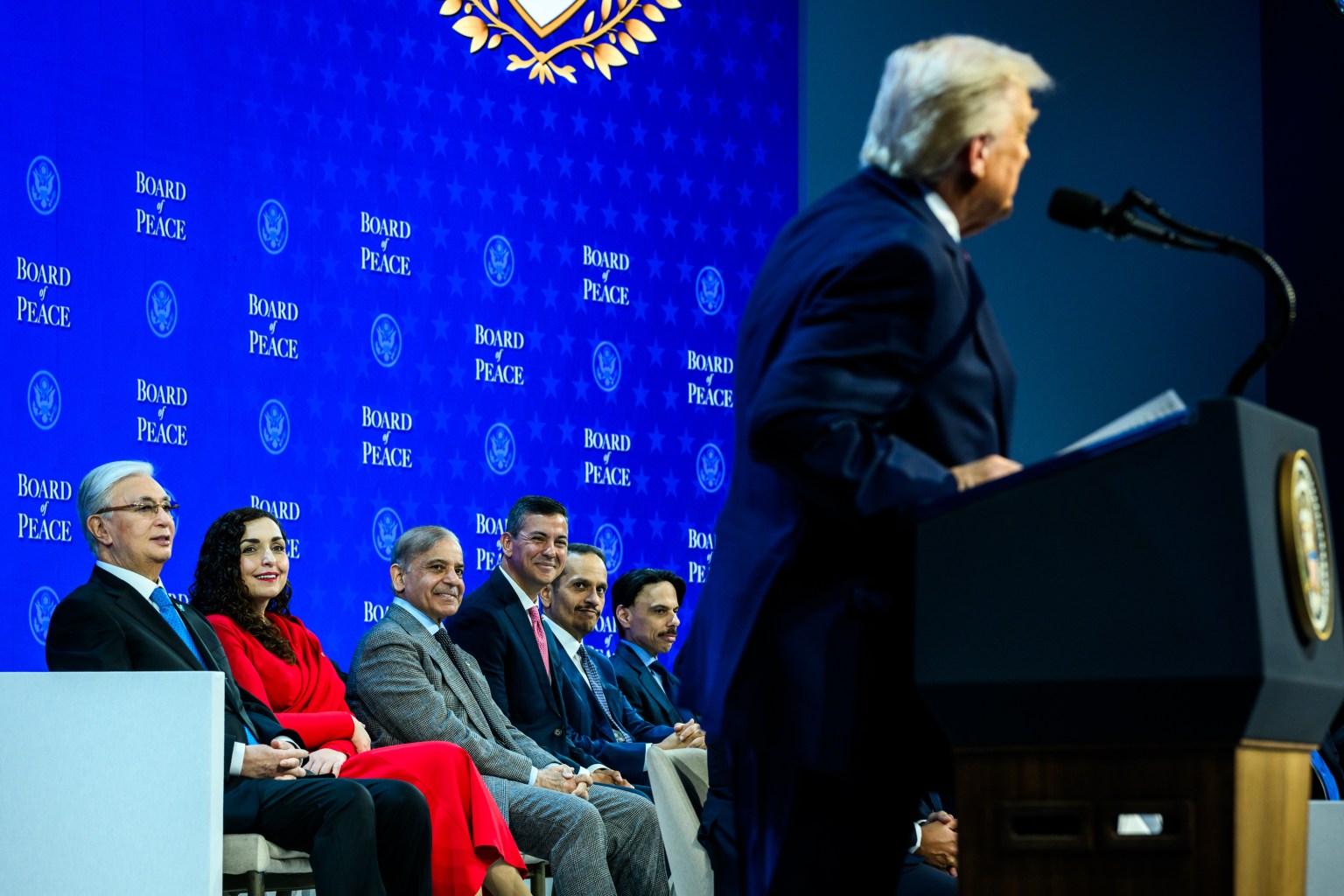
Today, in an historic ceremony
in Davos, Switzerland, President Donald J. Trump formally ratified the Charter
of the Board of Peace — establishing it as an official international
organization. President Trump, who is serving as the Board’s
Chairman, was joined by Founding Members representing countries around the
world who have committed to building a secure and prosperous future for Gaza
that delivers lasting peace, stability, and opportunity for its people.
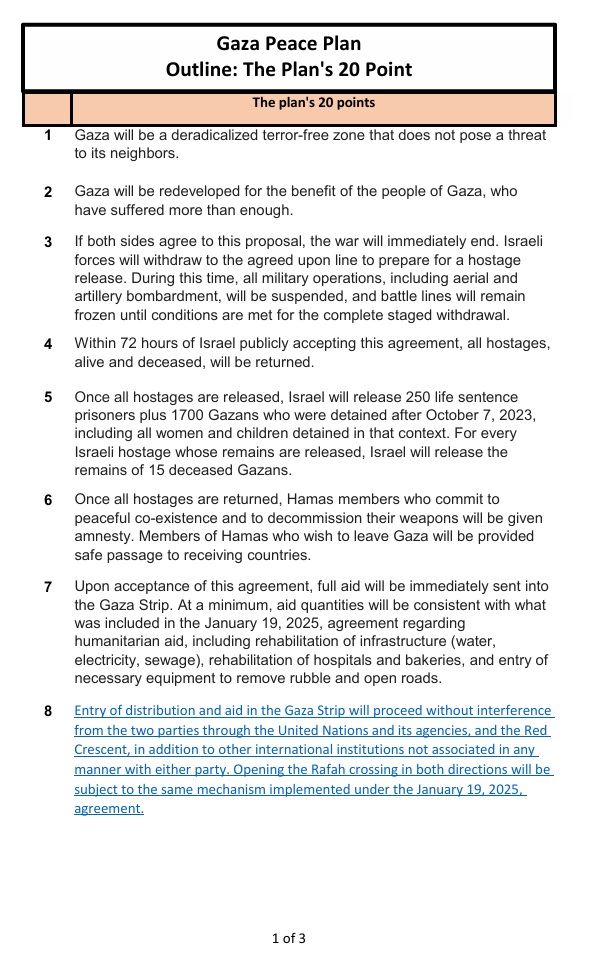
It’s another pivotal step
forward in realizing President Trump’s vision of
transforming Gaza from a region plagued by conflict and despair into one
defined by opportunity, hope, and vitality. The
Board of Peace stands ready to mobilize global resources, enforce
accountability, and guide the implementation of the next critical phases of
demilitarization, governance reform, and large-scale rebuilding.
President
Trump: “This Board has
the chance to be one of the most consequential bodies ever created, and
It’s my enormous honor to serve as its Chairman… Today, the first steps
toward a brighter day for the Middle East and a much safer future for the
world are unfolding right before your very eyes. Together, we are in a
position to have any credible chance… to end decades of suffering, stop
generations of hatred and bloodshed, and forge a beautiful, everlasting,
and glorious peace for that region.”
Secretary
of State Marco Rubio: “We
are here today because of President Trump’s vision. If we go back just a
few months ago, people thought what was happening in Gaza was impossible
to solve… No one thought that that would ever come to a resolution without
more fighting and more bloodshed along the way… But President Trump had
the vision and the courage to dream the impossible, to believe that it was
doable, and to pursue it with all of his heart.”
High
Representative for Gaza Nickolay Mladenov: “Who
would’ve thought two years ago that we would be sitting here with this
group of countries, with this leadership, giving the people of Gaza a new
chance?… For too long, Gazans, Palestinians, and Israelis have lived with
conflict, with death, with destruction. Now, the page turns.”
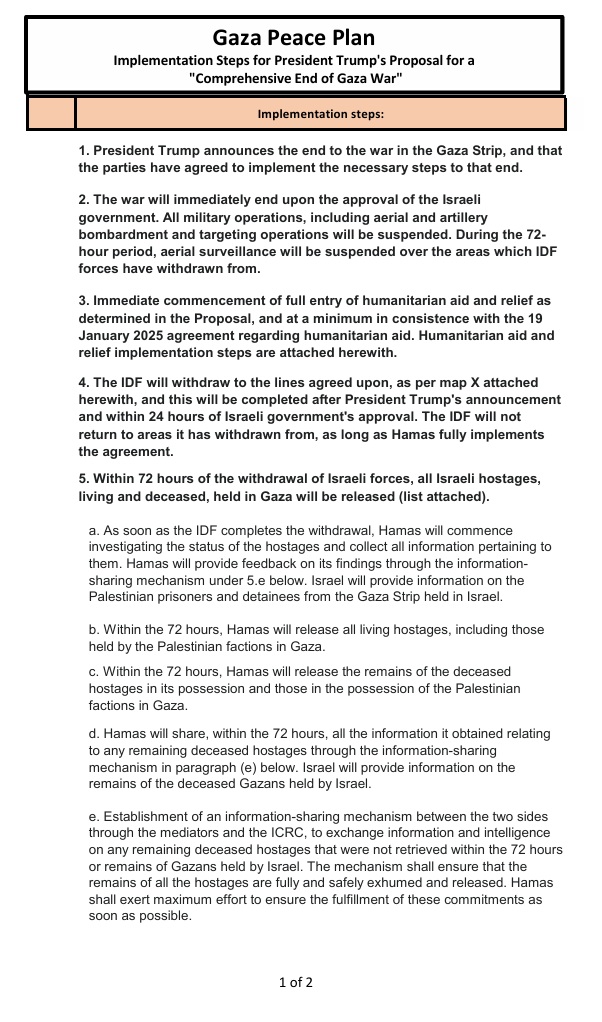
Special
Envoy for Peace Missions Steve Witkoff: “We
have achieved a peace deal in Gaza. We have brought the hostages home… And
maybe most importantly, we have created a sense of hope for what the
future can bring in Gaza and all other places where the Board of Peace
will operate. And I am so honored, Mr. President, to have worked on this
on your behalf.”
Jared
Kushner: “85% of the GDP of
Gaza has been aid for a long time. That’s not sustainable. It doesn’t give
these people dignity; it doesn’t give them hope. And so we want to use
free market economy principles — a lot of what President Trump spoke about
that he’s doing in America — we want to bring the same mindset, the same
approach, to a place like Gaza to give these people the ability to thrive
and have a good life… If we believe that peace is possible then peace
really can be possible.”
White House,wikipedia, Youtube, Fox Live, USA Tpoday, DRM, DW News, ABC, NBC, CNN, AP, MSN, New York Post, First Post Google, Yahoo, and Search, ISW
January 22nd 2026 - Rev. January 24, 2026, June 12, 2026
Catch4all.com
is proud to provide positive websites for the communities and for
the positive viewers from all over the world.....

)
)
)
)
)
)
)
)
)
)
)
)
)
)
)
)
)
)
)
)
)
)
)
)
)
)
)
)
)
)
)
)
)
)
)
)
)
)
)
)
)
)
)
)
)
)
)
)
)
)
)
)
)
)
)
)
)
)
)
)
)
)
)
)
)
)
)
)
)
)
)
)
)
)
)
)
)
)
)
)
)
)
)
)
)
)
)
)
)
)
)
)
)
)
)
)
)
)
)
)
)
)
)
)
)
)
)
)
)
)
)
)
)
)
)
)
)
)
)
)
)
)
)
)
)
)
)
)
)
)
)
)
)
)
)
)
)
)
)
)
)
)
)
)
)
)
)
)
)
)
)
)
)
)
)
)
)
)
)
)
)
)
)
)
)
)
)
)
)
)
)
)
)
)
)
)
)
)
)
)
)
)
)
)
)
)
)
)
)
)
)
)
)
)
)
)
)
)
)
)
)
)
)
)
)
)
)
)
)
)
)
)
)
)
)
)
)
)
)
)
)
)
)
)
)
)
)
)
)
)
)
)
)
)
)
)
)
)
)
)
)
)
)
)
)
)
)
)
)
)
)
)
)
)
)
)
)
)
)
)
)
)
)
)
)
)
)
)
)
)
)
)
)
)
)
)
)
)
)
)
)
)
)
)
)
)
)
)
)
)
)
)
)
)
)
)
)
)
)
)
)
)
)
)
)
)
)
)
)
)
)
)
)
)
)
)
)
)
)
)
)
)
)
)
)
)
)
)
)
)
)
)
)
)
)
)
)
)
)
)
)
)
)
)
)
)
)
)
)
)
)
)
)
)
)
)
)
)
)
)
)
)
)
)
)
)
)
)
)
)
)
)
)
)
)
)
)
)
)
)
)
)
)
)
)
)
)
)
)
)
)
)
)
)
)
)
)
)
)
)
)
)
)
)
)
)
)
)
)
)
)
)
)
)
)
)
)
)
)
)
)
)
)
)
)
)
)
)
)
)
)
)
)
)
)
)
)
)
)
)
)
)
)
)
)
)
)
)
)
)
)
)
)
)
)
)
)
)
)
)
)
)
)
)
)
)
)
)
)
)
)
)
)
)
)
)
)
)
)
)
)
)
)
)
)
)
)
)
)
)
)
)
)
)
)
)
)
)
)
)
)
)
)
)
)
)
)
)
)