|
|
| THE
WHITE HOUSE Office of the Press Secretary ________________________________________________________________
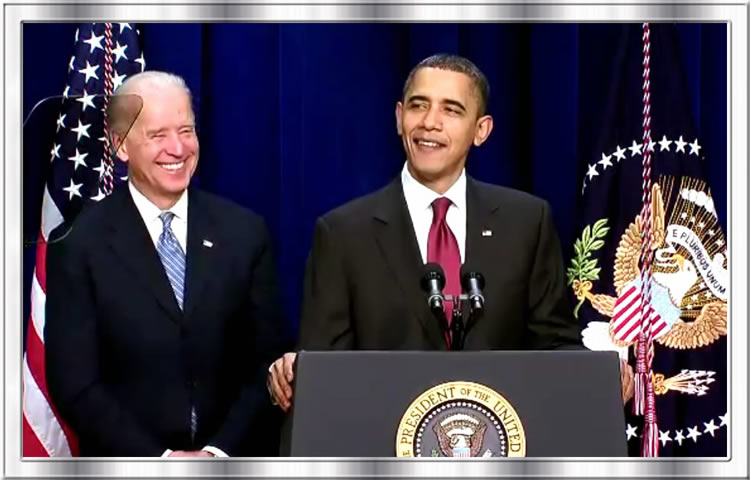
Remarks by the President and the Vice President Before 4:00 P.M. EST THE VICE PRESIDENT: Thank you all very, very much. Please be seated. Ladies and gentlemen, this is a -- I wasn’t going say, a big deal, but an important deal. (Laughter.) I can no longer say “big deal.” (Laughter.) Thank god, my mother wasn’t around. The famed 18th century British statesman, Edmund Burke, once said, “All government, indeed every human benefit and enjoyment, every virtue, and every prudent act, is founded on compromise and barter.” Today, we have a crystal clear example of what he meant. This package -- this package is a result of leaders from both sides coming together to act on behalf of the American people at a time they need it most. I want to begin by applauding Senator Mitch McConnell, and the other Republican leaders, who like their Democratic counterparts who are here today, were willing to take issue with some of their own party and to do what was, in their view, necessary in order to move the country forward. That’s what the American people expect of all of us, especially in these times. And that’s what we’ve done here. It means accepting some things we don’t like in order to get the job done for Americans as needs to be done. We were put in office amid the deepest recession this country has seen since the Great Depression. We were put here to protect and -- protect and rebuild the middle class. And throughout the process, we’re working with two principles in mind -- grow the economy and support working-class families. And that’s what we fought hard to do. And I stand here today to say, in my view, our fight has paid off. Most economists, many of whom are in this room, will tell you this plan will grow our economy in the next year. And it’s going to help millions of families keep their jobs, if they have one, and keep their unemployment benefits if they don’t, and keep their tax relief, and keep their kids in school as well. All while keeping our economic recovery moving in the right direction, providing immediate -- an immediate economic jolt, and giving more than 150 million Americans help where they need it most, in their paychecks, in their wallets. I believe it was the right thing to do. This is an example of what can happen when you have a President who knows what needs to be done and acts tenaciously to make sure it happens. The President, wholeheartedly -- wholeheartedly committed to serving the middle class. And that’s what happens when you have a President who knows in his gut that the middle class is the backbone of the American people, and that a full economic recovery will only happen if we have -- if they, the middle class, have the support they need in order to succeed. Ladies and gentlemen, the President of the United States, Barack Obama. (Applause.) THE PRESIDENT: Thank you, everybody. Thank you. Thank you so much. (Applause.) Thank you very much. Thank you everybody. Please have a seat. Good afternoon, everybody. Before I get started, I just want to acknowledge some of the extraordinary people who did some extraordinary work in a very short period of time. And I’m going to start with somebody who has been a champion for the middle class, but has also been just an extraordinary partner on every important initiative in this administration -- my friend, Joe Biden, the Vice President. (Applause.) I want to acknowledge and thank Senator Mitch McConnell and the rest of the Republican leadership in the Senate; Dave Camp, Republican over in the House, for their willingness, as Joe indicated, to do what was right for the country, even though it caused occasional political discomfort. I especially want to thank the folks who are here -- Dick Durbin, Max Baucus, Danny Davis, Allyson Schwartz, Rob Andrews -- part of a broader team that worked very diligently both in the House and the Senate on the Democratic side to make this happen. And we’ve got a bunch of other members of Congress who are here, as well as activists and economists and business leaders and people who generally recognize that at this critical juncture, we’ve got to think about what’s best to grow the economy and what’s best to put people back to work. We are here with some good news for the American people this holiday season. By a wide bipartisan margin, both Houses of Congress have now passed a package of tax relief that will protect the middle class, that will grow our economy, and will create jobs for the American people. Not only do I want to thank all the leaders here today, but I want to thank mayors and governors from across the country who couldn’t be here today, and all who worked together to get this done. First and foremost, the legislation I’m about to sign is a substantial victory for middle-class families across the country. They’re the ones hit hardest by the recession we’ve endured. They’re the ones who need relief right now. And that’s what is at the heart of this bill. This bipartisan effort was prompted by the fact that tax rates for every American were poised to automatically increase on January 1st. If that had come to pass, the average middle-class family would have had to pay an extra $3,000 in taxes next year. That wouldn’t have just been a blow to them -- it would have been a blow to our economy just as we’re climbing out of a devastating recession. I refused to let that happen. And because we acted, it’s not going to. In fact, not only will middle-class Americans avoid a tax increase, but tens of millions of Americans will start the New Year off right by opening their first paycheck to see that it’s actually larger than the one they get right now. Over the course of 2011, 155 million workers will receive tax relief from the new payroll tax cut included in this bill -– about $1,000 for the average family. This is real money that’s going to make a real difference in people’s lives. And I would not have signed this bill if it didn’t include other extensions of relief that were also set to expire -– relief that’s going to help families cover the bills, parents raise their children, students pay for college, and business owners to take the reins of the recovery and propel this economy forward. As soon as I sign this legislation, 2 million Americans looking for work who lost their jobs through no fault of their own can know with certainty that they won’t lose their emergency unemployment insurance at the end of this month. Over the past few weeks, 600,000 Americans have been cut off from that lifeline. But with my signature, states can move quickly to reinstate their benefits –- and we expect that in almost all states, they’ll get them in time for Christmas. Eight million college students who otherwise would have faced a tuition hike as soon as next semester will instead continue to have access to a $2,500 tax credit to afford their studies. Twelve million families with 24 million children will benefit from extensions of the Earned Income Tax Credit and the Child Tax Credit. And when combined with the payroll tax cut, 2 million American families who otherwise would have lived in poverty next year will instead be lifted out of it. (Applause.) And millions of entrepreneurs who have been waiting to invest in their businesses will receive new tax incentives to help them expand, buy new equipment, or make upgrades -- freeing up other money to hire new workers. Putting more money in the pockets of families most likely to spend it, helping businesses invest and grow -- that’s how we’re going to spark demand, spur hiring, and strengthen our economy in the New Year. Now, candidly speaking, there are some elements of this legislation that I don’t like. There are some elements that members of my party don’t like. There are some elements that Republicans here today don’t like. That’s the nature of compromise -– yielding on something each of us cares about to move forward on what all of us care about. And right now, what all of us care about is growing the American economy and creating jobs for the American people. Taken as a whole, that’s what this package of tax relief is going to do. It’s a good deal for the American people. This is progress. And that’s what they sent us here to achieve. There will be moments, I am certain, over the next couple of years, in which the holiday spirit won’t be as abundant as it is today. (Laughter.) Moreover, we’ve got to make some difficult choices ahead when it comes to tackling the deficit. In some ways, this was easier than some of the tougher choices we’re going to have to make next year. There will be times when we won’t agree, and we’ll have to work through those times together. But the fact is I don’t believe that either party has cornered the market on good ideas. And I want to draw on the best thinking from both sides. So wherever we can, whenever we can, it makes sense for our country’s success and our children’s future to work with people in both parties who are willing to come to the table for the hard work of moving our economy and our country forward. What happened with this economic package was a good example of that. A bipartisan group made up of Senators Baucus and Kyl and Representatives Van Hollen and Camp sat down with -- Secretary Geithner is here today and Director Jack Lew of the Office of Management and Budget to begin negotiations in good faith. Leaders like Nancy Pelosi, John Boehner, Harry Reid, and Mitch, other members who are here together worked to bring this bill across the finish line. And the final product proves when we can put aside the partisanship and the political games, when we can put aside what’s good for some of us in favor of what’s good for all of us, we can get a lot done. And if we can keep doing it, if we can keep that spirit, I’m hopeful that we won’t just reinvigorate this economy and restore the American Dream for all who work for it. I’m also hopeful that we might refresh the American people’s faith in the capability of their leaders to govern in challenging times, belief in the capacity of their institutions in this town to deliver in a rapidly changing world, and, most of all, confidence that our best days as a nation are still ahead of us. So to all of you who worked so diligently on this issue, thank you very much. To those on my staff who were working night and day, and on the Senate and House staffs in both parties who were working so hard, we’re very grateful to you. And with that, let me sign this bill to make sure that people are seeing a bigger paycheck come January. (Applause.) END ------------------------- The Tax Relief, Unemployment Insurance Reauthorization, and Job Creation Act of 2010 (H.R. 4853) was passed by the United States Congress on December 16, 2010 and signed into law by President Barack Obama on December 17, 2010. The act also includes several other tax- and economy-related measures intended to have a new stimulatory effect, especially an extension of unemployment benefits and a one-year reduction in the FICA payroll tax, as part of a compromise agreement between the Obama Administration and Congressional Republicans. The overall monetary impact of the measure will be placed at $858 billion which would have the Income taxes returned to Clinton administration-era rates in 2011 had Congress not passed this law. The Act also extends some provisions from the American Recovery and Reinvestment Act of 2009 (ARRA or 'the Stimulus') which we can looking back two-year reprieve from the sunset provisions of the Economic Growth and Tax Relief Reconciliation Act of 2001 (EGTRRA) and the Jobs and Growth Tax Relief Reconciliation Act of 2003 (JGTRRA), together known as the Bush tax cuts however, The package has been referred to as the Obama-GOP tax deal as well the "Obama tax cuts" which was also known as the Middle Class Tax Relief Act of 2010 during its earlier formulation in the House of Representatives. So finally it is became "The Bush-Obama tax cuts" encompass two laws passed during the presidency of George W. Bush and the dominant aspect of a third continuing their application through the presidency of Barack Obama. The laws generally lowered tax rates and revised the code specifying taxation in the United States. By name these laws were:
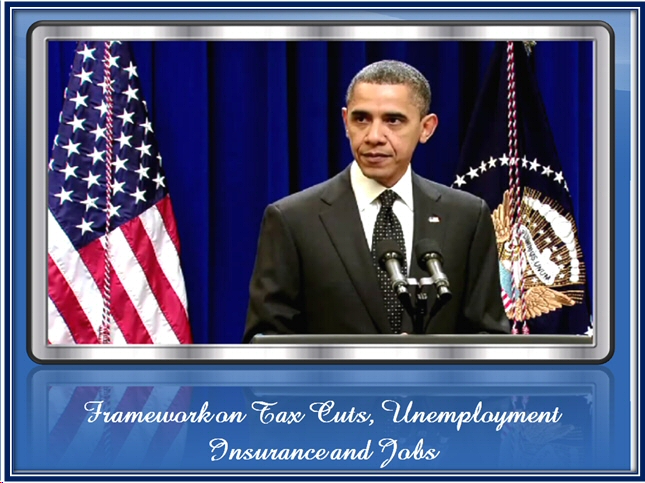
The Tax Relief, Unemployment Insurance Reauthorization, and Job Creation Act of 2010: A Win for Our Economy, Jobs and Working Families. The following description of the Framework on Tax Cuts, Unemployment Insurance and Jobs shows more detail.
. While each act has its own legislative history and effect on the tax code, the JGTRRA amplified and accelerated aspects of the EGTRRA, which were then wholly adopted and continued by the TRIURJCA. The acts are spoken of together in terms of analyzing their effect on the U.S. economy and population and in discussing their political ramifications. Sources: White House wikipedia The Wall street Journal Yahoo
|
------------------------------------------------------
|
|
| THE
WHITE HOUSE Office of the Press Secretary ________________________________________________________________
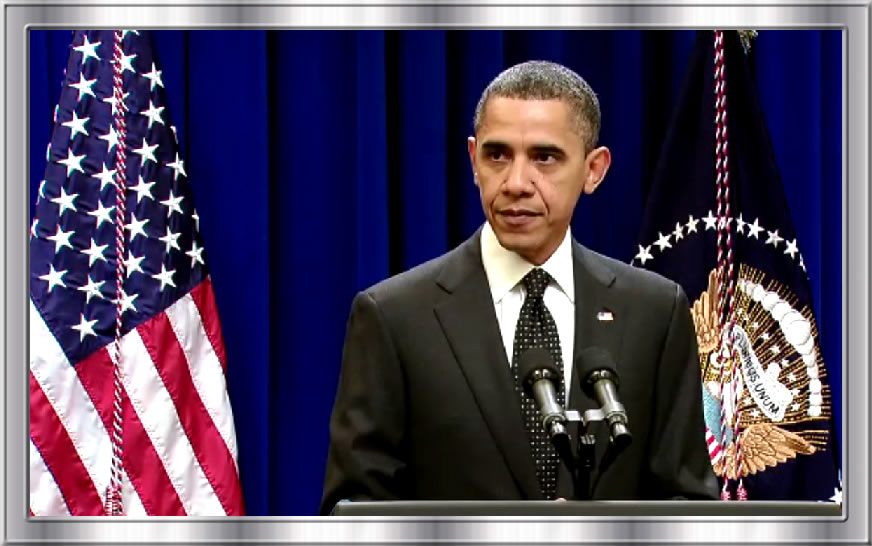
Remarks by the President on Tax Cuts and CEOs Meeting
9:23 A.M. EST I am absolutely convinced that this tax cut plan, while not perfect, will help grow our economy and create jobs in the private sector. It will help lift up middle-class families, who will no longer need to worry about a New Year’s Day tax hike. It will offer emergency relief to help tide folks over until they find another job. And it includes tax cuts to make college more affordable; help parents provide for their children; and help businesses, large and small, expand and hire. I know there are different aspects of this plan to which members of Congress
on both sides of the aisle object. That’s the nature of compromise. But we
worked hard to negotiate an agreement that’s a win for middle-class families and
a win for our economy, and we can’t afford to let it fall victim to either delay
or defeat. So I urge members of Congress to pass these tax cuts as swiftly as
possible. As I said when I was running for President and as I’ve said since, I believe that the primary engine of America’s economic success is not government. It’s the ingenuity of America’s entrepreneurs. It’s the dynamism of our markets. And for me, the most important question about an economic idea is not whether it’s good short-term politics or meets somebody’s litmus test. It’s whether it will help spur businesses, jobs and growth. That’s why I’ve set a goal of doubling U.S. exports in the next five years -- to create more jobs selling more products abroad. That’s why I’m so pleased that earlier this month, after intensive negotiations, we finalized a trade agreement with our ally South Korea that will boost the annual exports of American goods by $11 billion -- a deal that, all told, will support at least 70,000 American jobs. It’s an agreement that’s won support from business and labor because it’s good for the economy. This morning, I hope to elicit ideas from these business leaders that will help us not only climb out of recession, but seize the promise of this moment -– ideas about tax reform; ideas about a balanced approach to regulation that will promote, rather than undermine, growth; ideas that will help encourage businesses to invest in America and American jobs at a time when they’re holding nearly $2 trillion on their books. I want to discuss our shared mission of building a strong economy for the long run. We know some of what we need to do to out-compete other countries in the 21st century. We need to offer our children the best education in the world. We need to spur innovation and new industries like clean energy that will create the jobs of tomorrow. We need to upgrade America’s crumbling infrastructure, its roads and bridges, update high-speed rail and high-speed Internet to connect every community. And we need to redouble our commitment to fiscal discipline and address our long-term deficit challenges. We know the path that will lead to economic success. The only question is whether we will take it, whether we have the political will to do the work. I’m committed to taking that path. I know America’s business leaders are as well. And I look forward to talking to them this morning and working with them in the months and years to come to make sure that we’re adopting the best ideas for growing our economy and making the 21st century another great American Century. Thank you very much, everybody. END ------------------------------------------------------- President Barack Obama announced a compromise with Republicans in Congress that will extend for two years tax cuts put in place by former President George W. Bush and restore benefits for the long-term unemployed. According to Wall Stree Journal dated December 6, 2010, that University of California at Berkeley, J. Bradford DeLong describes that "Most of this round of stimulus does look to be relatively low bang-for-buck, and it is not paid for over ten years, but it does look to me as though it is better than a poke in the eye with a sharp stick" Wall Street Journal discusses with Martin Vaughan about the Stimulate and more targeted reason for the tax cut plans: see the following news:
Detail information is available via this link: in additional the White House report shows the Interested Parties Memo on the Impact of the Tax Agreement on Economic Expansion and Job Growth.
President Barack Obama appointed Treasury Secretary Tim Geithner and Office of Management and Budget chief Jack Lew to help Republicans and Democrats hammer out an agreement on extending the Bush tax cuts. All 42 Republican Senators pledged to block all legislation in the lame-duck session until the tax matter was settled.
Congressional Democrats offered two attempts to extend the Bush rates for "middle income" families but restore the previous, higher rates for "high income" people. The first proposal had a cutoff at $250,000, while the second raised the dividing line to $1 million. Both proposals were able to pass in the House, but on December 4, 2010, both fell short in the Senate, getting only 53 votes and not the 60 needed for cloture. On December 6, 2010, President Barack Obama announced a compromise tax package proposal had been reached, centered around a temporary, two-year extension of the Bush tax cuts. In particular, the framework included key points such as:
The former President George Bush urges strongly for maintaining the rates: "I do believe it's very important to send the signal to our entrepreneurs and our families that the government trusts them to spend their own money. And I happen to believe lower taxes is what stimulates economic growth and what we need now in our country is economic growth." On December 15, the Senate passed the compromise package with an 81–19 vote, with large majorities of both Democrats and Republicans supporting it which would lead to reducing the unemployement rates, win economic recoveries and win for the middle class as well as and for all......adopting the green....even further global economic growth.... Here is the description of the Framework on Tax Cuts, Unemployment Insurance and Jobs:
. Sources: White House The Wall street Journal Yahoo
|
|
Catch4all.com
is proud to provide positive websites for the communities and for
the positive viewers from all over the world.....
|
|